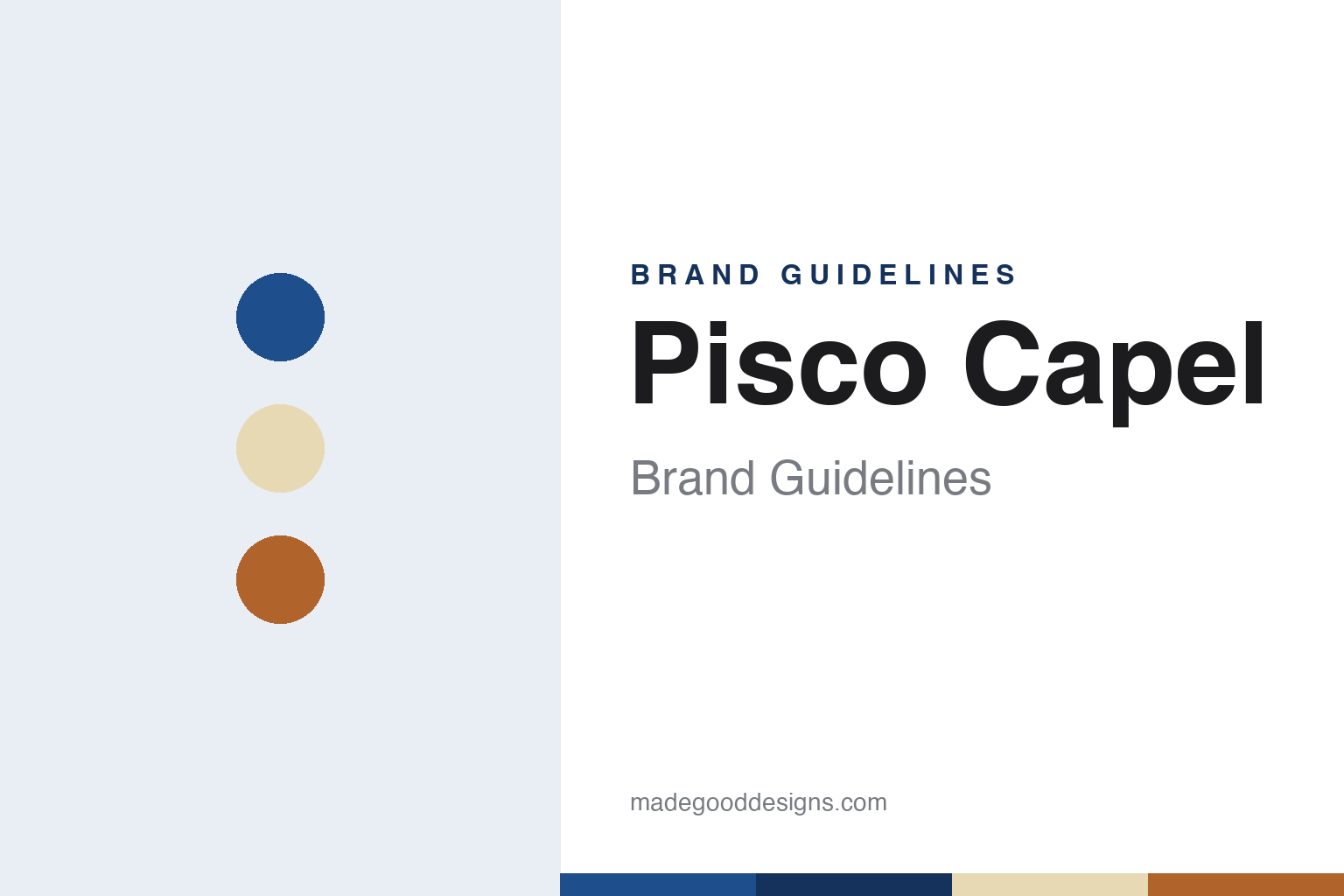
Pisco Capel Brand Guidelines
The Elqui Valley growers’ cooperative, founded 1938.
Aa
Two constants: an Elqui blue, valley sand and copper palette and a bold grotesque sans register. Abstract homage — not a Capel product or mark; no label, logo or bottle is reproduced.
A cooperative born of a slump
Twenty-five growers, a depression and a valley in northern Chile.
Capel is not a company in the usual sense. The name is an acronym for Cooperativa Agrícola Pisquera Elqui Limitada, a cooperative of pisco-grape growers in northern Chile, and the pisco that carries the name is made and sold by the cooperative on its members’ behalf. Its head office and main plant are in Vicuña, in the Elqui Valley of the Coquimbo Region.
The cooperative dates its story to February 1938. According to the history it publishes, 25 members formed a producers’ society that year, and a year later it obtained legal status as the Cooperativa Agrícola Pisquera Elqui Ltda. The cooperative traces its roots to a small group of distillers in Paihuano, further up the Elqui Valley, and says the impulse came from the Great Depression, which it says cut Chile’s exports by as much as 83 percent in the years after 1929 and pushed growers to join forces to lower their costs. English Wikipedia likewise describes Capel as a producers’ cooperative founded in 1938 as farmers responded to plunging exports.
Growth came with help from the state. The cooperative says that in 1967 production plants were built in the pisco-growing zones with the backing of CORFO, Chile’s production development corporation, and that Capel bought one of them; that factory, it says, is the plant in Vicuña that still operates today. The cooperative says it went on to lead the Chilean pisco market in the 1990s and 2000s, as free-trade agreements opened foreign markets to the spirit.
Membership is the brand’s defining fact, and the cooperative’s own figures vary. Its “Who we are” page describes more than 700 growers across the Atacama and Coquimbo regions, with an average age of 70, about 70 percent of whom grow only pisco grapes, farming around 2,300 hectares between them; another page of its site speaks of more than 1,000. The Argentine farm-news site Bichos de Campo reported in January 2019 that about half of the cooperative’s roughly 1,000 producers farm only around one hectare, and that members deliver their whole harvest to the cooperative, which sells the pisco under the Capel brand.
Colour
One member, one vote, and a name the brand once put to the test.
The cooperative’s structure shapes how it speaks. Capel says it has kept a democratic organisation since 1938 in which one member is one vote, whatever the size of the farm; Bichos de Campo contrasted a member with one hectare and one with sixty who carry the same weight at the annual meeting. A general assembly of members elects a nine-member board of administration for three-year terms, the cooperative says, and in its own words it is a business of the “solidarity economy”, offering members technical assistance, training and help with state farm programmes.
The grapes come from five valleys. The cooperative lists its presence in the Copiapó, Huasco, Elqui, Limarí and Choapa valleys and names plants at Vicuña, Alto del Carmen, Montegrande, Río Hurtado, Sotaquí, Punitaqui and Salamanca and in the Atacama Region, with sales branches as far south as Puerto Montt. It also runs a visitor centre in the Elqui Valley. Chile and Peru both claim pisco as a national spirit; Capel’s is made under Chile’s denomination of origin, which, the cooperative says, was established in the early 1930s and reserved the name for spirits from the Coquimbo and Atacama regions.
The brand’s best-known recent piece of communication turned its own reputation into the subject. In August 2022 El Mostrador’s Revista Jengibre described “Capel o Lepac”, a campaign in which the brand launched an apparently new pisco called Le Pac — Capel spelled backwards — with its own name, bottle and identity. More than 800 people signed up to try it, the magazine reported, before the reveal that the liquid was the familiar Capel at 40 degrees. The campaign set out, El Mostrador wrote, to challenge a perception of Capel as a heavy-drinking students’ pisco, and it described the spirit as double-distilled from Pedro Jiménez grapes.
Some of the line leans on imagery from far beyond the valleys. The Chilean retailer Jumbo describes Capel’s Moai special edition as a homage to the Rapa Nui culture of Easter Island, in a bottle it says was designed by an artisan from the island.
Typography
Design and documentation.
The seven brands in this group are all pisco, cachaça and anise-spirit names: Pisco Capel, Pisco Portón, BarSol, Leblon, Novo Fogo, Yeni Rakı and Ksarak. Spirit brands in general sit at many different points in the trade, from family houses and cooperatives that still carry a founder’s or a place’s name to labels that now belong to much larger drinks groups, and a single brand can be sold everywhere from a corner shop to a cocktail bar.
A spirit brand’s identity is usually carried less by a single bottle than by a label, a name and the place it promises, because the company behind the name may have changed hands, moved its production or grown far beyond the place where it started. That makes the questions behind each name worth asking plainly: who started it, who owns it now, and where its spirit is actually distilled and bottled.
Each guide separates what independent sources record from what the company says about itself — its founding story, its owners over time, where its spirit is made and how its labels have changed — and marks plainly what rests only on the company’s own word.
Aa
A bold grotesque sans for a cooperative’s plain-spoken wordmark. (Specimen set in Archivo, a sans-serif STAND-IN; NOT the Capel logo.)
Pisco Capel
A Chilean pisco that travels, and a cooperative that stays at home.
Capel has also crossed the Andes. The Mendoza news site Mendoza Post reported in May 2022 that Bodega Norton, the Mendoza winery, had added Capel to the range of spirits it imports into Argentina from April that year, starting with a double-distilled Especial at 35 degrees and a Reservado Transparente at 40 degrees. The same report put Capel’s record volume at about 1.1 million cases a year, a figure it dated to 2015.
At home, Capel sells more than pisco. The cooperative’s site groups its brands under pisco, sparkling wine, wine, cocktails and rum, and English Wikipedia says it widened its range in 2006 with ready-to-drink products sold as Capel drinks. Ownership has not changed hands: the brand belongs to the growers who supply its grapes, and its pisco is made in its own plants in the Atacama and Coquimbo regions.
The name needs a little care online. Capel is also a family name and a place name in England, and several unrelated businesses use it; the cooperative’s own site is cooperativacapel.cl.
For a design guide, Pisco Capel shows how a brand owned by hundreds of small growers can carry one short, hard-edged name across a whole national category, and how a campaign that hid the name behind a new label could make a point about the name itself. Compare Concha y Toro, the Chilean wine house, and Pisco Portón, a Peruvian pisco made at Hacienda La Caravedo in Ica. For this guide we use Elqui blue, valley sand and copper with a bold sans, an unofficial interpretation; no product or logo is reproduced.
Explore & save
Keep Pisco Capel’s identity on hand — save it to a board in the Made Good inspiration library.
Pisco Capel identity set
Pin the Pisco Capel Elqui blue, valley sand and copper palette and the bold grotesque sans register to your own board.


