Pisco Portón Brand Guidelines
The Ica pisco from Hacienda La Caravedo.
Aa
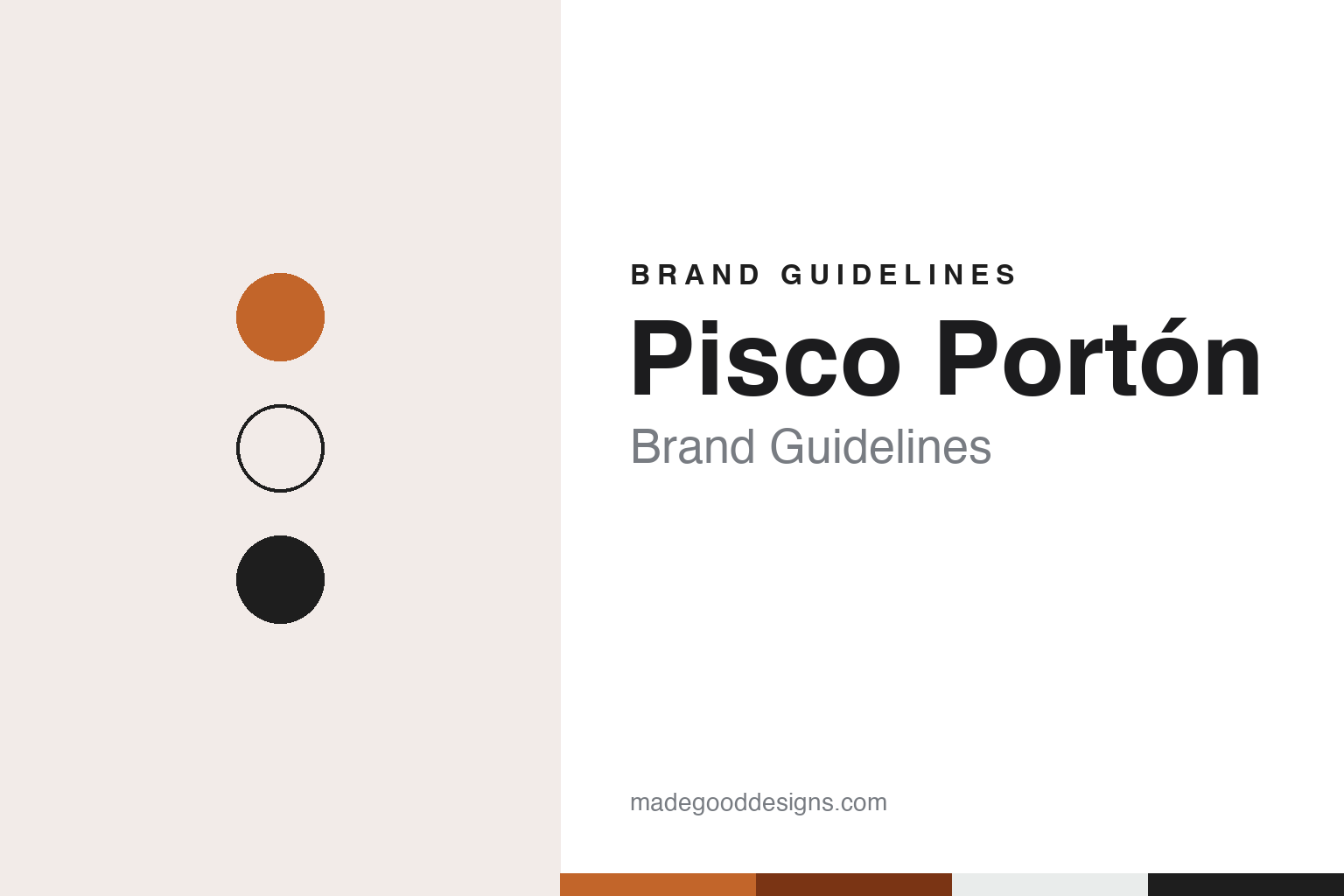
Two constants: a hacienda terracotta, frosted glass and still black palette and a classical serif register. Abstract homage — not a Pisco Portón product or mark; no label, logo or bottle is reproduced.
An old hacienda, a new brand
A seventeenth-century estate in Ica and the partners who bought it in 2010.
Pisco Portón is a brand built around a place. It is made at Hacienda La Caravedo, a distillery estate in the Ica Valley on Peru’s southern coast, the heartland of Peruvian pisco. The company dates the estate to 1684, when, its timeline says, Juan Facundo Caravedo Roque acquired adjoining vineyards and distilling equipment, and it calls La Caravedo the oldest working distillery in the Americas. The Oxford Companion to Spirits and Cocktails (2021) describes it as the oldest pisco distillery in Peru.
The brand itself is much younger. According to the Oxford Companion, the estate was bought in the mid-1990s by Rodrigo Peschiera Mifflin and his father, and in 2010 the Peschieras sold it to William Kallop, an American oilman from Texas, his son Brent Kallop and Johnny Schuler, a Bolivian-born Lima restaurateur and pisco expert who became master distiller; the new owners created Pisco Portón. The company’s own account differs slightly on timing, saying that founders Bill and Brent Kallop invited Schuler to join them in 2011. The drinks site Cocktail Wonk reported in 2015 that Brent Kallop was the company’s president.
The partners added capacity beside the old works. The Oxford Companion says they built a second distillery with modern steam-jacketed alembics and later added Charentais-style stills of the kind used for cognac, while the hacienda kept its wood-fired falcas, the traditional Peruvian pot stills. The estate is laid out to use gravity, the Companion says: grapes are pressed at the top of a slope, fermented lower down and distilled near the bottom.
Schuler gave the brand a public face. The company describes him as a long-standing judge and advocate for pisco who founded the Peruvian Academy of Pisco in 2004 and presents the television programme Por Las Rutas del Pisco. It credits day-to-day production to Carmen Gonzales, a chemical engineer trained at San Luis Gonzaga University of Ica who joined La Caravedo in January 2011.
Colour
A gate, a frosted monument and an American launch.
The name is a picture of the estate. Cocktail Wonk explained in 2015 that portón is the Spanish word for a gate and that the name refers to the original gate of the distillery. The bottle carries the same idea in glass: the site described it as frosted glass shaped like a stone monument, with a clear window on the front through which the La Caravedo house and its vineyards appear, closed by a tapered metal stopper embossed with the logo.
The liquid was aimed first at the United States. The company’s timeline and Cocktail Wonk agree that the first product imported there, in 2011, was a mosto verde acholado — a blend distilled from grape juice whose fermentation is not yet complete. The company says it is made from Quebranta, Torontel, Italia and Albilla grapes, about eight kilos of grapes to each 750 ml bottle, distilled in both falca stills and copper alembics and rested for at least a year without additives. A simpler sister brand, La Caravedo, in a clear cylindrical bottle with red vine linework, followed in the US in 2015, Cocktail Wonk reported.
Chile and Peru both claim pisco as their own; Portón is made under Peru’s denomination of origin, which the company says was declared in 1991 and requires every pisco to be certified by the government agency INDECOPI before sale.
The name also brought a legal fight. In January 2017 the US Trademark Trial and Appeal Board cancelled the company’s registration for the word mark Portón in a case brought by the owner of Patrón tequila, Law360 reported; Gestión noted on 13 January 2017 that the “Pisco Portón” marks were not affected by that ruling and that the company was weighing a new name for the US while keeping its bottle. The company’s timeline records that the brand changed its name to Caravedo under pressure from Patrón, and it dates the change to 2016.
Typography
Design and documentation.
The seven brands in this group are all pisco, cachaça and anise-spirit names: Pisco Capel, Pisco Portón, BarSol, Leblon, Novo Fogo, Yeni Rakı and Ksarak. Spirit brands in general sit at many different points in the trade, from family houses and cooperatives that still carry a founder’s or a place’s name to labels that now belong to much larger drinks groups, and a single brand can be sold everywhere from a corner shop to a cocktail bar.
A spirit brand’s identity is usually carried less by a single bottle than by a label, a name and the place it promises, because the company behind the name may have changed hands, moved its production or grown far beyond the place where it started. That makes the questions behind each name worth asking plainly: who started it, who owns it now, and where its spirit is actually distilled and bottled.
Each guide separates what independent sources record from what the company says about itself — its founding story, its owners over time, where its spirit is made and how its labels have changed — and marks plainly what rests only on the company’s own word.
Aa
A classical serif for a brand that leans on a seventeenth-century estate. (Specimen set in Cormorant Garamond, a serif STAND-IN; NOT the Pisco Portón logo.)
Pisco Portón
Two names for one pisco, and the hacienda behind both.
Today the brand lives under two names. In the United States the old piscoporton.com address now leads to the Caravedo Pisco site, which names Pisco Portón LLC of Houston, Texas, as its corporate contact and lists a Mosto Verde Acholado, an Acholado and single-grape Quebranta and Torontel piscos under the Caravedo name. In Peru, the Lima business daily Gestión reported in March 2025 that Destilería La Caravedo sells Portón as its ultra-premium label alongside Pago de los Frailes, La Caravedo and Toro Santo, and that it was planning new Portón “specialities” with different aromatic profiles.
The Peruvian business has also widened the brand. Gestión reported in March 2023 that it had launched Chilcano by Portón, a canned ready-to-drink version of the chilcano, a pisco highball, in four flavours at the end of February that year, and that the United States was its largest export market, taking about 30 percent of shipments. In 2025 the paper reported that about 40 percent of the distillery’s orders went abroad, led by the United States and Japan. The hacienda is open to visitors, and the company says its stillage is reused to irrigate the vineyards.
The name needs a little care. Portón is not Patrón, the Mexican tequila, and in the US the same pisco is now sold as Caravedo; the brand is also distinct from BarSol, another Peruvian pisco.
For a design guide, Pisco Portón shows how a young brand can borrow the authority of an old estate — a gate for a name and a window onto the house set into the glass — and how that place-based identity can outlast the loss of a word mark. Compare Inca Kola, Peru’s golden soda, and Pisco Capel, the Chilean growers’ cooperative. For this guide we use hacienda terracotta, frosted glass and still black with a serif, an unofficial interpretation; no product or logo is reproduced.
Explore & save
Keep Pisco Portón’s identity on hand — save it to a board in the Made Good inspiration library.
Pisco Portón identity set
Pin the Pisco Portón hacienda terracotta, frosted glass and still black palette and the classical serif register to your own board.