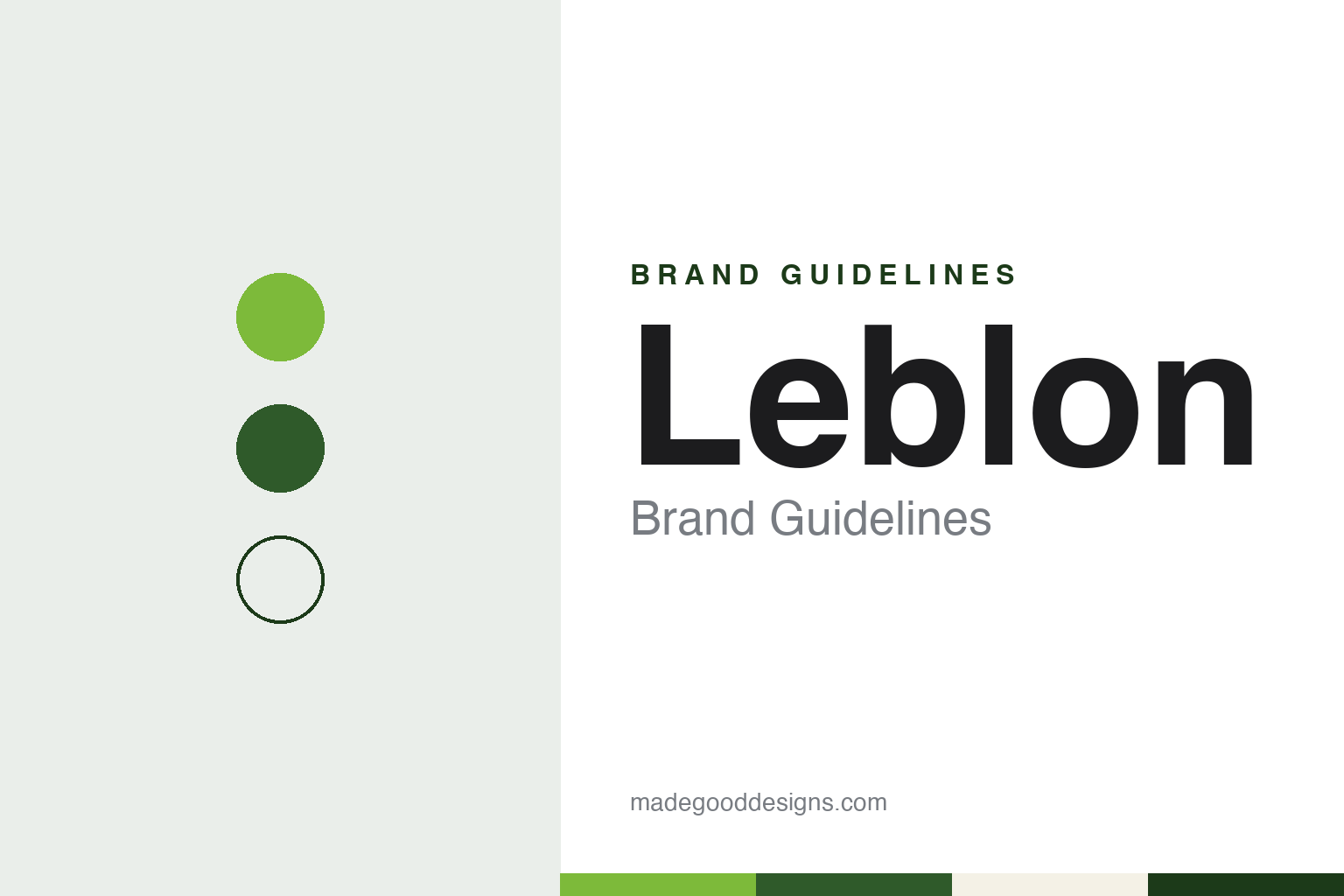
Leblon Brand Guidelines
The Minas Gerais cachaça Bacardi bought in 2015.
Aa
Two constants: a lime, cane green and cane cream palette and a refined serif register. Abstract homage — not a Leblon product or mark; no label, logo or bottle is reproduced.
Leblon Cachaça
A marketer, a cognac distiller and Brazil’s national spirit.
Leblon is a cachaça, the Brazilian spirit distilled from fresh sugarcane juice, and it was built from the start for drinkers outside Brazil as well as inside it. English Wikipedia says the brand was introduced in September 2005 in the United States and Brazil, and reached European markets in 2006. Its founder, Steve Luttmann, has said he created Leblon in 2005 out of a long affection for Brazil; in a 2020 interview with ForceBrands he described a career of about ten years at Unilever followed by work at Schieffelin & Somerset, the importer that later became part of Moët Hennessy.
The other founding figure came from cognac: Gilles Merlet, a French master distiller, whom the Massachusetts Beverage Business named in December 2008 as Leblon’s “Master Distiller and Co-Founder.” English Wikipedia names Merlet and Carlos Oliveira as the brand’s master distillers.
For its first years Leblon was made with a Brazilian partner. In December 2008 the Massachusetts Beverage Business reported that Leblon had completed the purchase of its own distillery in the Minas Gerais region, bought from the partner that had worked with the brand since its start, and that the site had been inaugurated as Maison Leblon, a showcase for small-batch alambique cachaça. Merlet said at the time that the dedicated distillery would let the company keep its artisanal methods while meeting rising demand.
Colour
Pot stills in the cane country of Minas Gerais.
Maison Leblon is in Patos de Minas, which the company describes as an agricultural town in the western highlands of Minas Gerais, in the heart of Brazil’s sugarcane country. The company says the distillery is fully integrated and makes only Leblon, and its method borrows openly from French brandy. Cane is cut by hand from nearby fields and pressed gently at the distillery, English Wikipedia says; the juice ferments for about a day and is distilled in single batches in copper alambique pot stills. The company says the cachaça then rests for up to six months in brandy-cured casks from France — English Wikipedia specifies vintage XO cognac casks — before batches are blended, lightly filtered and bottled.
English Wikipedia adds that Leblon is certified by the Instituto Mineiro de Agropecuária, the Minas Gerais agricultural institute, as an artisanal cachaça de alambique, and describes how the distillery reuses its by-products: cane tops go to local farmers as cattle feed, spent cane, or bagasse, heats water for the stills, and the leftover liquid from distillation is used, with excess bagasse, as fertiliser.
The range stays small. Alongside the flagship clear cachaça, the company’s site lists Maison Leblon Reserva Especial and Cedilla, a liqueur made with açaí, and builds most of its pages around the caipirinha, the muddled lime cocktail it calls the national cocktail of Brazil.
The category name itself took work abroad. English Wikipedia says that until 2013 Leblon’s US labels had to call the spirit “Brazilian Rum”; on 25 February 2013 the US Alcohol and Tobacco Tax and Trade Bureau published a final rule recognising cachaça as a distinctive product of Brazil, effective that April.
Typography
Design and documentation.
The seven brands in this group are all pisco, cachaça and anise-spirit names: Pisco Capel, Pisco Portón, BarSol, Leblon, Novo Fogo, Yeni Rakı and Ksarak. Spirit brands in general sit at many different points in the trade, from family houses and cooperatives that still carry a founder’s or a place’s name to labels that now belong to much larger drinks groups, and a single brand can be sold everywhere from a corner shop to a cocktail bar.
A spirit brand’s identity is usually carried less by a single bottle than by a label, a name and the place it promises, because the company behind the name may have changed hands, moved its production or grown far beyond the place where it started. That makes the questions behind each name worth asking plainly: who started it, who owns it now, and where its spirit is actually distilled and bottled.
Each guide separates what independent sources record from what the company says about itself — its founding story, its owners over time, where its spirit is made and how its labels have changed — and marks plainly what rests only on the company’s own word.
Aa
A refined serif for a short, place-name wordmark. (Specimen set in Cormorant Garamond, a serif STAND-IN; NOT the Leblon logo.)
Leblon
From a minority stake to a Bacardi brand.
Bacardi came in early. Shanken News Daily reported in 2015 that Bacardi had held a minority stake in Leblon since 2007, and on 8 July 2015 Bacardi, writing from Hamilton, Bermuda, announced that it had completed the acquisition of Leblon Holdings LLC and the Leblon brand after serving as a significant minority investor for several years. Terms were not disclosed. The release said Leblon, then celebrating its tenth anniversary, was sold in more than 35 countries and would continue to be led by Luttmann. Forbes Brasil noted that the deal came a day after Bacardi bought the Banks rum brand; earlier in 2015 Bacardi had also bought the Kentucky bourbon Angel’s Envy. At the time Forbes Brasil described the business as headquartered in New York with production in Patos de Minas. Bacardi’s own release called Leblon a favourite in leading restaurants and cocktail bars in Brazil and around the world.
Luttmann later told ForceBrands that, over time, much of the Leblon team was absorbed into Bacardi itself. The brand’s own site now gives Leblon USA in Coral Gables, Florida, in its footer, and still describes Maison Leblon in Patos de Minas as the distillery that makes it.
The name needs care online. Leblon is also one of Rio de Janeiro’s best-known beach neighbourhoods, and searches for it return hotels and apartments long before cachaça; the brand’s site is leblon.com. Our separate note on the Leblon cachaça lettering covers type stand-ins for its wordmark.
For a design guide, Leblon shows how a cachaça can borrow the codes of cognac — a French master distiller, small-batch pot stills, rest in French casks — while keeping the caipirinha and Brazil at the centre of its story. Compare Ypióca, the Ceará cachaça of 1846, and Angel’s Envy, its Bacardi stablemate. For this guide we use lime, cane green and cane cream with a serif, an unofficial interpretation; no product or logo is reproduced.
Explore & save
Keep Leblon’s identity on hand — save it to a board in the Made Good inspiration library.
Leblon identity set
Pin the Leblon lime, cane green and cane cream palette and the refined serif register to your own board.