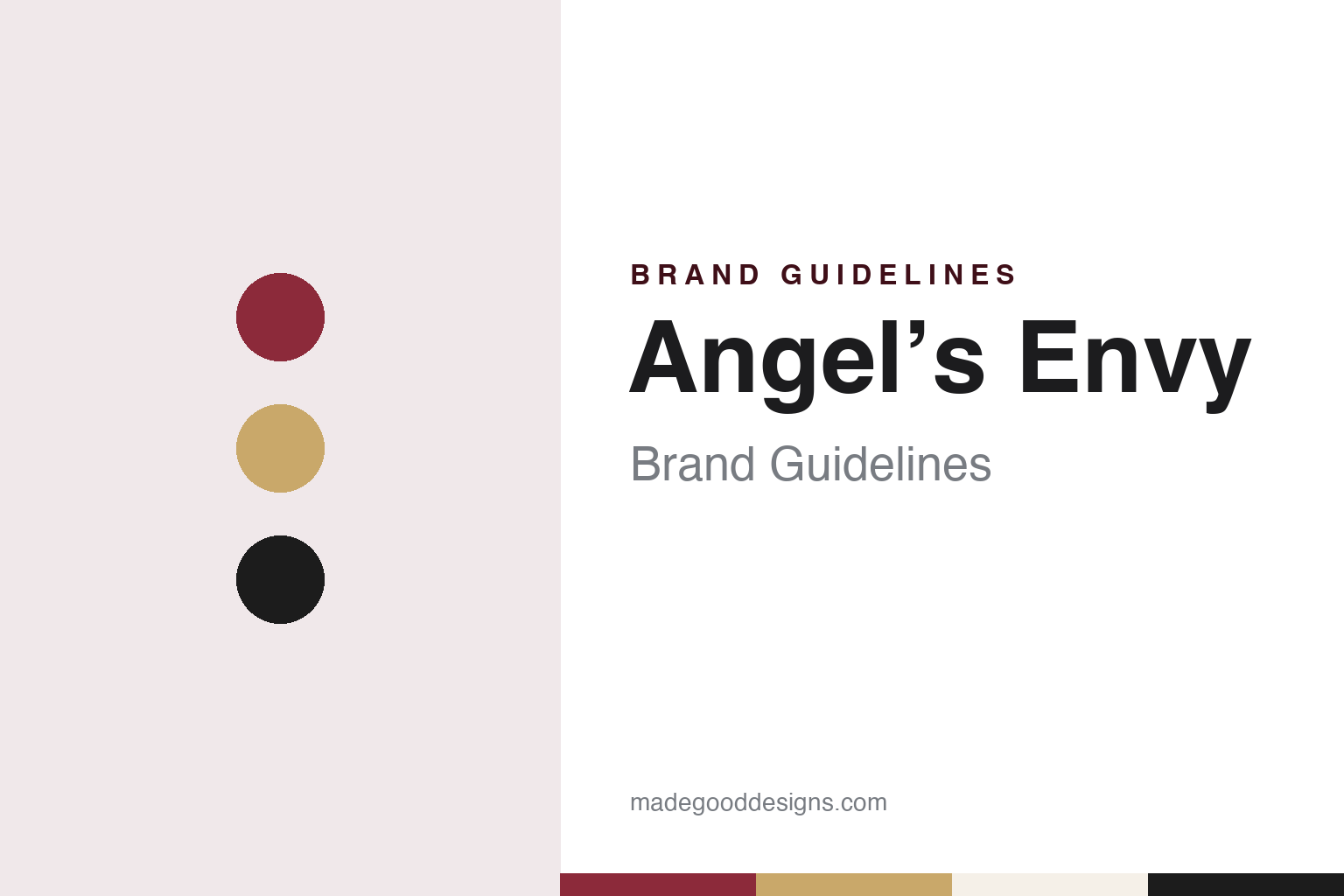
Angel’s Envy Brand Guidelines
The Hendersons’ port-finished bourbon from Louisville.
Aa
Two constants: a ruby port, wing gold and ivory palette and a classical serif register. Abstract homage — not an Angel’s Envy product or mark; no bottle, label or logo is reproduced.
A better deal than the angels
A master distiller, his son and a second barrel.
Angel’s Envy was founded in Louisville, Kentucky, in 2010, according to its owner Bacardi, by the master distiller Lincoln Henderson and his family. The company describes Henderson as a member of the Bourbon Hall of Fame, and Bacardi called him an inaugural member of it and one of the original pioneers of the premium bourbon and whiskey categories in the United States. The company’s own site speaks of a career of more than 40 years in the industry. His son Wes Henderson ran the business side: the company’s blog named him chief operating officer of Angel’s Share Brands, the parent company, and Bacardi later called him the brand’s global ambassador. Lincoln’s grandsons Kyle and Andrew also went to work in the business, and Bacardi said in 2015 that three generations of the Henderson family had kept the secrets of making it.
The idea was a finish rather than a new recipe. The whiskey is a Kentucky straight bourbon that, after ageing in new charred oak barrels, is moved into port wine barrels for a second, finishing period, a technique the company calls “secondary finishing.” Bacardi said in 2016 that the port casks come from Portugal. The company says each batch is hand-blended from 8 to 12 barrels and that it tastes every barrel throughout the process, and Bacardi’s boilerplate calls Angel’s Envy among the first American whiskey producers to use secondary finishing broadly across its range. By 2015, Bacardi said, the range also included a rye whiskey finished in Caribbean rum casks and a cask-strength edition.
The name comes from an old distilling term. The spirit that evaporates from barrels as they age — the company puts it at about 5 percent a year — is called the angels’ share. The company says that after tasting the finished whiskey, Lincoln Henderson joked that they had finally struck a better deal than the angels, and the brand was named Angel’s Envy.
The early whiskey drew attention quickly. In its 2015 announcement Bacardi said the flagship had received 98 points out of 100 from Wine Enthusiast, which Bacardi described as the highest rating the magazine had ever given a bourbon, and that the Spirit Journal had named the cask-strength edition its best spirit in the world in 2013.
Colour
A distillery on Main Street, and Bacardi’s first bourbon.
For its first years Angel’s Envy had no distillery of its own. The company announced in a blog post that it had bought a building from the State of Kentucky at the corner of Main Street and Jackson in downtown Louisville, formerly known as the Vermont American Building and Baer Fabrics, and that the Louisville firm Joseph & Joseph Architects would manage the renovation. Kentucky Governor Steve Beshear and Louisville Mayor Greg Fischer were among the guests at the groundbreaking, and Lincoln Henderson was quoted calling it a dream come true to have his own distillery on Main Street. Wes Henderson said the plan was a fully functioning distillery, from milling grain to blending and bottling on site.
Ownership changed before the distillery opened. On 30 March 2015, Bacardi Limited announced that it had acquired Angel’s Share Brands, its subsidiary Louisville Distilling Co. and the Angel’s Envy brand, in a deal that closed on 27 March and whose terms were not disclosed. Bacardi said the purchase marked its entry into bourbon and that Angel’s Envy would continue as a standalone operation, with its production, distribution and marketing unchanged and the Henderson family still involved.
The distillery opened in 2016 at 500 East Main Street. Bacardi describes it as the first full-production whiskey distillery in downtown Louisville, and the company says it was the first along Whiskey Row since Prohibition. A larger brand home followed: Bacardi announced plans in July 2021, mentioned earlier news from 2018 of three new rickhouses in Henry County, Kentucky, and said the expansion, completed in June 2022, doubled the number of guests the distillery could receive.
The family handed over the master distiller’s role in 2022. Bacardi announced in September 2022 that Owen Martin, previously head distiller at Stranahan’s Colorado Whiskey, would join as master distiller from 17 October, describing him as the first master distiller the brand had appointed since co-founder Lincoln Henderson. In May 2026 the production team was named global Production Team of the Year at the Icons of Whisky awards, and Martin was named Craft Distiller of the Year for the Americas, Bacardi said.
Typography
Design and documentation.
The seven brands in this group are all bourbon names: Elijah Craig, Eagle Rare, Blanton’s, Angel’s Envy, Old Forester, Michter’s and Basil Hayden. Bourbon brands in general sit at many different points in the trade, from family distillers that still carry a founder’s name to labels that now belong to much larger drinks groups, and a single brand can be sold everywhere from a corner shop to a hotel bar.
A bourbon brand’s identity is usually carried less by the whiskey itself than by a bottle, a label and a name, because the company behind the name may have changed hands, moved its distilling or grown far beyond the place where it started. That makes the questions behind each name worth asking plainly: who started it, who owns it now, and where its whiskey is actually distilled, aged and bottled.
Each guide separates what independent sources record from what the company says about itself — its founding story, its owners over time, where its whiskey is made and how its bottles and labels have changed — and marks plainly what rests only on the company’s own word.
Aa
A classical serif for a name taken from the angels’ share. (Specimen set in Cormorant Garamond, a serif STAND-IN; NOT the Angel’s Envy logo.)
Angel’s Envy
A finished whiskey, a sign-off and a set of extra programmes.
The brand’s sign-off on the company site and in Bacardi’s releases reads “Heaven can wait,” and its press releases set the name in capitals as ANGEL’S ENVY. Bacardi names Louisville Distilling Company, its subsidiary, as the producer. The company has also run a tree-planting programme it calls Toast the Trees with the Arbor Day Foundation since 2014, it says.
Bacardi said in 2026 that the brand is sold in all 50 US states and several international markets and that the distillery, marking ten years in 2026, employs more than 100 people. Beyond the port-finished bourbon and rum-finished rye, the company sells limited series such as a Cellar Collection and an annual cask-strength release. The typography of the wordmark is covered in a separate guide, What Font Does Angel’s Envy Use?
For a design guide, Angel’s Envy shows how a single process — a second barrel — and a joke about the angels’ share can carry a young bourbon from a family business to a Bacardi brand with its own distillery on Whiskey Row. Compare Old Forester, the Brown-Forman bourbon with a distillery on Louisville’s Main Street, and St-Germain, the elderflower liqueur that is also part of Bacardi. For this guide we use ruby port, wing gold and ivory with a classical serif, an unofficial interpretation; no product or logo is reproduced.
Explore & save
Keep Angel’s Envy’s identity on hand — save it to a board in the Made Good inspiration library.
Angel’s Envy identity set
Pin the Angel’s Envy ruby port, wing gold and ivory palette and the classical serif register to your own board.


