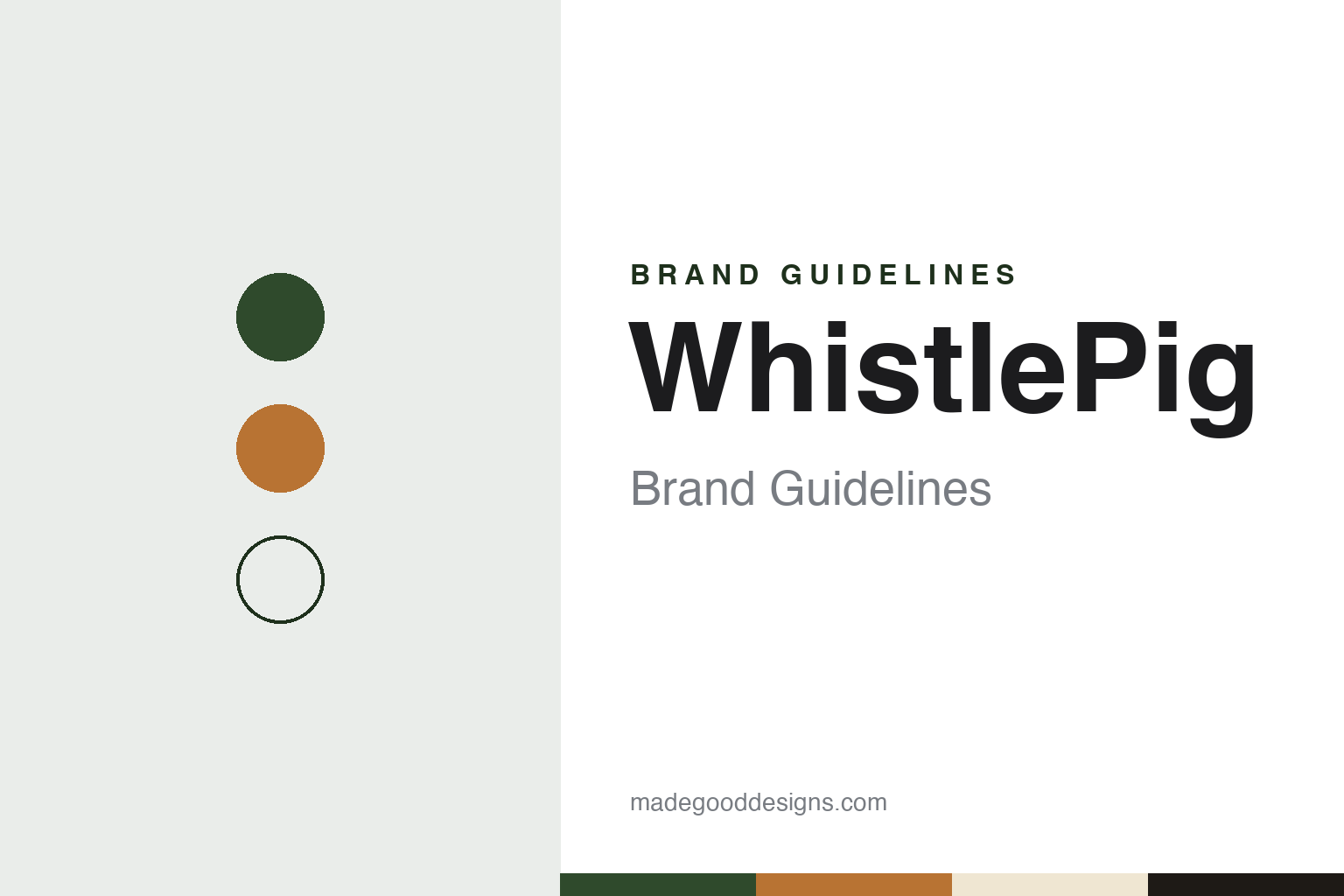
WhistlePig Brand Guidelines
A Vermont farm, aged Canadian rye and a pig in a top hat.
Aa
Two constants: a farm green, still copper and barn cream palette and an old-style serif register. Abstract homage — not a WhistlePig product or mark; no label, logo or bottle is reproduced.
A dairy farm in Shoreham
Land in Vermont, whisky from Alberta and a master distiller from Kentucky.
WhistlePig is a rye whiskey company based on a farm in Shoreham, Vermont. Its founder is the entrepreneur Raj Bhakta. English Wikipedia says he bought the land in 2007 and built a distillery and ageing warehouse there, and The Spirits Business also gave 2007 as the founding year in January 2019; VinePair, in a 2019 profile, gave 2008, so the sources differ by a year. The brand itself was launched in 2010, English Wikipedia says, citing the trade site CanadianWhisky.org.
The farm came first and the stills came later. Edible Vermont describes the property as a former dairy farm about 150 years old, and the Michelin Guide puts it at around 500 acres, of which roughly 300 are planted with rye and about 200 hold maple trees. VinePair says Bhakta bought a 150-year-old barn on the farm and that the business began with stocks of ten-year-old rye whisky bought in from a distillery in Alberta, Canada. For its first years WhistlePig was what the American trade calls a non-distiller producer: a company that buys, ages, blends and bottles whiskey made elsewhere.
The man who found that whisky was Dave Pickerell. VinePair says he had spent fourteen years at Maker’s Mark before joining WhistlePig as master distiller, and that he helped source the first Canadian stock, helped create the first blend and designed the copper pot still the distillery uses. He also ran a consultancy, Oak View Spirits, which VinePair says helped hundreds of distilleries open around the world. English Wikipedia says bottling began on the farm in 2009 and distilling in 2015, and The Spirits Business reported that the “grain-to-glass” distillery opened in October 2015; a second still followed in 2019, according to Cool Hunting. Edible Vermont describes the two pot stills as 750-gallon stills.
Sourced whiskey has stayed part of the business. The Michelin Guide says WhistlePig buys in some aged whiskey, naming the Alberta Premium distillery in Canada and MGP of Indiana, and concentrates on ageing and finishing it in Vermont.
Colour
A grinning pig, a family of farm pigs and a pewter stopper.
The name is a piece of American folk vocabulary: “whistlepig” is an old regional name for the groundhog, as English Wikipedia notes at the top of its article on the company. The brand’s own animal, though, is a pig. Edible Vermont describes the logo as a plump, grinning pig wearing a top hat and a bow tie, and links it to the Kunekune pigs kept on the farm.
Those pigs are part of the company story. English Wikipedia, citing Edible Vermont, says the first two, Mortimer and Mauve, died in 2014 and 2018, that their ashes rest under a granite obelisk on the farm, and that the distillery’s two stills are named after them. The company’s own site calls their successors, Mortimer Jr. and Orwell, its “chief pigs.”
The pig also turns up on the bottle tops. The Boss Hog, a single-barrel, barrel-strength rye released in a new edition most years, began in 2013, Tasting Table reported, and the editions carry names of their own. The Whiskey Wash reported in January 2019 that the fifth edition, The Spirit of Mauve, came in a coffin-shaped box with a stopper by the pewterer Danforth showing Mauve rising to heaven. The sixth, The Samurai Scientist, was made with the Kitaya brewery on Kyushu and finished in casks that had held umeshu, a Japanese plum liqueur; VinePair called it the first American whiskey finished that way, and The Whiskey Wash said in 2020 that its stopper showed the Japanese chemist Takamine Jōkichi in samurai armour.
The farm itself became a product. VinePair says FarmStock, first released in 2017, was made with the farm’s own grain, wood and water, and that the company coined and trademarked the phrase “Triple Terroir” to describe it. The six-year-old PiggyBack rye followed in 2018, the last whiskey Pickerell created, according to VinePair. Glass has played a part too: the Valley News reported in 2021 that the Vermont glassmaker Simon Pearce made the stoppers for an edition of the 18-year-old rye.
Typography
Design and documentation.
The seven brands in this group are all whisky names: WhistlePig, Rittenhouse, Hakushu, Mars Shinshu, Slane, Roe & Co and The Sexton. Whisky brands in general sit at many different points in the trade, from family distilleries that still carry a founder’s name to labels that now belong to much larger drinks groups, and a single brand can be sold everywhere from a corner shop to a hotel bar.
A whisky brand’s identity is usually carried less by a single bottle than by a label, a name and the place it promises, because the company behind the name may have changed hands, moved its production or grown far beyond the place where it started. That makes the questions behind each name worth asking plainly: who started it, who owns it now, and where its whisky is actually distilled, matured and bottled.
Each guide separates what independent sources record from what the company says about itself — its founding story, its owners over time, where its whisky is made and how its labels have changed — and marks plainly what rests only on the company’s own word.
Aa
An old-style serif for a farm-and-heritage register. (Specimen set in Libre Caslon Text, a serif STAND-IN; NOT the WhistlePig logo.)
WhistlePig
A founder’s exit, a new investor and a reach beyond rye.
The company has changed hands at the top more than once. In May 2016 the Burlington Free Press reported that WhistlePig’s board had moved to push Bhakta out of his own company; The Spirits Business later wrote that the dispute was settled and that he stayed on the board as founder and “chief steward.” Bhakta retired from the business in 2017, VinePair says. Pickerell died in November 2018 while attending WhiskyFest in San Francisco, VinePair and The Spirits Business reported.
In January 2019 The Spirits Business reported that WhistlePig had taken a structured equity investment from BDT Capital Partners, the Chicago-based investment firm, including what it called a significant minority stake, and that the deal let Bhakta sell his remaining shares and leave entirely. The chief executive quoted at the time was Jeff Kozak; the release also quoted Wilco Faessen, described as a co-founder.
Since then WhistlePig has moved beyond rye. Forbes reported in July 2021 that it had added a bourbon, Beyond Bonded, and an Irish whiskey sold as Limavady; a PiggyBack bourbon followed in 2022, according to Whiskey Raiders. In 2023 the company released Béhôlden, a 21-year-old single malt, Vermont Business Magazine reported, and in 2025 it made a wheat whiskey called GraveStock with the canned-water brand Liquid Death, Maxim reported. It has also built places to drink: a whiskey parlour in Quechee, Vermont, opened with Simon Pearce in 2021, the Valley News reported, and a venue called The Vault in a former bank vault in downtown Louisville, which Kentucky Living reported had opened in December 2025.
The name needs a little care online: “whistle pig” is also simply the groundhog, and the brand’s own site is whistlepigwhiskey.com.
For a design guide, WhistlePig shows how a farm, a cast of named pigs and a dressed-up pig emblem can give a sourced-then-distilled rye a story told on every label and stopper. Compare Maker’s Mark, where Pickerell worked before Vermont, and Wild Turkey, the Kentucky distillery with its own long-running rye. For this guide we use farm green, still copper and barn cream with an old-style serif, an unofficial interpretation; no product or logo is reproduced.
Explore & save
Keep WhistlePig’s identity on hand — save it to a board in the Made Good inspiration library.
WhistlePig identity set
Pin the WhistlePig farm green, still copper and barn cream palette and the old-style serif register to your own board.