BarSol Brand Guidelines
The Ica pisco from Bodega San Isidro, launched 2002.
Aa
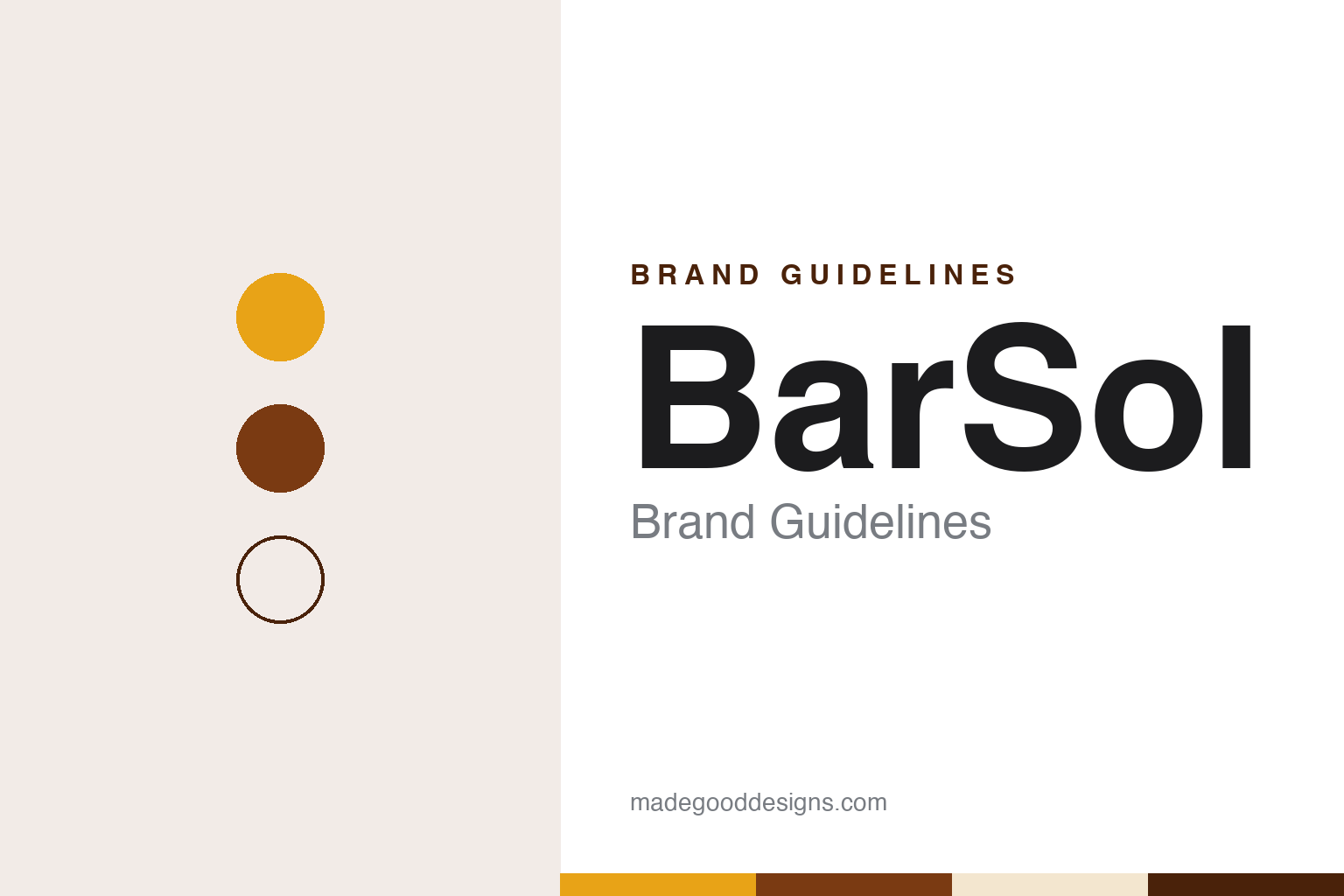
Two constants: an Ica sun, copper and desert sand palette and a condensed sans register. Abstract homage — not a BarSol product or mark; no label, logo or bottle is reproduced.
Bodega San Isidro
A bar, a sun and an old distillery in Ica.
BarSol is a pisco brand from Ica, the desert valley south of Lima that is the heartland of Peruvian grape brandy. It was launched in 2002, when a group of US-based private investors led by Carlos Ferreyros and Diego Loret de Mola acquired Bodega San Isidro, an old distillery in the valley, Difford’s Guide says. The company names the same two men as its founders, and the pisco is still distilled and bottled at the bodega, which the company calls “century old.”
The estate has a longer story than the brand, and most of it comes from the company. In its telling, the oldest documents in the local archives date from 1919, when the bodega and nearby plantations were sold together; from 1940 the distillery was run by a master distiller, Doña Blanca Mendiola, whose family made pisco there for decades, and her son Alfredo Mendiola Martinez took over in the 1960s. The company says commercial production stopped in 1968, when the military government’s agrarian reform expropriated the family’s land, and that the stills stood largely idle through the difficult decades that followed.
The new owners set out to bring the bodega back to work. The company says the new owners reclaimed the Quebranta and Italia vines planted in the Mendiola era and restarted production with grapes bought from a handful of small growers, a network the company says has since grown to more than a hundred. The name is a statement of intent: the company says it wants to bring to every bar in the world the finest pisco made under the sol, the sun, of Ica — hence “BarSol.”
Colour
Four grapes, three styles, no water added.
Pisco in Peru is a regulated spirit, and BarSol builds its range around the rules. The company says Peruvian pisco may be made from only eight grape varieties, split into aromatic and non-aromatic groups, and that it specialises in the aromatic Italia, Torontel and Moscatel and the non-aromatic Quebranta, all grown in the southern part of the Ica valley.
The range follows the three official styles. Puro is made from a single variety and fully fermented wine; Mosto Verde, “green must,” is distilled from wine whose fermentation has not finished, which leaves more of the grape in the spirit; and Acholado is a blend, which the company says is mostly Quebranta with smaller shares of Italia and Torontel. BarSol says every bottle is distilled once, in copper pot stills, straight to bottle strength, with no water, wood ageing, flavouring or other additions, and that the spirit then rests before it is hand-filled, bottled and packed at the bodega.
One product sits outside pisco itself. In January 2014 BarSol introduced Perfecto Amor to the United States, an aperitif in a traditional Peruvian style made at Bodega San Isidro, BevNET reported; the release said BarSol had been exporting pisco to the US since 2005. The company also lists environmental habits: it says it turns spent grape pomace into compost for agriculture and reuses bottles as branded glassware where it can.
Pisco has two homes. Both Peru and Chile make a grape brandy under the name, and each country regulates its own; BarSol’s own site calls its pisco proudly Peruvian.
Typography
Design and documentation.
The seven brands in this group are all pisco, cachaça and anise-spirit names: Pisco Capel, Pisco Portón, BarSol, Leblon, Novo Fogo, Yeni Rakı and Ksarak. Spirit brands in general sit at many different points in the trade, from family houses and cooperatives that still carry a founder’s or a place’s name to labels that now belong to much larger drinks groups, and a single brand can be sold everywhere from a corner shop to a cocktail bar.
A spirit brand’s identity is usually carried less by a single bottle than by a label, a name and the place it promises, because the company behind the name may have changed hands, moved its production or grown far beyond the place where it started. That makes the questions behind each name worth asking plainly: who started it, who owns it now, and where its spirit is actually distilled and bottled.
Each guide separates what independent sources record from what the company says about itself — its founding story, its owners over time, where its spirit is made and how its labels have changed — and marks plainly what rests only on the company’s own word.
Aa
A condensed sans for a short, two-syllable name. (Specimen set in Oswald, a sans-serif STAND-IN; NOT the BarSol logo.)
BarSol
A Peruvian bodega with a San Francisco partner.
BarSol’s route into the United States has run through San Francisco. On 31 August 2012 Drinks International reported that Anchor Distilling, the San Francisco distiller and importer, would import and distribute BarSol in the US, with Loret de Mola aiming to grow distribution there. Anchor Distilling itself changed name on 31 January 2018, becoming Hotaling & Co. after Sapporo bought Anchor Brewing and the distilling business gave up the Anchor name, The Drinks Business reported. Hotaling & Co. is an importer, not an owner: a release of 8 July 2026, carried by BevNET and reported by Beverage Industry on 31 July, described BarSol as imported by Hotaling & Co. and announced a two-litre bottle of Puro Quebranta for busy cocktail bars, still made at Bodega San Isidro.
The brand has done well with bartenders. In Drinks International’s annual Brands Report, which polls leading bars, BarSol topped the pisco ranking for the fifth year running in 2021, and the 2024 report said it had been the bestseller for eight years, ever since pisco entered the survey. In a Drinks International interview around 2023, Loret de Mola said the company focuses on exports rather than on dominating Peru’s home market, and put its sales at about 21,000 cases before the pandemic and about 62,000 by the end of 2022.
For a design guide, BarSol shows how a name that explains itself — a bar and the sun — and a single historic bodega can carry a regulated national spirit to cocktail bars abroad. Compare Pisco Portón, another Ica pisco made for export, and Inca Kola, Peru’s golden soda. For this guide we use Ica sun, copper and desert sand with a condensed sans, an unofficial interpretation; no product or logo is reproduced.
Explore & save
Keep BarSol’s identity on hand — save it to a board in the Made Good inspiration library.
BarSol identity set
Pin the BarSol Ica sun, copper and desert sand palette and the condensed sans register to your own board.


