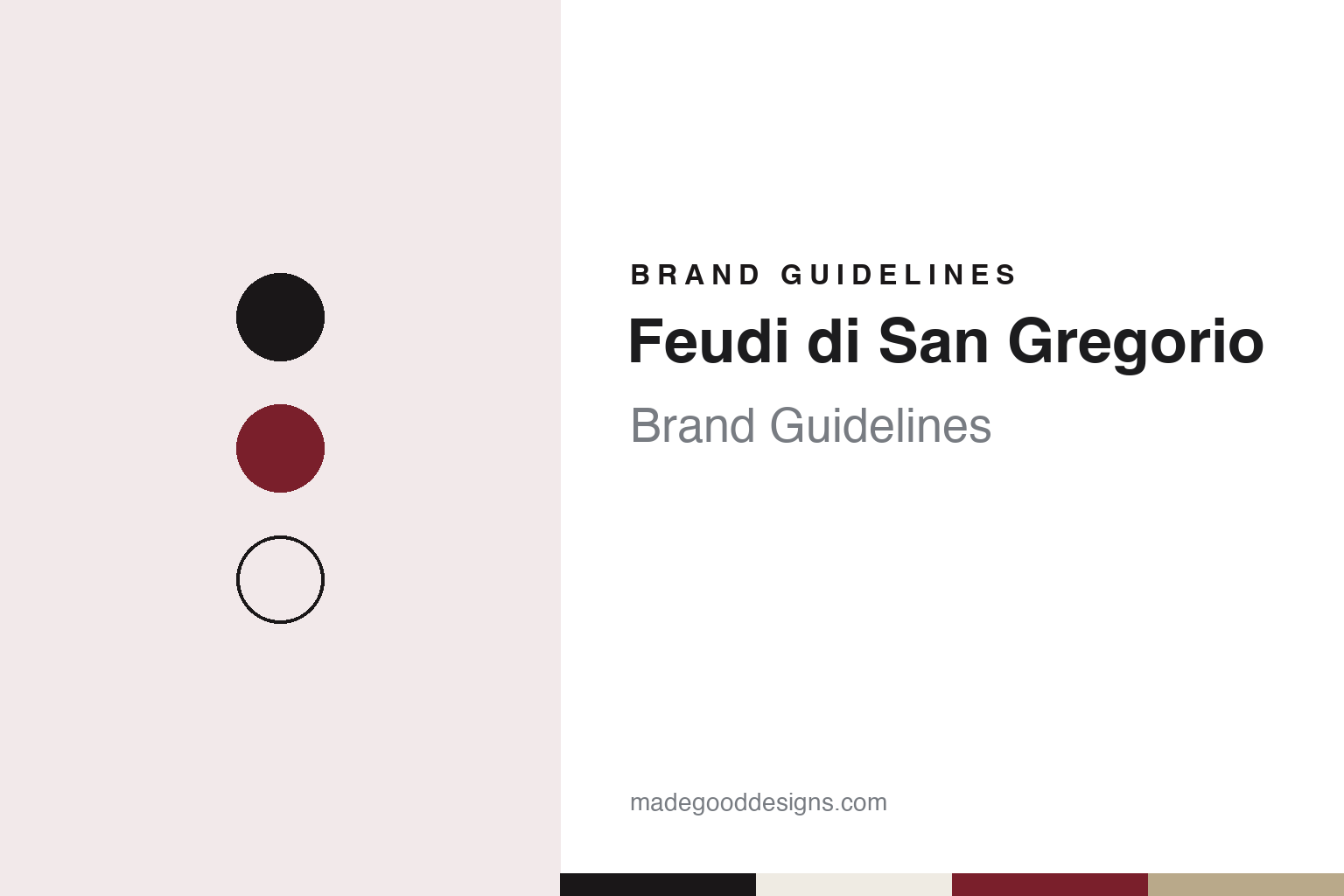
Feudi di San Gregorio Brand Guidelines
The Irpinia winery founded in 1986, with labels by Vignelli.
Aa
Two constants: a cellar black, Aglianico red and label white palette and a Modernist sans register. Abstract homage — not a Feudi di San Gregorio product or mark; no label, logo or bottle is reproduced.
After the earthquake
A winery founded in the hills above Atripalda, six years after the 1980 earthquake.
Feudi di San Gregorio was founded in 1986 at Sorbo Serpico, a village in the hills above Atripalda in Irpinia, the inland, mountainous part of Campania around Avellino. The company says it has worked “since 1986” with the native grapes of the Campanian tradition, and its address is still Sorbo Serpico.
The founding story begins with the earthquake of November 1980, which destroyed villages and farms around its epicentre in the province of Avellino. In a 2017 profile, Escapement magazine reported that reconstruction funds offered to people under 40 with viable business plans helped Enzo Ercolino, an Avellino native who had moved to Rome, to raise part of the money he needed. He returned in 1986 and opened the estate with his brothers Mario and Luciano, his wife Mirella Capaldo and one of her brothers, Mario Capaldo, Escapement said. The group began with about 30 hectares of vineyards.
Ercolino’s plan, as Escapement described it, was to make the wines of Campania exciting to a modern audience rather than to follow the classic style of the older Irpinia houses. He hired winemakers to match, first Luigi Moio and then the consultant Riccardo Cotarella. The timing helped: the province of Avellino gained three DOCG appellations, for the red Taurasi in 1993 and for the white Fiano di Avellino and Greco di Tufo in 2003, Escapement noted.
The ownership changed in the 2000s. Escapement reported that Pellegrino Capaldo, an economics professor and Mirella’s brother, had joined as a silent majority partner in 2001; that Mario and Luciano Ercolino left in 2003 and Enzo and Mirella in 2006; and that principal ownership passed to Pellegrino Capaldo. In 2009 his son Antonio Capaldo came in to run the company, and Wallpaper* wrote in 2024 that he has led its transformation since then. Antonio Capaldo is listed today as executive chairman of Feudi di San Gregorio SpA.
Colour
Greco, Fiano, Aglianico — and a cellar by Hikaru Mori.
Feudi’s wines are built on three native grapes: Greco, Fiano and Aglianico. The company’s current range names single sites as well as appellations. Its four headline wines are the Piano di Montevergine Taurasi Riserva, the Cutizzi Greco di Tufo Riserva, the Pietracalda Fiano di Avellino Riserva and Serpico, an Irpinia Aglianico. Escapement described the vineyards as lying on gentle hills of volcanic, sandstone and lime-rich marl soils around Sorbo Serpico, and put the estate at around 300 hectares in 2017.
Sparkling wine became its own name. DUBL is the company’s Campanian Metodo Classico, a traditional-method sparkling wine made from native Irpinian grapes. Escapement reported that the Champagne grower Anselme Selosse was the lead consultant on the project until 2010. In 2016 the Italian architect and designer Fabio Novembre created a custom bottle for the sparkling wine, Wallpaper* said, and a recent limited edition of DUBL carries a label with artwork by the French artist JR, made to support the Rione Sanità district of Naples, the company says.
The building is part of the brand. A new winery was inaugurated in 2004, designed by the Milan-based Japanese architect Hikaru Mori, who, Escapement wrote, was asked to give architectural unity to structures that had grown up over the years; Lella and Massimo Vignelli handled the interiors and furnishings. It includes a barrique cellar, a tasting room and a restaurant on the top floor, Marennà. The company has also used the site for art: Wallpaper* listed a 2011 workshop with the gallerist Beatrice Bertini, Marinella Senatore’s “Watercolour Collection” of 2013 and Mimmo Jodice’s photographs of the estate, shown as “Immaginazioni,” the same year.
Typography
Design and documentation.
The seven brands in this group are all Italian wine houses from Piedmont, Sicily and Campania: Fontanafredda, Marchesi di Barolo, Planeta, Donnafugata, Feudi di San Gregorio, Mastroberardino and Cusumano. Wine houses in general sit at many different points in the trade, from families that still carry a founder’s name to estates that now belong to investors or larger groups, and a single name can be sold everywhere from a local wine shop to a restaurant list abroad.
A wine house’s identity is usually carried less by a single bottle than by a label, a name and the place it promises, because the company behind the name may have changed hands, bought vineyards far from where it started or added new labels of its own. That makes the questions behind each name worth asking plainly: who started it, who owns it now, and where its grapes are grown and its wine is made and bottled.
Each guide separates what independent sources record from what the company says about itself — its founding story, its owners over time, where its wine is made and how its labels have changed — and marks plainly what rests only on the company’s own word.
Aa
A Modernist sans for a winery whose identity was shaped by Lella and Massimo Vignelli. (Specimen set in Inter Tight, a sans STAND-IN; NOT the Feudi di San Gregorio logo or label lettering.)
Feudi di San Gregorio
Vignelli, the Capaldo group and a benefit corporation.
Few wineries can point to a designer as well known as Massimo Vignelli, the Italian-born graphic designer who worked in New York with his wife and partner Lella Vignelli. Triennale Milano, which held the retrospective “Lella and Massimo Vignelli. A Language of Clarity” from 25 March to 6 September 2026, says their relationship with Feudi began in the late 1990s and shaped the company’s identity, “from its logo and labels to its bottles and winery spaces.” Wallpaper* dated Massimo Vignelli’s hiring to redesign the labels to 2001. On 2 September 2026 the Triennale hosted the presentation of a book on the collaboration, published by 24 Ore Cultura for the winery’s 40th anniversary and curated by Domitilla Dardi, with Antonio Capaldo among the speakers. Escapement called the labels iconic and minimalist.
Under the Capaldo family the company has grown into a group. Feudi says its experience in Campania led the family to other Italian regions under the name Tenute Capaldo, which today includes DUBL; Costa delle Parracine on the island of Ischia; Galardi, maker of the wine Terra di Lavoro; Campo alle Comete in Bolgheri, Tuscany; Basilisco, an organic winery in Vulture, Basilicata, which Escapement said was acquired in 2010; and Sirch in the Colli Orientali del Friuli. Feudi describes itself as the leading winery in southern Italy, with exports to more than 50 countries.
The company has also changed its legal form. Since 10 May 2021, Feudi di San Gregorio has been a società benefit, an Italian benefit corporation, with stated purposes that include supporting grape growers, the people of Irpinia and artistic projects; it has published impact and sustainability reports since 2021. It adopted a code of ethics in January 2019. For its 40th anniversary the website was redesigned to present the group as a “cabinet de curiosités,” the company says.
For a design guide, Feudi di San Gregorio shows how a young winery used a famous designer, an architect’s cellar and a run of art projects to give a new name the weight of an old one. Compare Mastroberardino, the older Irpinia house in Atripalda, below Sorbo Serpico, and Donnafugata, another southern Italian winery known for its labels. For this guide we use cellar black, Aglianico red and label white with a Modernist sans, an unofficial interpretation; no product or logo is reproduced.
Explore & save
Keep Feudi di San Gregorio’s identity on hand — save it to a board in the Made Good inspiration library.
Feudi di San Gregorio identity set
Pin the Feudi di San Gregorio cellar black, Aglianico red and label white palette and the Modernist sans register to your own board.