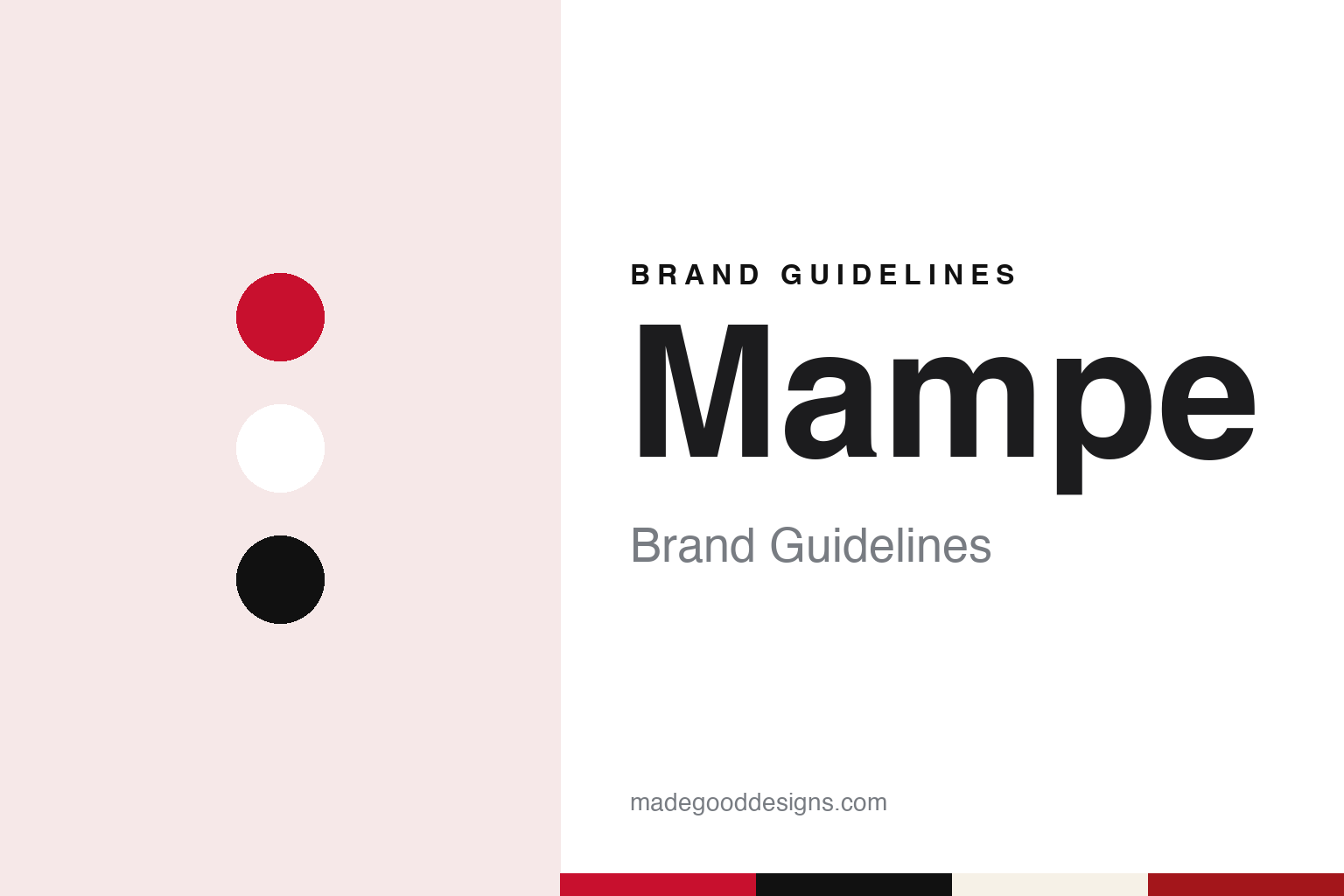
Mampe Brand Guidelines
Berlin’s white-elephant spirits brand, since 1831.
Aa
Two constants: an elephant red, white and stoneware black palette and a heavy grotesque sans register. Abstract homage — not a Mampe product or mark; no label, logo or bottle is reproduced.
From Stargard to Berlin
A Pomeranian bitter, a family split in two and a liqueur empire.
Mampe dates its story to 1831. German Wikipedia says that Carl Mampe first made a bitter called Bittere Tropfen that year in Stargard, in Pomerania, a town that is now in Poland; the brand’s own site still advertises itself as the best schnapps from Berlin “seit 1831.” The recipe did not stay with one business. According to German Wikipedia, Carl Mampe passed it to two half-brothers, each of whom set up his own works: Ferdinand Johann Mampe in Stargard in 1835, and Carl Mampe Junior in Köslin seventeen years later. The Carl Mampe AG, founded in 1877, later moved to Berlin; the Berlin daily taz reported in 2011 that production ran first in Stargard and from 1877 on Grenzallee in Neukölln.
Berlin made Mampe famous. German Wikipedia credits Robert Exner, an advertising representative who became a partner in the Berlin liqueur works in 1898 and its sole owner in 1900, with building it into one of the leading names of the German liqueur trade. In 1922 the business became a family-held stock company, with Exner as general director, and bought the brandy distillery H. Teichelmann und Schwinge, which German Wikipedia dates to 1784. The best seller was Halb und Halb, which German Wikipedia says Carl Mampe Junior developed in 1894; taz described it as an orange-bitter liqueur made from herbs and bitter oranges, and recorded that the firm produced up to seventy kinds of liqueur and vodka.
The brand also had its own bars. German Wikipedia dates the first Mampe-Stuben to 1916 and says there were twenty in Berlin at the peak, where customers could taste the whole range; taz put the first one on the Kurfürstendamm in 1917. The house at Kurfürstendamm 15, fitted out in 1912 by Walter Koeppen, became a meeting place for writers in the 1920s, and German Wikipedia says Joseph Roth finished his novel Radetzkymarsch there. German Wikipedia says that room closed in 1986 and was placed under monument protection.
The two family firms remained rivals. Ferdinand Johann Mampe’s company produced in Stargard until the end of the Second World War and moved to Hamburg in 1945 as F. J. Mampe KG. German Wikipedia describes years of litigation between Berlin and Hamburg, and taz wrote in 2011 that the two works publicly disputed which of them supplied the Ethiopian emperor Haile Selassie. In 1964 the Berlin company came under Willi Maurer, head of the detergent maker Rei-Werke, and in 1965 the two firms agreed to cooperate.
Colour
A team of white horses, then a white elephant.
Mampe’s best-known sign is an animal. German Wikipedia says the Berlin brand’s marks were first a team of white horses, the “Schimmelgespann,” and from 1951 a white elephant in a red circle created by August Rhades, which appeared on every label into the 1970s. taz also dated the elephant logo to 1951, and noted in 2011 that it looked so current it could pass for the work of a young agency in Berlin-Mitte. A small relief elephant in white plastic was tied around the neck of each bottle of Halb und Halb and became a collectors’ item; the city magazine zitty reported in 2014 that the plastic tag had returned to Mampe bottles.
The Hamburg branch went its own way. German Wikipedia says its Stargard bottles had shown the town’s Mill Gate, and that after the move to Hamburg it used two monks drinking to brotherhood as its emblem, later trying a poodle that was soon dropped.
The elephant has long been literal as well as graphic. German Wikipedia records that a forest elephant that arrived at the Berlin Zoo in 1926 was named Mampe after its sponsor, and that after the Second World War the company sponsored another elephant of the same name. German Wikipedia also quotes 1960s slogans such as “Mampe Halb und Halb ist eine ganze Sache” (1969), which it reads as a nod to the divided city.
Mampe’s name also travelled. taz wrote that the company created a Lufthansa Cocktail with an apricot note that was served on the airline’s flights into the 1970s, and German Wikipedia says it was later sold in bottles shaped like a cocktail shaker. Between 1977 and 1979 Mampe backed the Zakspeed racing team, whose black and yellow Ford Capri driven by Hans Heyer won several races, and in the 1978–79 Bundesliga season it was the shirt sponsor of Hertha BSC. German Wikipedia adds that the firm’s finer products were bottled in black stoneware as well as ordinary glass, citing the Berliner Zeitung in 2020.
Typography
Design and documentation.
The seven brands in this group are all German and Polish spirits and liqueurs: Asbach, Berentzen, Underberg, Killepitsch, Mampe, Żołądkowa Gorzka and Krupnik. Spirits and liqueur brands in general sit at many different points in the trade, from family houses that still carry a founder’s name to labels that now belong to much larger drinks groups, and a single brand can be sold everywhere from a corner shop to a bar shelf.
A spirit or liqueur brand’s identity is usually carried less by a single bottle than by a label, a name and the place it promises, because the company behind the name may have changed hands, moved its production or grown far beyond the place where it started. That makes the questions behind each name worth asking plainly: who started it, who owns it now, and where its spirits are actually distilled and bottled.
Each guide separates what independent sources record from what the company says about itself — its founding story, its owners over time, where its spirits are made and how its labels have changed — and marks plainly what rests only on the company’s own word.
Aa
A heavy grotesque sans for a red-and-white elephant brand. (Specimen set in Archivo Black, a sans-serif STAND-IN; NOT the Mampe logo.)
Mampe today
A licence, a revival in Kreuzberg and new owners.
The postwar decades ended in decline. German Wikipedia, citing the Berliner Zeitung, says the last Mampe-Stube closed in 1984 when the company went bankrupt; the Berliner Kurier reported in September 2024 that a bankruptcy followed in 1992 and that the brand then faded as part of Berentzen. German Wikipedia says that soon after German reunification the Doornkaat company and then the Berentzen group made Mampe spirits under licence.
The revival began in 2012. German Wikipedia says the Berliners Tom Inden-Lohmar and Frank Zächel bought the brand rights from the Berentzen group that year and began making and selling Mampe themselves, and the Berliner Kurier reported that Inden-Lohmar secured the rights and rebuilt the brand at a new site in Berlin-Kreuzberg. Halb und Halb returned to the market in 2013, according to German Wikipedia. In 2020 Quirin Graf Adelmann, Florian Löhlein and Tom Hölzner took over the company, the Berliner Kurier reported.
Today the business trades as Mampe Spirituosen GmbH, with its manufactory at Am Tempelhofer Berg in Kreuzberg. The company says its black-bottle specials are made by hand in Kreuzberg, and its range runs from Halb und Halb, liqueurs, gin, vodka and rum to an alcohol-free line, along with a revived Bittere Tropfen. The Berliner Kurier reported in 2024 on a production hall in the Bergmannkiez and a new production and warehouse building in Marzahn, and on the owners weighing a move of some production abroad, chiefly to Thailand, over Berlin bureaucracy. In April 2026 the paper reported that a free museum of the brand’s history would open in the Kreuzberg manufactory in July 2026; German Wikipedia says the collection was assembled by Karin Erb, who ran a private Mampe museum from 2007.
The name needs care online. The company’s German shop is mampe.berlin, while mampe.com is the site of MAMPE Thailand, which describes itself as an authorised importer and distributor; mampemuseum.de belongs to the older private museum. Mampe is also a family name.
For a design guide, Mampe shows how a single animal in a red circle, drawn in 1951, can carry a nineteenth-century Berlin spirits brand through bankruptcy, a licence and a revival. Compare Berentzen, its former licensee, and Underberg, another German bitter. For this guide we use elephant red, white and stoneware black with a heavy sans, an unofficial interpretation; no product or logo is reproduced.
Explore & save
Keep Mampe’s identity on hand — save it to a board in the Made Good inspiration library.
Mampe identity set
Pin the Mampe elephant red, white and stoneware black palette and the heavy grotesque sans register to your own board.