Berentzen Brand Guidelines
The Haselünne distiller behind Apfelkorn, since 1758.
Aa
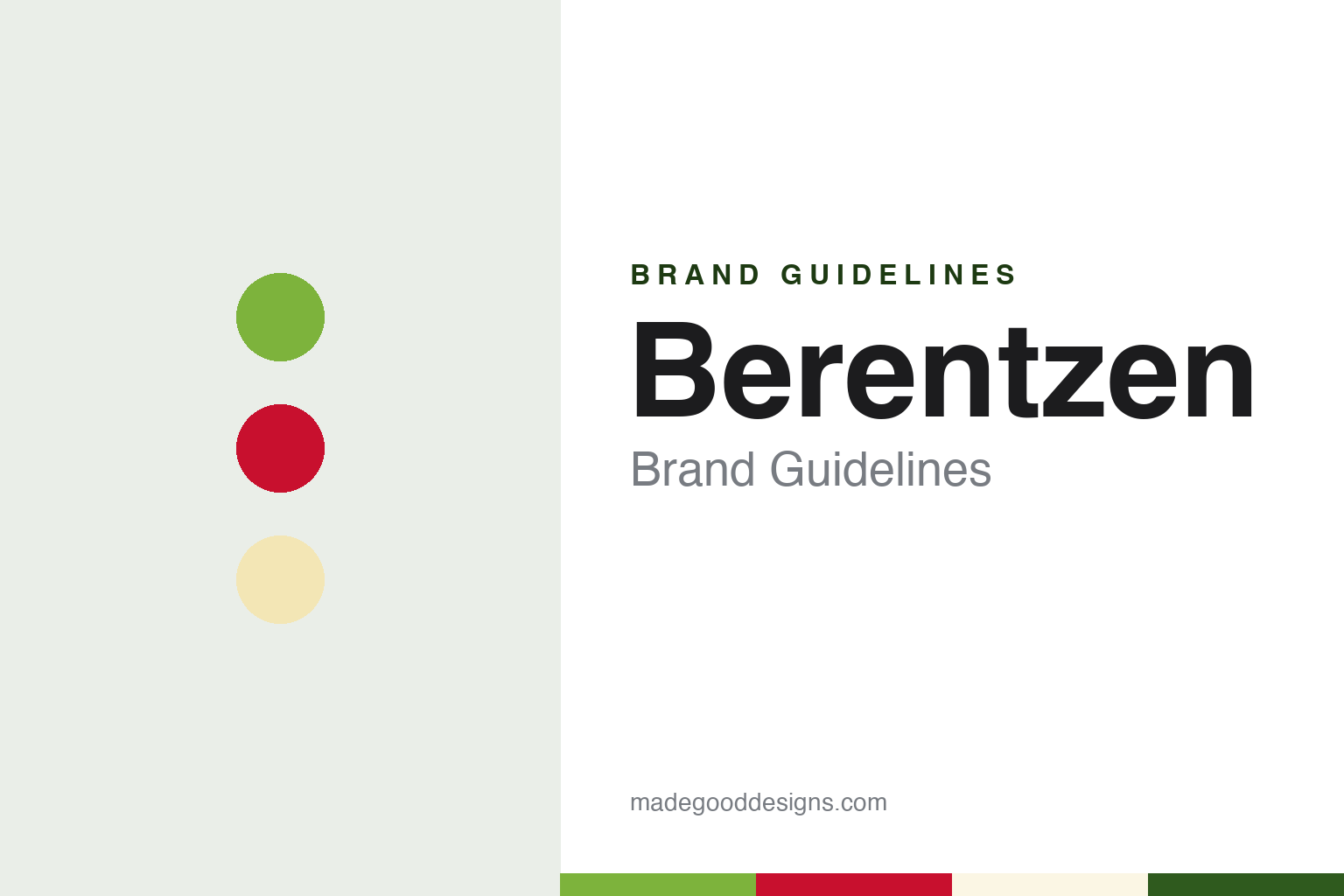
Two constants: an apple green, red apple and grain cream palette and a clean humanist sans register. Abstract homage — not a Berentzen product or mark; no label, logo or bottle is reproduced.
A grain distillery in Emsland
From a town of corn distillers to a national spirits brand.
Berentzen is a German spirits brand and the name of the listed drinks group behind it, the Berentzen-Gruppe AG, based in Haselünne, a small town in the Emsland district of Lower Saxony. The group dates its origin to 1758, when the record of a court inspection in Haselünne listed the grain distillery of the Berentzen family. German Wikipedia names the founder as the town councillor Johann Bernhard Tobias Berentzen, and, citing the broadcaster NDR, says that the same 1758 record lists 25 other spirit distillers in the town. The firm traded as I. B. Berentzen and made Korn, the clear German grain spirit.
The family name became a brand early. The company says its Korn “Berentzen vom alten Faß” (“from the old cask”) was registered as a trademark in 1899, one of the first German spirits to be protected that way. In 1958 the family opened a second line of business in Haselünne, soft drinks, under the name Emsland-Getränke, and in 1960 it took a Pepsi bottling concession, which Handelsblatt reported in 2014 had run for more than five decades. The soft-drinks arm, now called Vivaris, switched to a Sinalco concession from 2015.
The product that made Berentzen a national name arrived in 1976. The brothers Friedrich and Hans Berentzen launched Berentzen Apfelkorn, a blend of wheat Korn and apple juice, NDR reports. The company calls it the most successful new spirit launched in Germany after 1945, and says it began building an export business on the back of it in 1979. The fruit range grew from there: German Wikipedia lists flavours such as sour apple, wild cherry and passion fruit, all made on a wheat-Korn base at between 15 and 20 per cent alcohol.
Colour
Mergers, a listing and a new principal owner.
In 1988 I. B. Berentzen merged with the brandy maker Pabst & Richarz to form the Berentzen-Gruppe, which the company says became the second-largest spirits business in Germany. Acquisitions followed. According to the company’s own history, it bought the vodka brand Puschkin from König & Schlichte in 1990 and the business of the Norden Korn distiller Doornkaat in 1992. Around the turn of 1998 and 1999 it took over its rival Dethleffsen, adding brands such as Bommerlunder, Echt Stonsdorfer and Hansen rum. The company became a stock corporation in 1993 and its shares were first listed in Frankfurt and Bremen in June 1994.
The family era ended in 2008, the company’s 250th year. The Munich investor Aurelius bought 75.1 per cent of the voting ordinary shares from the founding families, the company says and the Lebensmittel Zeitung reported in September 2008. Under the new owner the group closed the historic distillery in Haselünne’s old town and moved spirits production to its existing plant in Minden, German Wikipedia says, citing the 2008 annual report. Aurelius sold the last of its shares in 2016, after which most shares were held in free float, the company said in a release of September 2016.
Minden remains the group’s spirits works. The company says the group’s spirits are made there, more than 80 million bottles a year, while Haselünne holds the head office, a soft-drinks plant and the Berentzen Hof, a visitor attraction in the historic buildings. In 2017 the company opened a small craft distillery at the Berentzen Hof, Spirituosen-Journal and the Neue Osnabrücker Zeitung reported.
A new chapter was announced on 21 September 2026. In a disclosure that day, the Berentzen-Gruppe said it had signed a business combination agreement with the Sazerac Company of Louisville, Kentucky, a family-run spirits company founded in New Orleans in 1850, and that its boards backed a voluntary public cash takeover offer for all its shares. The company said completion was expected in the fourth quarter of 2026, subject to a minimum acceptance of half the shares plus one, and that the bidder intended to delist the shares afterwards.
Typography
Design and documentation.
The seven brands in this group are all German and Polish spirits and liqueurs: Asbach, Berentzen, Underberg, Killepitsch, Mampe, Żołądkowa Gorzka and Krupnik. Spirits and liqueur brands in general sit at many different points in the trade, from family houses that still carry a founder’s name to labels that now belong to much larger drinks groups, and a single brand can be sold everywhere from a corner shop to a bar shelf.
A spirit or liqueur brand’s identity is usually carried less by a single bottle than by a label, a name and the place it promises, because the company behind the name may have changed hands, moved its production or grown far beyond the place where it started. That makes the questions behind each name worth asking plainly: who started it, who owns it now, and where its spirits are actually distilled and bottled.
Each guide separates what independent sources record from what the company says about itself — its founding story, its owners over time, where its spirits are made and how its labels have changed — and marks plainly what rests only on the company’s own word.
Aa
A clean humanist sans for a fruit-led spirits range. (Specimen set in Barlow, a sans-serif STAND-IN; NOT the Berentzen logo.)
Berentzen
A family name that now spans soft drinks and juice presses.
The group has kept reshaping its range. In 2004 it introduced an umbrella-brand concept for its fruit spirits under the claim “Das fruchtet”, with television work by the Hamburg agency Economia, Horizont reported in June 2004. The company adopted “Durst auf Leben” (“thirst for life”) as its corporate claim in 2018. In 2019 it added the rum Tres Países and a line of premium fruit liqueurs, Berentzen Signature, and in 2020 it bought the cider brand Goldkehlchen. The group also sells juice presses through Citrocasa of Linz, Austria, bought in 2014, and soft drinks such as Mio Mio through Vivaris. Its bottle design has been tested in court: in November 2024 the Paulaner brewery group sued over the bottle of Mio Mio Cola + Orange, tagesschau.de reported; a Munich court found for Paulaner, and Berentzen appealed, LebensmittelPraxis reported.
Not every brand in its warehouse stayed. German Wikipedia says the Spanish liqueur Licor 43 and the Norwegian Linie Aquavit left Berentzen’s distribution in April 2009, after their makers ended the contracts following the sale to Aurelius.
The name needs a little care online. Berentzen is also a family surname, and several family members have their own encyclopedia entries; the group’s corporate site is berentzen-gruppe.de, and the Berentzen Hof in Haselünne has a site of its own.
For a design guide, Berentzen shows how a regional grain distiller turned a single fruit idea into a family of colour-coded bottles, and kept its family name on the label through mergers, a stock listing and changes of owner. Compare Asbach, the Rüdesheim brandy house, and Krombacher, the Siegerland brewery. For this guide we use apple green, red apple and grain cream with a humanist sans, an unofficial interpretation; no product or logo is reproduced.
Explore & save
Keep Berentzen’s identity on hand — save it to a board in the Made Good inspiration library.
Berentzen identity set
Pin the Berentzen apple green, red apple and grain cream palette and the clean humanist sans register to your own board.