Chateau Ste. Michelle Brand Guidelines
Washington’s Woodinville winery, opened 1976.
Aa
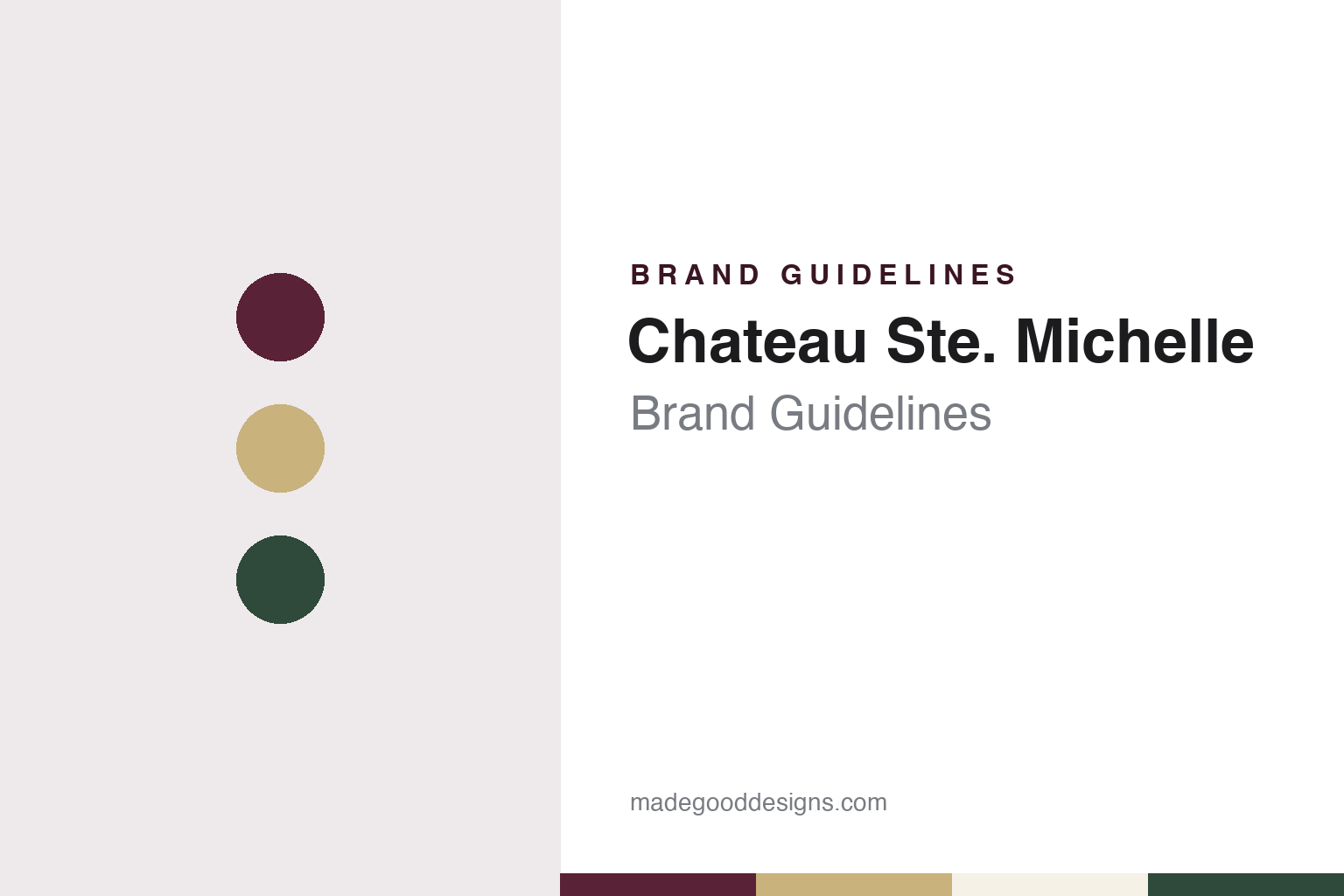
Two constants: a cabernet plum, Riesling gold and Columbia green palette and a classical serif register. Abstract homage — not a Chateau Ste. Michelle product or mark; no label, logo or bottle is reproduced.
From Seattle fruit wines to a Woodinville chateau
Four decades of mergers and renamings before the chateau.
Chateau Ste. Michelle is the flagship winery of Ste. Michelle Wine Estates, and its story starts with the end of Prohibition. The company’s own timeline says the National Wine Company (NAWICO) and the Pomerelle wine company were founded in Seattle in 1933; English Wikipedia gives NAWICO’s founding as 1934. VinePair reported in 2019 that Pomerelle made fruit wines in the 1930s from Washington blackberries, loganberries and black currants. In 1954 the two merged as American Wine Growers, which the company says created Washington’s largest winery.
The turn to European grape varieties came in 1967, when, the company says, American Wine Growers launched “Ste. Michelle Vineyards.” That same year the Napa winemaker André Tchelistcheff, who had left Beaulieu Vineyards, came to Washington and consulted on the new wines, VinePair reported, urging a focus on cooler-climate whites such as Riesling. The company timeline says American Wine Growers became Ste. Michelle Vintners in 1973, the year its Cold Creek Vineyard was planted; other published histories date the renaming a year or more earlier.
An early outside verdict helped. VinePair wrote that a 1974 blind tasting of 19 Rieslings run by the Los Angeles Times placed Ste. Michelle’s 1972 bottling first. The same year the business passed to UST, the tobacco company, which Altria’s filings with the US Securities and Exchange Commission say had owned Ste. Michelle since 1974.
The name on the label today dates from 1976. The company says Ste. Michelle Vineyards became Chateau Ste. Michelle that year, when the chateau opened in Woodinville, northeast of Seattle, on what English Wikipedia describes as the former Hollywood Farm of the lumberman Frederick Stimson. The property was added to the National Register of Historic Places in 1978, English Wikipedia says.
Colour
A French-style chateau, a Riesling focus and two European partners.
The brand’s name and its building tell the same story: a French-style chateau set in a Pacific Northwest landscape. VinePair reported in 2019 that the chateau, first built in 1976, had been extensively renovated in 2018, and that its grounds host a summer concert series whose performers have included Bob Dylan, Paul Simon and John Legend.
Riesling is the grape most closely tied to the name. VinePair wrote in 2019 that the winery made more than 500,000 cases a year of its Columbia Valley Riesling and described it as the single largest Riesling producer in the world. Two partnerships with European families extended that reputation. The company says it joined Ernst Loosen of Germany’s Mosel in 1999 to create Eroica, a Riesling, and English Wikipedia, citing the Seattle Times, describes Col Solare as an alliance with Piero Antinori of Tuscany.
The grapes come from eastern Washington, across the Cascades from the chateau. English Wikipedia lists the estate vineyards Canoe Ridge in the Horse Heaven Hills and Cold Creek and Indian Wells in the Columbia Valley, and it reports, citing KOMO, that white-wine production moved from Woodinville to eastern Washington with the 2022 harvest. The magazine Wine Enthusiast named Chateau Ste. Michelle its American Winery of the Year in 2004, English Wikipedia says.
Plans for the Woodinville site have drawn local attention. The Seattle Times reported in February 2024 on a proposal to redevelop part of the estate with homes, a hotel, shops and a larger music venue, and the Seattle Daily Journal of Commerce followed the plans in October 2024.
Typography
Design and documentation.
The seven brands in this group are all wine names: Chateau Ste. Michelle, Bogle, 14 Hands, Dark Horse, Cupcake, Ménage à Trois and Chandon. Wine brands in general sit at many different points in the trade, from family houses that still carry a founder’s name to labels that now belong to much larger drinks groups, and a single brand can be sold everywhere from a corner shop to a restaurant list.
A wine brand’s identity is usually carried less by a single bottle than by a label, a name and the place it promises, because the company behind the name may have changed hands, moved its production or grown far beyond the place where it started. That makes the questions behind each name worth asking plainly: who started it, who owns it now, and where its wine is actually made and bottled.
Each guide separates what independent sources record from what the company says about itself — its founding story, its owners over time, where its wine is made and how its labels have changed — and marks plainly what rests only on the company’s own word.
Aa
A classical serif for a chateau name with French spelling. (Specimen set in Cormorant Garamond, a serif STAND-IN; NOT the Chateau Ste. Michelle logo.)
Chateau Ste. Michelle
Tobacco, private equity, then a Washington farming family.
The winery grew into a group. The company timeline lists Columbia Crest in Paterson in 1983, Northstar in Walla Walla in 1994 and the launch of 14 Hands in 2005. VinePair noted in 2019 that several former employees went on to found wineries of their own, among them Januik, Betz and Long Shadows, and that the company opened the Ste. Michelle Wine Estates WSU Wine Science Center at Washington State University in 2015.
Ownership has changed three times since 2009. Altria’s SEC filings show that it completed its purchase of UST on 6 January 2009, bringing Ste. Michelle Wine Estates with it. In July 2021 Altria agreed to sell the wine business to the investment firm Sycamore Partners, Business Wire reported. Then in December 2025 the Wyckoff family, eastern Washington grape growers and the owners of Coventry Vale Winery, bought Ste. Michelle Wine Estates from Sycamore, Northwest Wine Report, Wine Spectator and Shanken News Daily reported. The purchase covered the Washington brands, production facilities and vineyards; Sycamore kept the Oregon brands, and the reports described the sale as the first local ownership of the business in more than fifty years.
The name needs care online. The winery’s site is ste-michelle.com, while smwe.com is the parent company’s; Domaine Ste. Michelle is a separate sparkling-wine brand in the same group.
For a design guide, Chateau Ste. Michelle shows how a building can become a brand: a French-style chateau, a French-styled name and a close tie to one grape, Riesling, have given a Washington winery its identity since 1976. Compare 14 Hands, its sister brand from the same group, and Penfolds, the South Australian winery behind Grange. For this guide we use cabernet plum, Riesling gold and Columbia green with a classical serif, an unofficial interpretation; no product or logo is reproduced.
Explore & save
Keep Chateau Ste. Michelle’s identity on hand — save it to a board in the Made Good inspiration library.
Chateau Ste. Michelle identity set
Pin the Chateau Ste. Michelle cabernet plum, Riesling gold and Columbia green palette and the classical serif register to your own board.