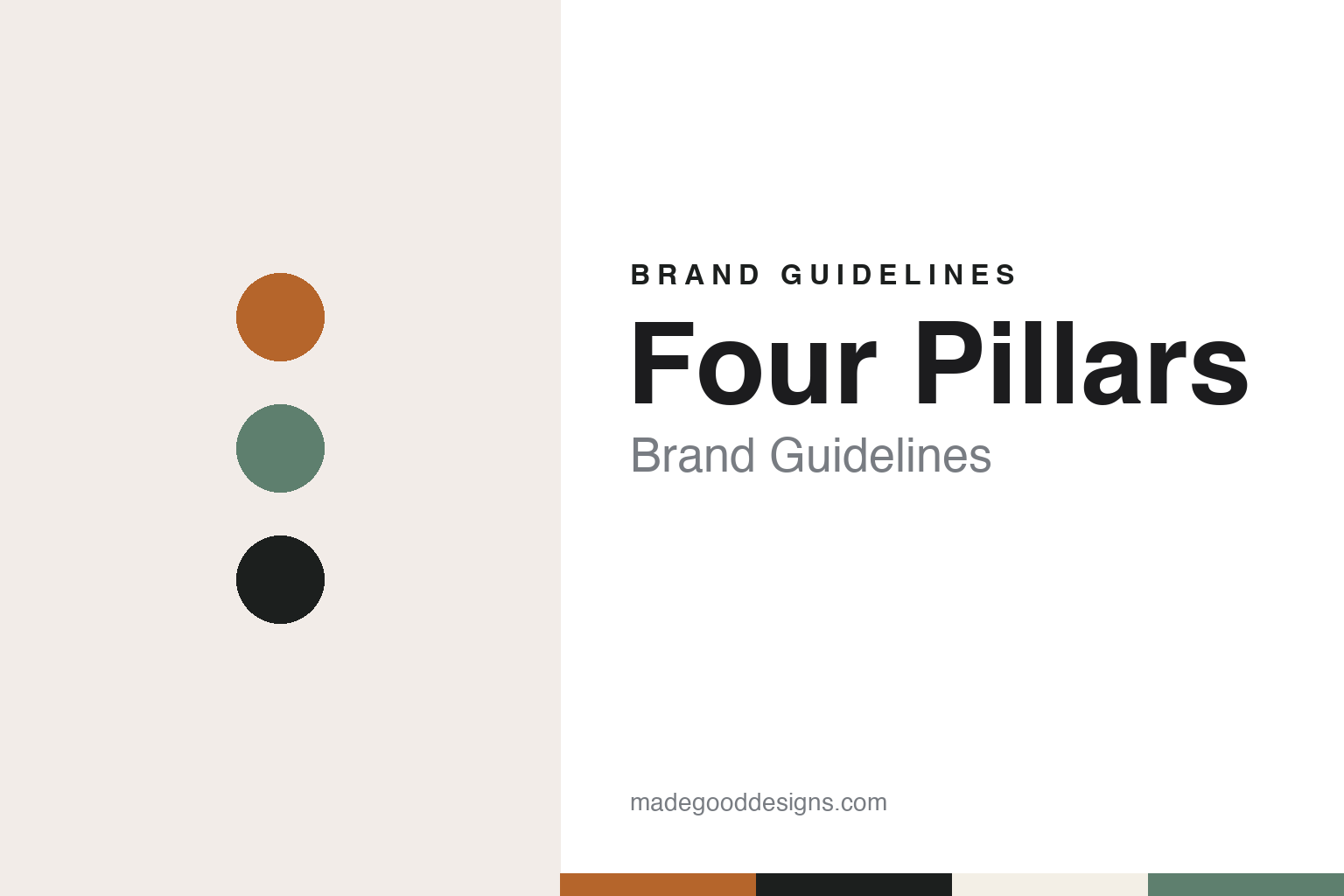
Four Pillars Brand Guidelines
The Yarra Valley gin distillery built on a still, water, botanicals and love.
Aa
Two constants: a still copper, eucalyptus and ink palette and a slab serif register. Abstract homage — not a Four Pillars product or mark; no label, logo or bottle is reproduced.
Three founders and a still
A Rare Dry Gin in numbered batches of 420 bottles.
Four Pillars is a gin distillery in Healesville, in Victoria’s Yarra Valley, east of Melbourne. The company says it all started in 2013 “with three mates and one extraordinary copper still.” Its website in 2014 named Cameron Mackenzie as founder and distiller and described Stuart and Matt as “the other founders”; team pages on the company’s 2015 site give their full names as Stuart Gregor and Matt Jones. Mackenzie, the company said in 2015, had spent fifteen years in the wine trade, making, selling and judging wine, before he turned to distilling.
The first product was a Rare Dry Gin. The company’s 2014 homepage said it had launched “in late 2013” and had sold out its first two batches immediately, and that it was distilling in small batches of just 420 bottles, each individually numbered and hand labelled. An archived page from January 2014 shows that one early batch had been reserved through the Australian crowdfunding platform Pozible. The same year the company announced that Rare Dry had won a Double Gold at the San Francisco World Spirits Competition.
The first distillery was at Warrandyte, on Melbourne’s eastern edge, according to the 2014 contact page. In 2015 the company moved to Healesville, into what it describes as a former timber yard, which it says has since been much expanded. A second base followed in Sydney: in 2020 the company opened its Surry Hills Laboratory, with a working copper still and a cocktail bar.
Colour
Still, water, botanicals and love.
The name is the brand’s own explanation of itself. From the start the company set out its approach as four numbered pillars, written on its 2014 site as “No.1_ STILL,” a copper pot still made in Germany by the still-maker CARL and named Wilma; “No.2_ WATER,” from its home in the Yarra Valley; “No.3_ BOTANICALS,” some native to Australia and some sourced from around the world; and “No.4_ LOVE,” described as a commitment to craft and attention to detail. The numbered, underscored headings ran through the early website, and in November 2014 the company published a separate story on each pillar.
Wilma was the first of several stills with names. The company says she has since been joined by Jude, Eileen, Beth, Coral and Linda, all named after the mothers of its founders or after long-serving members of staff.
The flavour was part of the identity from the first bottle. The 2014 site called Rare Dry “a truly modern Australian gin” that captured “the flavours of both Asia and the Mediterranean,” made with whole oranges, cardamom, cinnamon and star anise alongside Australian botanicals such as lemon myrtle and Tasmanian pepperberry leaf. The range widened quickly: a Navy Strength gin and a barrel-aged gin were on the site by late 2014, and a Bloody Shiraz gin by 2017. Today the company’s site also lists an Olive Leaf gin and non-alcoholic drinks under the Bandwagon name.
The early look has recorded credits. The footer of the company’s 2014 and 2015 websites credited graphic design to War Design Studios, photography to Anson Smart, video to Steve Oxton and digital work to HERBERT. Archived copies of the site from 2015 to 2017 also load web-font files of Clarendon, the slab-serif type family, for the website.
Typography
Design and documentation.
The seven brands in this group are all gin, vodka and brandy names: Four Pillars, Ki No Bi, Deep Eddy, New Amsterdam, Chopin, Christian Brothers and Paul Masson. Spirits brands in general sit at many different points in the trade, from independent distilleries that still carry a founder’s name to labels that now belong to much larger drinks groups, and a single brand can be sold everywhere from a corner shop to a cocktail bar.
A gin, vodka or brandy brand’s identity is usually carried less by a single bottle than by a label, a name and the place it promises, because the company behind the name may have changed hands, moved its production or grown far beyond the place where it started. That makes the questions behind each name worth asking plainly: who started it, who owns it now, and where its spirit is actually distilled and bottled.
Each guide separates what independent sources record from what the company says about itself — its founding story, its owners over time, where its spirit is made and how its labels have changed — and marks plainly what rests only on the company’s own word.
Aa
A slab serif for a numbered, pillar-by-pillar story. (Specimen set in Zilla Slab, a slab-serif STAND-IN; NOT the Four Pillars logo.)
Four Pillars
From a crowdfunded batch to a brewer’s gin house.
Four Pillars stayed independent for six years. In March 2019 the brewer Lion bought half of the business, the Australian Financial Review reported, and in July 2023 Lion acquired the remaining half, the same paper reported. Lion, headquartered in Sydney, is a subsidiary of the Japanese brewer Kirin, which bought Lion Nathan in 2009 and renamed it Lion in 2011, English Wikipedia says. The company continues to present Healesville as the home where it makes its gin.
Awards became part of the story. The International Wine & Spirit Competition in London named Four Pillars the world’s leading gin producer in 2019 and again in 2020, Business News Australia reported in November 2020, and the company says it won the title a third time in 2023. In 2022 it received the IWSC’s first Green Spirits Initiative trophy and, the company says, became Australia’s first certified carbon-neutral gin distillery.
The name needs a little care online. “Four pillars” is a common phrase in many other contexts, so searches for the gin are best paired with the word “gin”; the company’s current site is fourpillarsgin.com, and its older Australian domain now redirects there.
For a design guide, Four Pillars shows how a simple numbered idea, four things the company says it cares about, can carry a whole brand, from named stills to a website built pillar by pillar, while the product itself grows from a single Rare Dry into a family of gins. Compare Sipsmith, the London copper-pot gin distillery, and Kirin, the Japanese brewer whose Australian arm now owns Four Pillars. For this guide we use still copper, eucalyptus and ink with a slab serif, an unofficial interpretation; no product or logo is reproduced.
Explore & save
Keep Four Pillars’s identity on hand — save it to a board in the Made Good inspiration library.
Four Pillars identity set
Pin the Four Pillars still copper, eucalyptus and ink palette and the slab serif register to your own board.


