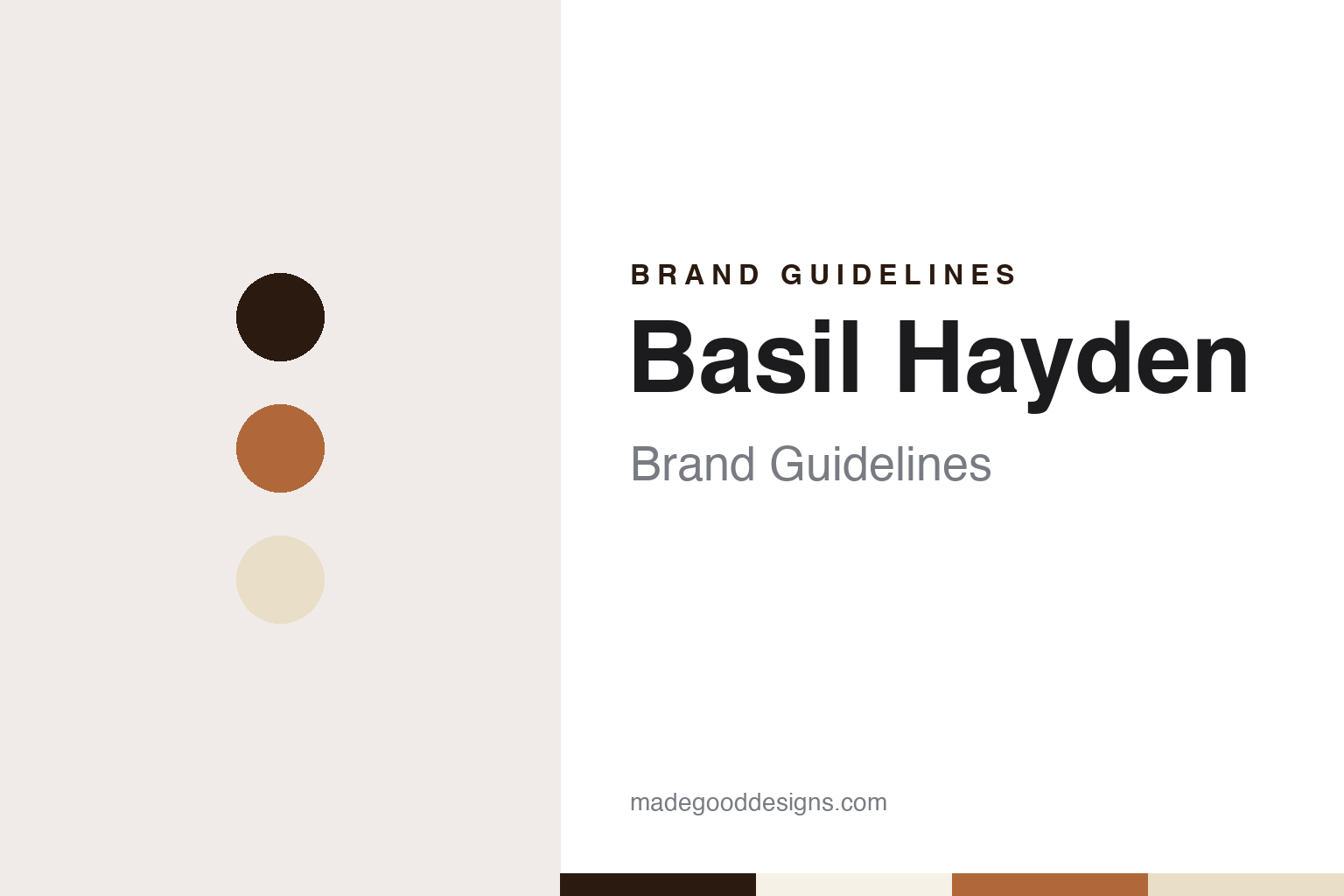
Basil Hayden Brand Guidelines
Booker Noe’s 1992 high-rye bourbon and its copper belt.
Aa
Two constants: a burnished copper, deep oak and parchment palette and a tracked-out bookish serif register. Abstract homage — not a Basil Hayden product or mark; no bottle, belt, label or logo is reproduced.
Old Grand-Dad’s grandfather
A Maryland pioneer’s name on a 1992 bourbon.
Basil Hayden is a young brand with an old name. The bourbon was introduced in 1992 by the Jim Beam company as one of the four bottlings in its Small Batch collection, alongside Knob Creek, Booker’s and Baker’s. Suntory Global Spirits, the brand’s current owner, said in a September 2023 release that Booker Noe — the Jim Beam master distiller and grandson of Jim Beam — created Basil Hayden that year as part of the collection, drawing on bourbons made with a high proportion of rye. English Wikipedia describes it as the lightest-bodied of the four, bottled at 80 proof where its siblings are stronger, and The Dieline reported that Noe used to say, “If you don’t like bourbon, try Basil Hayden.”
The name belongs to Basil Hayden Sr., an 18th-century Kentucky settler. The Kentucky Historical Society’s account of the state’s Catholic pioneers says some sixty Maryland Catholic families, largely from St. Mary’s County, formed a league to move west, and that in 1785 about twenty-five of them travelled by flatboat down the Ohio River and on to Goodwin’s Station in present-day Nelson County. From there, the society says, the men of the party, led by Basil Hayden, set out for claimed land on Pottinger’s Creek, where the Holy Cross congregation grew up; a log church was built there in 1792 and the present church in 1823.
Hayden’s place in whiskey comes through his family. English Wikipedia describes him as a distiller who used a larger share of rye in his mash than some other bourbon makers, and says his grandson Raymond B. Hayden founded a distillery in Nelson County and named its label Old Grand-Dad in his honour; that bottle still carries a portrait of the elder Hayden. Old Grand-Dad passed through several owners and eventually came to Jim Beam, which is how the same family name came to sit on two of the company’s bourbons. Wikipedia also cites a 1995 book, The Book of Classic American Whiskeys, for the company’s statement that Basil Hayden uses the same mash as Knob Creek.
Colour
A paper bib, a metal belt and a dropped apostrophe.
For most of its life the brand was called Basil Hayden’s, and its bottle was dressed in a way unlike any other in the Small Batch range: a paper bib hung over the shoulder, printed with the brand’s history, and a metal band ran around the middle like a belt. The front label once read “Aged 8 Years”; English Wikipedia says that in 2014 the age statement was replaced with the words “Artfully Aged,” so the bottling no longer carries an age guarantee.
In April 2020 the brand hired the New York office of the agency Design Bridge and Partners to redesign the pack, The Dieline reported in December 2023, and the new bottle reached shelves in August 2021. The paper bib, with its weathered colouring and a backstory dated 1796, was removed; The Dieline says it had a habit of tearing or soaking through when bartenders poured. The belt stayed and grew. It is now wider and burnished in copper, with an enlarged monogram buckle, and the label below states in tracked-out lettering that the bourbon is “artfully aged by The James B. Beam Distilling Co.” The agency’s creative director, Gregor Johnstone, told the magazine that “the barrel is central” to the belt and closure; strategy director Alice Clapp said the belt “literally ties everything together” across the range. The packaging-testing firm Designalytics, reviewing the redesign in March 2022, noted that the label paper had moved from beige to white, that the buckle and its rivets had been enlarged and that the possessive had gone: the brand is now simply Basil Hayden. In the firm’s own consumer test, 71% of whiskey buyers preferred the new design.
The range has grown around the belt. Dark Rye, announced in October 2017 as the brand’s first permanent addition, blends Kentucky straight rye with Canadian rye and a splash of California port, BevNET reported. A 10 Year bourbon, first released in limited quantities in December 2018, later became a year-round bottling with a dark grey label and gold lettering, according to VinePair. Toast, announced in August 2021, swaps the rye for brown rice and adds a second, toasted-barrel finish; it was made by Freddie Noe, the eighth-generation Beam family distiller, and was the first bottle to wear the new belt. Malted Rye, made from a mash of entirely malted rye, followed in September 2023, alongside limited editions finished in red wine and Cognac casks.
Typography
Design and documentation.
The seven brands in this group are all bourbon names: Elijah Craig, Eagle Rare, Blanton’s, Angel’s Envy, Old Forester, Michter’s and Basil Hayden. Bourbon brands in general sit at many different points in the trade, from family distillers that still carry a founder’s name to labels that now belong to much larger drinks groups, and a single brand can be sold everywhere from a corner shop to a hotel bar.
A bourbon brand’s identity is usually carried less by the whiskey itself than by a bottle, a label and a name, because the company behind the name may have changed hands, moved its distilling or grown far beyond the place where it started. That makes the questions behind each name worth asking plainly: who started it, who owns it now, and where its whiskey is actually distilled, aged and bottled.
Each guide separates what independent sources record from what the company says about itself — its founding story, its owners over time, where its whiskey is made and how its bottles and labels have changed — and marks plainly what rests only on the company’s own word.
Basil Hayden
A bookish, tracked-out serif for a bourbon belted in copper. (Specimen set in Libre Caslon Text, a serif STAND-IN; NOT the Basil Hayden logo or label lettering.)
Basil Hayden
From Beam to Suntory, and from Clermont.
Basil Hayden has always been a Beam brand, but Beam itself has changed hands. English Wikipedia records that the James B. Beam Distilling Company became Jim Beam Brands in 1987, was owned by the Fortune Brands holding company, and was spun off as the independent Beam Inc. in October 2011. In January 2014 Japan’s Suntory announced it would buy Beam; the deal was completed that April and the business was renamed Beam Suntory. In May 2024 it took the name Suntory Global Spirits, with a new visual identity, Forbes reported. It is a subsidiary of Suntory Holdings of Osaka, and its American whiskey stable also includes Jim Beam, Knob Creek, Booker’s, Old Grand-Dad and Maker’s Mark.
The brand’s website signs off from James B. Beam Distilling Co., Clermont, Kentucky, and describes the flagship as “a high-rye Kentucky straight bourbon.” The Beam family is still part of the story: Suntory Global Spirits introduces Freddie Noe as the eighth-generation master distiller, and his name is attached to recent Basil Hayden releases such as Toast and Malted Rye.
For a design guide, Basil Hayden shows how a single piece of hardware — a metal belt with a monogram buckle — can become the whole identity once the paper around it is stripped away, and how dropping one apostrophe can make a pioneer’s name read as a brand. Compare Jim Beam, the Clermont bourbon that puts seven generations on its label, and Maker’s Mark, its Suntory stablemate from Loretto with the red wax. For this guide we use a burnished copper, a deep oak and a parchment with a bookish serif, an unofficial interpretation; no product or logo is reproduced.
Explore & save
Keep Basil Hayden’s identity on hand — save it to a board in the Made Good inspiration library.
Basil Hayden identity set
Pin the Basil Hayden burnished copper, deep oak and parchment palette and the tracked-out bookish serif register to your own board.