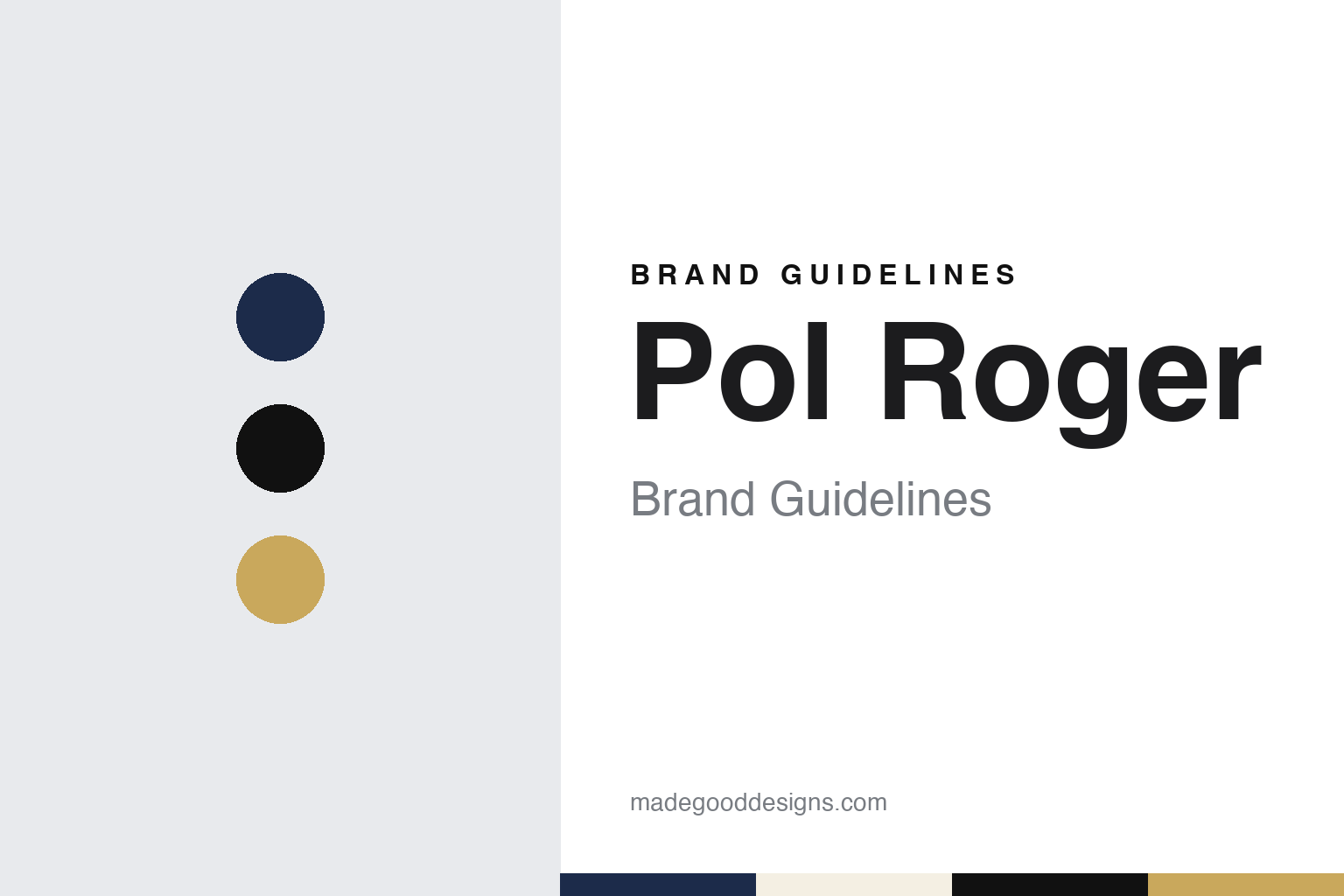
Pol Roger Brand Guidelines
The Épernay house of 1849 and Churchill’s cuvée.
Aa
Two constants: an Épernay navy, mourning black and foil gold palette and a classical book serif register. Abstract homage — not a Pol Roger product or mark; no label, logo or bottle is reproduced.
A young merchant in Épernay
Pol Roger, a first sale in 1849 and a family that took his name.
Pol Roger is a Champagne house in Épernay that still carries the name of its founder. English Wikipedia says Pol Roger set up in business in 1849, starting out as a wine wholesaler, and that the house released its first growths in 1853. The company’s own history adds detail: it says Pol made his first sale on 2 January 1849, to a merchant in Aÿ, when he was eighteen, that the firm moved to Épernay in 1851, and that from 1855 he favoured the drier brut style he knew English customers preferred.
The business passed to the next generation in 1899, when his sons Maurice and Georges took over. The start of their tenure was a disaster. The house says that on 23 February 1900 part of its cellars and buildings collapsed, losing about 500 casks and some 1.5 million bottles; the wine magazine The World of Fine Wine gives the same date and figures. The same year, the company says, the brothers obtained the right to change the family name to Pol-Roger, so that the founder’s first name became part of the surname. The house name is still written Pol Roger, without the hyphen, while the family name carries one.
Maurice became a public figure in his own right: the company says he was elected mayor of Épernay in 1912 and was in office when the German occupation of the town began in 1914. His son Jacques joined in 1927, bringing in the third generation, and the house says the years from 1919 to 1945 — American Prohibition, the Russian Revolution, the crisis of 1929 and the Second World War — held back its export growth. English Wikipedia says the house is still owned and run by Pol Roger’s descendants, and that its owners belong to Primum Familiae Vini, an association of family-owned wine companies.
Colour
A friendship, a black border and a cuvée named after a prime minister.
The name most associated with the house is not a family member’s. English Wikipedia says Pol Roger had been Winston Churchill’s favourite champagne since 1908, and that in 1944 he met Odette Pol-Roger at a party at the British Embassy in Paris. The friendship lasted the rest of his life: Churchill even named one of his racehorses Pol Roger, and the house’s history quotes his phrase “the most drinkable address in the world.”
That connection shows up in the label itself. After Churchill’s death in January 1965, English Wikipedia says, Pol Roger added a black border to the labels of the Brut non-vintage shipped to the United Kingdom, a mark of mourning that became one of the most recognisable details of the bottle. Two decades later the house gave him a wine. English Wikipedia says the Cuvée Sir Winston Churchill was introduced in 1984, with the 1975 vintage as its first, released only in magnums; it replaced an earlier prestige wine, P.R. Réserve Spéciale. The house says the cuvée was presented at Blenheim Palace, Churchill’s birthplace. English Wikipedia notes that its blend is kept confidential and that it is typically released about ten years after the vintage.
The house’s other wines follow a short list. English Wikipedia names a Brut Vintage, a Blanc de Blancs and a Rosé Vintage among the vintage wines, and Brut Réserve, Pure and Rich among the non-vintage ones. The company says it launched its vintage rosé in 1961, its demi-sec “Rich” in 2001 and its extra brut “Pure” in 2007, and that in 2001 it also redesigned its logo and bottle.
Royal patronage is part of the house’s presentation too. English Wikipedia, citing the Royal Warrant Holders Association, says Pol Roger held the Royal Warrant as purveyor of champagne to Queen Elizabeth II, and that it also held an imperial and royal warrant from the Austro-Hungarian court.
Typography
Design and documentation.
The seven brands in this group are all Champagne houses: Pol Roger, Billecart-Salmon, Perrier-Jouët, Pommery, Nicolas Feuillatte, Charles Heidsieck and Gosset. Champagne houses in general sit at many different points in the trade, from family houses that still carry a founder’s name to labels that now belong to much larger drinks groups, and a single name can be sold everywhere from a corner shop to a restaurant list.
A Champagne house’s identity is usually carried less by a single bottle than by a label, a name and the place it promises, because the company behind the name may have changed hands, moved its cellars or grown far beyond the town where it started. That makes the questions behind each name worth asking plainly: who started it, who owns it now, and where its wine is actually made and aged.
Each guide separates what independent sources record from what the company says about itself — its founding story, its owners over time, where its wine is made and how its labels have changed — and marks plainly what rests only on the company’s own word.
Aa
A classical book serif for an old Épernay name. (Specimen set in Cormorant Garamond, a serif STAND-IN; NOT the Pol Roger logo.)
Pol Roger
A family house that has kept its independence.
Pol Roger has stayed in family hands while much of Champagne has passed to larger groups. The company’s history describes a long hand-over across generations: Christian Pol-Roger joined the management in 1963, a board of directors ran the house from 2000, and since 2013 the descendants named by the company are Laurence, Evelyne and Véronique Collard de Billy and Hubert de Billy. The company says Laurent d’Harcourt became president of the board of directors in June 2013, that Véronique Collard de Billy became president of the supervisory board on 1 January 2019, and that Bastien Collard de Billy joined in November 2020 as the first member of the sixth generation. In the cellar, the house says, Damien Cambres succeeded Dominique Petit as cellar master in April 2018.
The house has also invested in its own buildings. The company says the winery was completely renovated between 2001 and 2011 and that the nineteenth-century family home in Épernay, on a street now named rue Winston Churchill, was restored between 2011 and 2013. English Wikipedia adds a further link with Churchill’s memory: after the Great Storm of 1987 damaged the trees at Chartwell, his former home in Kent, the Pol-Roger family paid for much of the replanting.
The name needs a little care online. The house’s own site is polroger.com, and “Pol Roger” was also the name of one of Churchill’s racehorses. Nearby houses offer a useful comparison: Bollinger in Aÿ is also family-owned, and Billecart-Salmon in Mareuil-sur-Aÿ traces its own family line back to 1818.
For a design guide, Pol Roger shows how a single dated gesture — a black border added in 1965 — can become part of a label’s identity for decades, alongside a founder’s name the family itself adopted. Compare it with Bollinger and Krug. For this guide we use Épernay navy, mourning black and foil gold with a serif, an unofficial interpretation; no product or logo is reproduced.
Explore & save
Keep Pol Roger’s identity on hand — save it to a board in the Made Good inspiration library.
Pol Roger identity set
Pin the Pol Roger Épernay navy, mourning black and foil gold palette and the classical book serif register to your own board.


