Niepoort Brand Guidelines
The Dutch-founded port house of Gaia, since 1842.
Aa
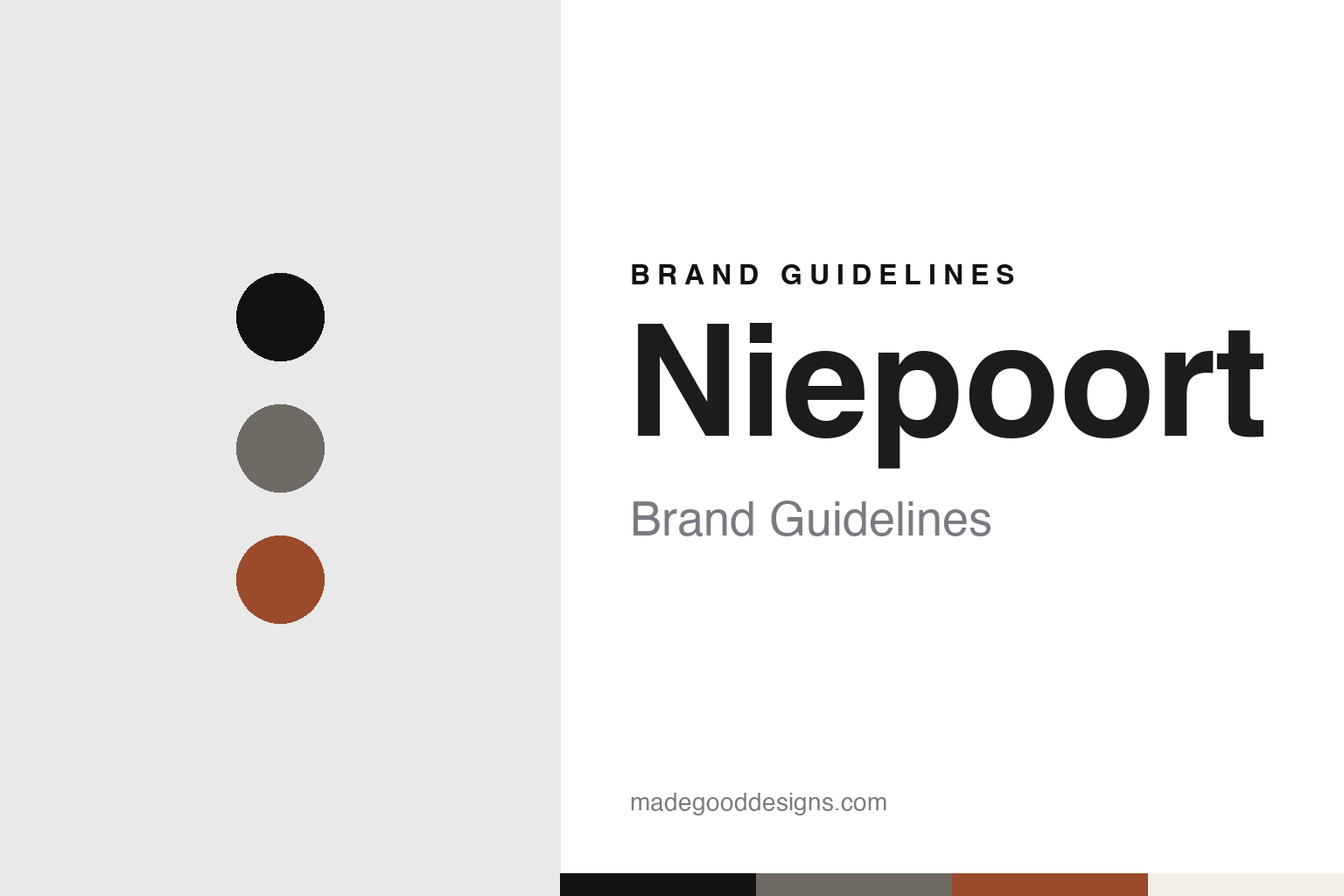
Two constants: a raven black, schist and tawny palette and a condensed grotesque sans register. Abstract homage — not a Niepoort product or mark; no label, logo or bottle is reproduced.
A Dutch house in Gaia
From an 1842 partnership to five generations of one family.
Niepoort calls itself a family business dating back to 1842, and the date is printed across its own website. The founding story is a little more involved than the name suggests. Dutch Wikipedia and the port reference site vintageport.se both say the house was established in 1842 by a Dutchman, Eduard Kebe, and that in 1847 he took on Franciscus Marius van der Niepoort as a partner. By 1858 Van der Niepoort was the sole owner, vintageport.se says, and the business has stayed with his family ever since. The house is based in Vila Nova de Gaia, across the Douro from Porto, where port has traditionally been aged and shipped.
The family name passed down through a son who entered the firm in 1873 and took over in 1897, according to vintageport.se. In 1997 Eduard Rudolph, known as Rolf, Niepoort retired and his son Dirk Niepoort, the fifth generation, took charge. Dutch Wikipedia adds that his sister Verena became an executive in 2005, and that for five generations the Nogueira family has supplied the house with its cellar masters.
For most of its history Niepoort owned no vineyards at all. It bought wine and grapes from Douro growers and aged and blended them in Gaia, a classic shipper’s model; vintageport.se says the house had no quinta of its own for more than 140 years. Its speciality on the port side is the Garrafeira, a style matured first in cask, then in large glass demijohns and finally in bottle, a style the same source likens to a lighter vintage port.
Ownership has since narrowed within the family. Wine Spectator reported in August 2018 that Dirk Niepoort had bought the shares held by his sister and his mother earlier that year, giving him 95 per cent of the company, with the general manager José Teles holding the remaining five per cent. The same report named Dirk Niepoort as chief executive.
Colour
Quintas, table wines and a raven on the label.
The change of direction came in the late 1980s. Niepoort says Quinta de Nápoles, on the left bank of the Tedo river, was the first winery it bought, in 1987, when Dirk joined his father in the business; the company says the quinta’s records go back to 1756. The neighbouring Quinta do Carril followed in 1988, and together the two hold 62 hectares of organic vineyards, the company says. Dutch Wikipedia notes that a third property bought in the same decade, Quinta do Passadouro, became a separate business in 2003.
In 1990, the company says, Niepoort went from a business that only sold port to one that also made unfortified Douro DOC wines. Its first red table wine, Robustus, was made that year but never released; the grapes of Carril now go into Redoma, Batuta, Bioma and Vertente, according to Niepoort. In 2003 it bought Vale de Mendiz in the Pinhão valley and turned it into a winery, which it calls the cradle of its ports, trodden in old round granite lagares. The red Charme is the only unfortified wine made there, the company says.
The house’s best-known piece of label design began in Germany. The Alliance Graphique Internationale archive records a 2005 project by the Austrian designer Cordula Alessandri for Fabelhaft (German for “fabulous”), a Douro cuvée Dirk Niepoort made for the German market. Alessandri drew a comic-strip label around Hans Huckebein, the unlucky raven of Wilhelm Busch’s nineteenth-century picture story, and when the wine sold well in Germany the concept was taken to other countries, the archive says.
Management has moved towards a sixth generation. In its 2018 report Wine Spectator said Dirk’s son Marco Niepoort, then 22, would run the dry wines with Luís Pedro Cândido, while the port team at Vale de Mendiz under Nick Delaforce, with Rodrigo Nogueira as master blender, was unchanged. Niepoort’s own site says another son, Daniel, has led its Mosel project, Fio Wines, with the German winemaker Phillip Kettern since 2012.
Typography
Design and documentation.
The seven brands in this group are all sherry and port houses: Lustau, Hidalgo La Gitana, Fonseca, Quinta do Noval, Niepoort, Ramos Pinto and Warre’s. Sherry and port houses in general sit at many different points in the trade, from family houses that still carry a founder’s name to houses that now belong to much larger drinks or insurance groups, and a single name can be sold everywhere from a corner shop to a restaurant list.
A sherry or port house’s identity is usually carried less by a single bottle than by a label, a name and the place it promises, because the company behind the name may have changed hands, moved its production or grown far beyond the place where it started. That makes the questions behind each name worth asking plainly: who started it, who owns it now, and where its wine is actually made, aged and bottled.
Each guide separates what independent sources record from what the company says about itself — its founding story, its owners over time, where its wine is made and how its labels have changed — and marks plainly what rests only on the company’s own word.
Aa
A condensed grotesque sans for a plain family name. (Specimen set in Archivo Narrow, a sans-serif STAND-IN; NOT the Niepoort logo.)
Niepoort
A port shipper that became a multi-region wine producer.
From the Douro the business spread across Portugal. Niepoort’s site sets out the timeline itself: in the Bairrada Dirk first made and sold wine between 1992 and 1996, and in 2012 the family bought the 22-hectare Quinta de Baixo there; in the Dão it bought Quinta da Lomba in 2012 and began making wine from its own grapes in a new cellar in 2014, with Rótulo as the first Dão wine under the Niepoort name. Its first Vinho Verde wines reached the market in 2016, and in the Alentejo it works with partners including Cortes de Cima. Outside Portugal, the Fio Wines project makes Riesling on Germany’s Mosel.
Where the wine is made is therefore a question with several answers. The ports are made at Vale de Mendiz in the Douro and aged in the house’s cellars, which the company calls the guardian of more than 150 years of port-making knowledge; the Douro table wines come from Nápoles and Carril; and the regional wines are made in each region, according to Niepoort. The company describes itself as producing wine “for six generations.”
The name needs a little care online. The family also appears as Van der Niepoort, the form Dutch Wikipedia uses; the wine house is unrelated to Nieuport, the French aircraft maker, or Nieuwpoort, the Belgian coastal town, and its site is niepoort.pt.
For a design guide, Niepoort shows how an old port shipper can keep its family name plain on the bottle while letting individual wines carry their own characters, from the Garrafeira’s demijohn to a cartoon raven drawn for the German market. Compare Quinta do Noval, another Douro house with its own quinta at its centre, and Esporão, the Alentejo estate. For this guide we use raven black, schist grey and tawny with a condensed sans, an unofficial interpretation; no product or logo is reproduced.
Explore & save
Keep Niepoort’s identity on hand — save it to a board in the Made Good inspiration library.
Niepoort identity set
Pin the Niepoort raven black, schist and tawny palette and the condensed grotesque sans register to your own board.