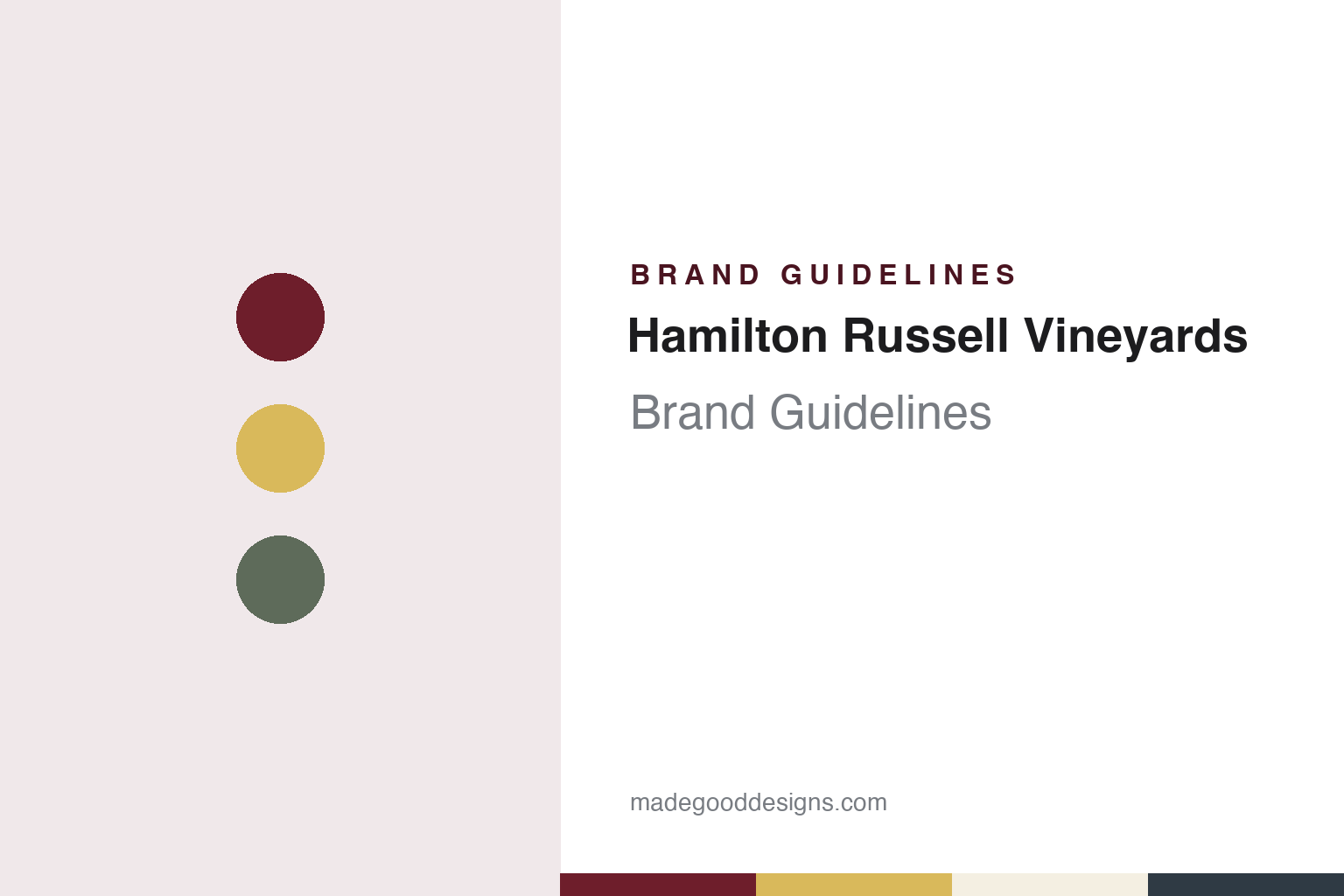
Hamilton Russell Vineyards Brand Guidelines
Pinot Noir and Chardonnay from a valley behind Hermanus.
Aa
Two constants: a Pinot garnet, Chardonnay straw and fynbos sage palette and a classical book serif register. Abstract homage — not a Hamilton Russell Vineyards product or mark; no label, logo or bottle is reproduced.
An advertising man’s search for a cool site
From a farm called Braemar to a two-wine estate.
Hamilton Russell Vineyards is a wine estate in the Hemel-en-Aarde Valley, the “heaven and earth” valley that runs inland from the old fishing town of Hermanus on Walker Bay, on South Africa’s southern Cape coast. Its story begins with an advertising executive. The Drinks Business reported in March 2025 that on 27 February 1975 Tim Hamilton Russell, then an ad-agency owner, bought a farm of about 170 hectares called Braemar in the valley; Wine Spectator wrote in 2013 that he was chairman of the agency J. Walter Thompson when he invested in the undeveloped land near Hermanus, and that he planted the first vines in the Hemel-en-Aarde Valley. The estate says he chose the site after a long search for the most southerly place on which to make cool-climate wine in South Africa.
The early years were not straightforward. Production in South Africa was then governed by quotas, and Wine Spectator’s James Molesworth wrote in February 2013 that the first vintages were made in a “slightly clandestine manner” from fruit grown on what became the estate’s vineyards; he gave 1979 as the year Tim Hamilton Russell founded the winery, while the estate itself counts from the 1975 land purchase. Wine Spectator reported that the first Hamilton Russell Vineyards wine, a 1981 Pinot Noir, was released in 1982. The same magazine recorded that in 1989 Tim Hamilton Russell and four other Cape winemakers formed the Cape Winelands Commitment, which rejected apartheid and set out better employment practices on farms.
The handover came at the start of the 1990s. Wine Spectator reported that Tim Hamilton Russell retired in 1991 and that his son Anthony Hamilton Russell took over the management of the winery and later became its owner; the estate says Anthony took over in 1991 and bought the business in 1994. Wine Spectator reported in August 2013 that Tim Hamilton Russell had died in Hermanus on 17 July that year. In its fiftieth year, 2025, The Drinks Business described Anthony Hamilton Russell as the owner of Hamilton Russell Vineyards.
Colour
Two grapes, one soil and a valley name on the label.
The estate’s identity rests on narrowing rather than adding. The estate says that under Anthony Hamilton Russell the range was cut to Pinot Noir and Chardonnay only, and that Hamilton Russell Vineyards was registered as an estate, committing it to work only with grapes from its own land. The Drinks Business reported in 2025 that it was during the 1990s that the winery narrowed its focus to the two Burgundian varieties and carried out the research that identified the best ground for them. The estate says soil work begun in 1994 picked out 52 hectares of stony, clay-rich, shale-derived soil, and that all plantings are now limited to it.
That 52-hectare vineyard is described, in a borrowed Burgundian word, as a monopole. The Drinks Business reported that it is made up of 10 Pinot Noir and 18 Chardonnay parcels that are vinified separately where possible, and quoted Anthony Hamilton Russell describing shale-derived soils of 35 to 55 per cent clay with a high iron content, “but sadly no limestone.” The estate puts its philosophy in his words: it is not so much using the land to make Pinot Noir and Chardonnay as using the two grapes to express the personality of the place. In the same 2025 interview he said that Burgundy comparisons are “given to us” and that he had stopped trying to avoid them.
Where the wine is made is part of that promise. The estate says its Pinot Noir and Chardonnay are estate grown, and Wine Spectator placed the winery in the Hemel-en-Aarde Valley ward, on clay and shale soils, in 2013. The estate says it is one of the most southerly wine estates in Africa and one of the closest to the sea. Molesworth reported that the Walker Bay area was reorganised into a larger district divided into more detailed wards, a change he said Anthony Hamilton Russell had led.
The cellar has passed through several hands. Wine Spectator listed three winemakers up to 2013: Peter Finlayson, who went on to found Bouchard Finlayson; Kevin Grant, later of Ataraxia; and Hannes Storm, at the estate since 2000. The estate now names Emul Ross as winemaker and Johan Montgomery as viticulturist, and The Drinks Business reported in 2025 on a recent revamp of the winery and on barrels made for the estate by the French cooper François Frères.
Typography
Design and documentation.
The seven brands in this group are all South African wine estates: Kanonkop, Meerlust, Sadie Family Wines, Boekenhoutskloof, Klein Constantia, Vergelegen and Hamilton Russell Vineyards. Wine estates in general sit at many different points in the trade, from family farms that still carry a founder’s name to properties that now belong to investors or much larger drinks groups, and a single estate’s wine can be sold everywhere from a cellar-door shop to a restaurant list.
A wine estate’s identity is usually carried less by a single bottle than by a label, a name and the place it promises, because the people behind the name may have changed, the farm may have changed hands, and the wine may be made from grapes grown well beyond the estate’s own boundary. That makes the questions behind each name worth asking plainly: who started it, who owns it now, and where its wine is actually grown, made and bottled.
Each guide separates what independent sources record from what the estate says about itself — its founding story, its owners over time, where its wine is made and how its labels have changed — and marks plainly what rests only on the estate’s own word.
Aa
A classical book serif for a family name and a place. (Specimen set in Cormorant Garamond, a serif STAND-IN; NOT the Hamilton Russell Vineyards logo.)
Hamilton Russell Vineyards
One estate, and the neighbouring labels around it.
The family name has spread beyond the two-wine estate, but under separate labels. The company says Anthony Hamilton Russell founded Southern Right in 1994 to make a serious, age-worthy Pinotage, and that in 2005 it bought a property of about 448 hectares on the western border of Hamilton Russell Vineyards as the label’s long-term home, with a cellar finished in time for the 2009 harvest. Southern Right makes only Pinotage and Sauvignon blanc and is named after the southern right whales that visit Walker Bay, about three kilometres from the vineyards. Ashbourne, on the estate’s eastern border, is a blend specialist built on Pinotage and Sauvignon blanc; Wine Spectator reported in 2013 that Hamilton Russell owns and runs Southern Right separately and that Ashbourne’s first red vintage was 2001. The estate also sells olive oil and fynbos honey.
The name has also crossed to the United States. The Eola-Amity Hills winegrowers’ association says Hamilton Russell Oregon, which makes single-vineyard Willamette Valley Pinot Noir and Chardonnay, is owned and operated by Olive Hamilton Russell, who co-managed the three South African wineries for two decades, and that its first vintages were made at a custom-crush facility outside McMinnville with Emul Ross consulting.
The Drinks Business reported in 2025 that Hamilton Russell Vineyards is represented in the United Kingdom by Mentzendorff. It also reported that the estate’s flagship Chardonnay has been served to Nelson Mandela at Buckingham Palace.
The name needs a little care online. Hamilton is also the name of an unrelated watch brand, and the estate’s own site is hamiltonrussellvineyards.com.
For a design guide, Hamilton Russell Vineyards shows how a family name, a valley and a deliberately short list of two grapes can carry an estate for half a century while the family’s Pinotage, Sauvignon blanc and Oregon wines sit under names of their own. Compare Kanonkop, the Stellenbosch estate, and Nederburg, the Paarl wine farm. For this guide we use Pinot garnet, Chardonnay straw and fynbos sage with a serif, an unofficial interpretation; no product or logo is reproduced.
Explore & save
Keep Hamilton Russell Vineyards’s identity on hand — save it to a board in the Made Good inspiration library.
Hamilton Russell Vineyards identity set
Pin the Hamilton Russell Vineyards Pinot garnet, Chardonnay straw and fynbos sage palette and the classical book serif register to your own board.