Ramos Pinto Brand Guidelines
The 1880 port house of the Belle Époque posters.
Aa
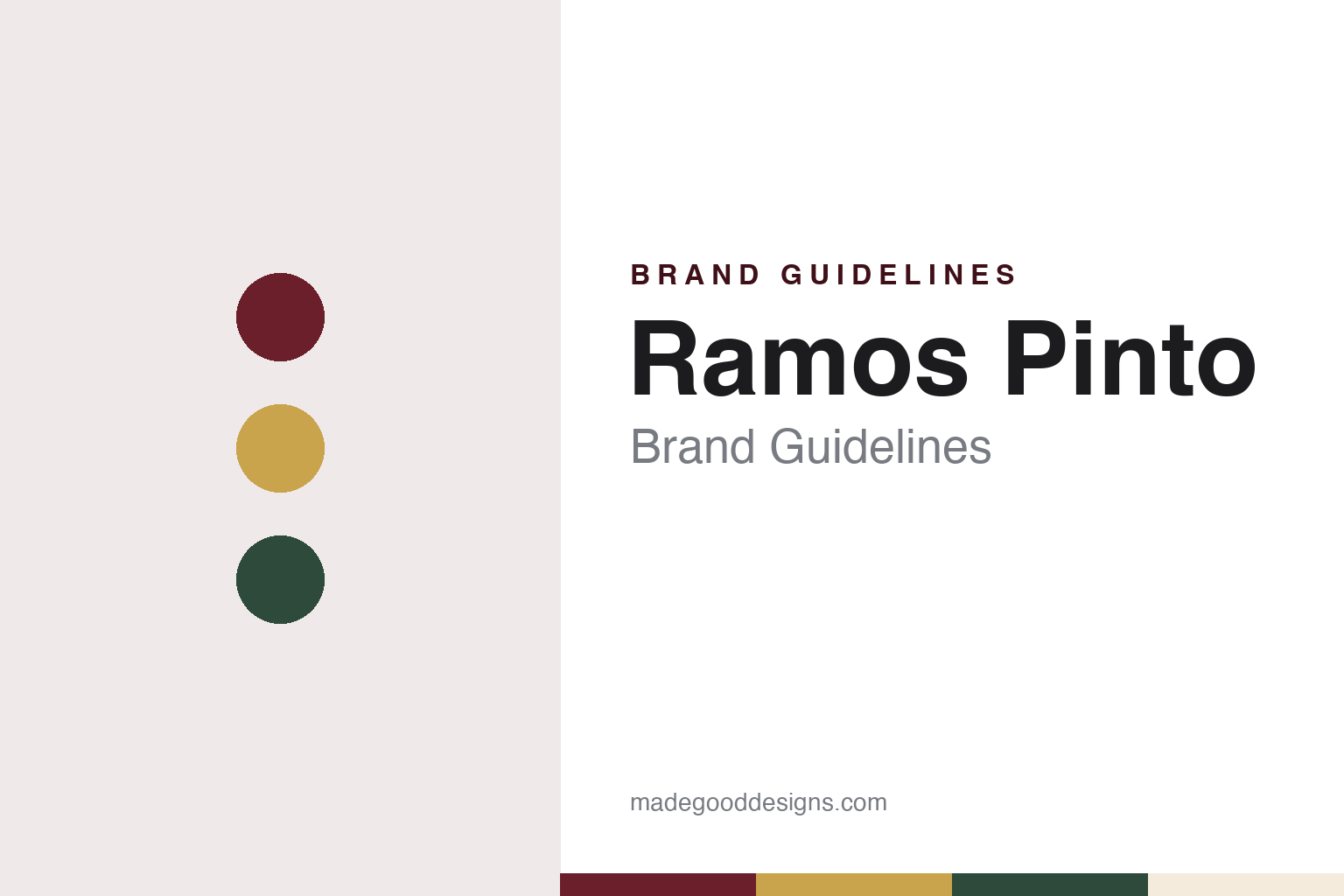
Two constants: a port red, poster gold and lodge green palette and a Belle Époque serif register. Abstract homage — not a Ramos Pinto product or mark; no poster, label, logo or bottle is reproduced.
Adriano’s house
Two brothers, a tawny called “Adriano” and the Brazilian trade.
Ramos Pinto was founded in 1880 in Vila Nova de Gaia, the port-lodge town across the Douro from Porto, by Adriano Ramos Pinto and his brother António. The brothers are named as joint founders by the port reference site vintageport.se and by LEADERS magazine, which in January 2024 published an interview with the company’s chief executive, Jorge Rosas, who describes Adriano as his great-grandfather. Roy Hersh’s profile on For the Love of Port gives a slightly different order of events: Adriano set the firm up and his brother, who owned a photography studio, joined some eighteen years later to help run it.
Hersh writes that the first wines were simply called “Adriano” and were tawny ports, and that the house built its early trade on Brazil and South America, where within two decades it controlled half of all the port sold on that continent. Adriano’s name still appears on the house’s bottles, and Hersh calls its tawny ports the house’s strong suit. Its first vintage port came later: vintageport.se dates it to 1917, while Hersh gives 1924.
The house added vineyards in the first half of the twentieth century. vintageport.se says Quinta do Bom Retiro, near Pinhão in the Cima Corgo, was bought in 1919 and that the neighbouring Quinta da Urtiga was joined to it in 1933. The Brazilian trade that had built the firm collapsed in the 1920s, Hersh writes, and exports suffered for years afterwards.
Colour
Posters commissioned for a port.
The house’s advertising is the other half of its story. Hersh writes that Adriano, using his contacts, commissioned Portuguese artists and others across Europe to produce lithographic posters to promote the brand, from the late nineteenth century through the 1920s, and that he turned work down when he did not like it. The images often showed Bacchus and young nymphs raising glasses of the house’s port; Hersh calls them avant-garde and often risqué, and says they made the brand well known in society and in the press.
The posters are now the house’s own archive. In the 2024 LEADERS interview Jorge Rosas describes two company museums: the Casa Adriano Ramos Pinto museum at the headquarters in Gaia, which holds an extensive collection of advertising posters and memorabilia from the late nineteenth to the early twentieth century, and a second museum at Quinta de Ervamoira. vintageport.se describes the Gaia collection as one of original posters by well-known artists of the 1920s.
The second museum belongs to a later chapter. vintageport.se says the estate now called Ervamoira was to have been named Quinta de Santa Maria, but that name was already used by Cockburn’s, so the family took the name of a novel by the French writer Suzanne Chantal, with her permission; Hersh dates the purchase to 1974. Rosas says the Sítio de Ervamoira museum, in the Côa Valley, a UNESCO World Heritage Site, presents the region’s Roman remains and its Palaeolithic rock engravings, which he says helped save the estate from disappearing. The house also owns Quinta dos Bons Ares in the Douro Superior, bought in 1985 according to vintageport.se and in 1989 according to Hersh.
Typography
Design and documentation.
The seven brands in this group are all sherry and port houses: Lustau, Hidalgo La Gitana, Fonseca, Quinta do Noval, Niepoort, Ramos Pinto and Warre’s. Sherry and port houses in general sit at many different points in the trade, from family houses that still carry a founder’s name to houses that now belong to much larger drinks or insurance groups, and a single name can be sold everywhere from a corner shop to a restaurant list.
A sherry or port house’s identity is usually carried less by a single bottle than by a label, a name and the place it promises, because the company behind the name may have changed hands, moved its production or grown far beyond the place where it started. That makes the questions behind each name worth asking plainly: who started it, who owns it now, and where its wine is actually made, aged and bottled.
Each guide separates what independent sources record from what the company says about itself — its founding story, its owners over time, where its wine is made and how its labels have changed — and marks plainly what rests only on the company’s own word.
Aa
A Belle Époque serif for a poster-era house. (Specimen set in Cormorant Garamond, a serif STAND-IN; NOT the Ramos Pinto logo.)
Ramos Pinto
A Champagne owner and a family at the helm.
The family sold the business in 1990. Hersh writes that ownership had become split among more than forty family members, and that in 1990 they sold the port house to the Champagne house Louis Roederer; vintageport.se says Roederer has been the majority shareholder since 1990, and LEADERS gives the same year for its acquisition by Maison Louis Roederer. When Decanter reported in February 2006 that Jean-Claude Rouzaud had handed control of Roederer to his son Frédéric, it listed the port producer Ramos Pinto among the group’s properties alongside Champagne Deutz, Roederer Estate in California and Domaines Ott in Provence. Rosas says the house is still run independently.
The family stayed in charge of the wine. Hersh writes that José Ramos-Pinto Rosas was the house’s chairman and its winemaker for more than fifty years, and that his nephew João Nicolau de Almeida joined in 1976; LEADERS credits the two with a technical study of Douro grape varieties and with introducing partially mechanised vertical planting. The magazine says Jorge Rosas joined the commercial department in 1986, became a director in 2014 and took over when his cousin João Nicolau de Almeida retired in 2016.
Roederer’s arrival also changed what the house makes. Rosas says the 1990 integration pushed forward a project that began with viticultural research in 1976 and led to red and white Douro table wines, including the brand Duas Quintas, and more recently to single-estate Douro wines from Ervamoira and Urtiga. The wine comes from the house’s four Douro estates, which LEADERS puts at 890 acres, and Rosas says the company stopped using herbicides in 2010.
For a design guide, Ramos Pinto shows how a house’s advertising can outlast the campaigns it was made for and become the brand’s own museum. Compare Sandeman, another port house remembered for a poster figure, and Louis Roederer, its Champagne owner. For this guide we use port red, poster gold and lodge green with a serif, an unofficial interpretation; no product or logo is reproduced.
Explore & save
Keep Ramos Pinto’s identity on hand — save it to a board in the Made Good inspiration library.
Ramos Pinto identity set
Pin the Ramos Pinto port red, poster gold and lodge green palette and the Belle Époque serif register to your own board.