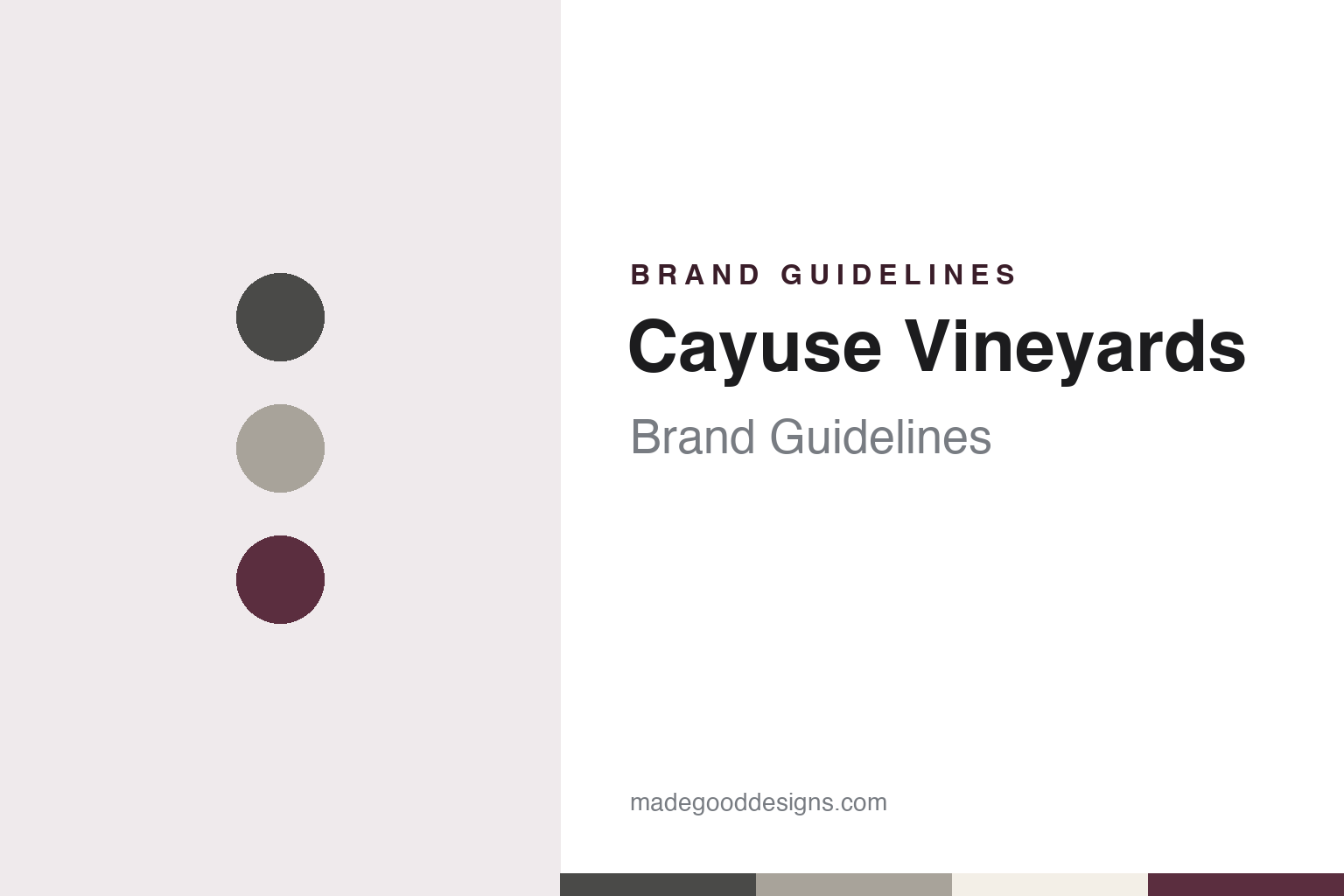
Cayuse Vineyards Brand Guidelines
Christophe Baron’s stones of Walla Walla, planted 1997.
Aa
Two constants: a basalt, cobble grey and Syrah plum palette and an old-style serif register. Abstract homage — not a Cayuse Vineyards product or mark; no label, logo or bottle is reproduced.
A field of stones on the Oregon side
A Champagne grower’s son who came for Pinot Noir and stayed for Syrah.
Cayuse Vineyards is the Walla Walla Valley estate of Christophe Baron, a vigneron born in the Champagne region of France. Wine Spectator profiled him in October 2016 as “the Champagne native” who found a singular terroir in the Pacific Northwest, and the company says he grew up among the vineyards of his family’s Champagne house, Baron Albert, which it says has grown grapes in the Marne Valley since 1677. The company says he trained in Champagne and Burgundy and that an internship first brought him to the Walla Walla Valley in 1993, after which he worked in Australia, New Zealand, Romania and Oregon; Seattle Met reported the same Australian, New Zealand and Romanian stints in 2018.
His plan was the Willamette Valley and Pinot Noir. W. Blake Gray wrote in The Gray Report in February 2015 that Baron found the area in 1996 while driving from Walla Walla to the Willamette Valley, where he hoped to buy land for Pinot Noir; instead he saw a field covered in stones and changed course to plant Syrah. The company tells the same story, dating the sighting to an April morning in 1996 on the Oregon side of the valley, and says the stones reminded him of the rolled cobbles of Châteauneuf-du-Pape in the southern Rhône.
The company says Baron bought the land and planted his first vineyard on 21 March 1997; Seattle Met described the area as orchard country when he planted his first vines that year, and Wine Spectator reported in 2016 that the estate had grown to nearly 45 acres from an original five. The first site, which the company calls the Cailloux Vineyard, gave its name to the flagship Syrah. According to the company’s list of wines, the Syrah first bottled as Cobblestone Vineyard in 1998 was renamed Cailloux in 1999, and the range grew to include Bionic Frog Syrah, God Only Knows Grenache, Impulsivo Tempranillo and Widowmaker Cabernet Sauvignon. The company says all Cayuse wines are made from estate fruit, from five vineyards of a little more than 47 acres, with Syrah the dominant grape.
Colour
A name that means stones, and an address on the wrong side of the state line.
The name is itself a description of the ground. The company says Baron named the venture after a Native American people whose name came from the French word “cailloux”, meaning stones. English Wikipedia’s article on the Cayuse people, citing a 2013 University of Oklahoma Press guide by Ruby, Brown and Collins, gives the same derivation, from French Canadian trappers, and notes that the Cayuse called themselves the Liksiyu and are today part of a confederated tribe on the Umatilla Reservation. The French word runs through the estate: the first vineyard is Cailloux, and Seattle Met reported in 2018 that at Cayuse “the word you have to use is stones.”
Where the wine is made is the part of the story most often misread. Gray wrote in 2015 that readers might assume Cayuse was in Washington because its mailing address is there, but that it is not: the vineyards lie on the Oregon side of the Walla Walla Valley, and Cayuse has its winery inside what became The Rocks District of Milton-Freewater. English Wikipedia says that appellation lies entirely within the Oregon part of the Walla Walla Valley AVA, was proposed by the geologist Kevin Pogue, was published for comment in the Federal Register in February 2014 and was established in February 2015. Because federal rules require wine to be finished in the state where such an appellation lies, only Oregon wineries may use the name on their labels, and English Wikipedia, citing a 2013 report, lists Cayuse among the few that qualify.
Farming is the other constant. The company says the vineyards were farmed organically from the start and that in 2002 Cayuse became the first domaine in the Walla Walla Valley to farm biodynamically; the home page of its parent site says biodynamic practices have been used across the estate since the 2005 vintage.
Typography
Design and documentation.
The seven brands in this group are all Oregon and Washington wineries: Domaine Serene, Cristom, Bergström, The Eyrie Vineyards, Leonetti Cellar, Quilceda Creek and Cayuse Vineyards. Wineries in general sit at many different points in the trade, from family estates that still carry a founder’s name to labels that now belong to much larger drinks groups, and a single wine can be sold everywhere from a mailing list to a restaurant list.
A winery’s identity is usually carried less by a single bottle than by a label, a name and the place it promises, because the company behind the name may have changed hands, moved its production or grown far beyond the place where it started. That makes the questions behind each name worth asking plainly: who started it, who owns it now, and where its wine is actually grown, made and bottled.
Each guide separates what independent sources record from what the company says about itself — its founding story, its owners over time, where its wine is made and how its labels have changed — and marks plainly what rests only on the company’s own word.
Aa
An old-style serif for a domaine named after stones. (Specimen set in Cormorant Garamond, a serif STAND-IN; NOT the Cayuse Vineyards logo.)
Cayuse Vineyards
One domaine, and the family of labels that grew around it.
Cayuse is no longer Baron’s only label. Wine Spectator reported in 2016 that he also made the No Girls and Horsepower wines, and Seattle Met reported in 2018 on his Hors Catégorie Syrah, from what that label’s site calls the first vineyard planted, in 2011, on the steep slope along the North Fork of the Walla Walla River. The company now groups the labels under Bionic Wines, which it describes as the umbrella for five brands: Cayuse Vineyards, No Girls Wines, Horsepower Vineyards, Hors Catégorie Vineyards and Champagne Christophe Baron, a Pinot Meunier project from four vineyards in the Marne Valley.
The founder is still at the centre of the business. In August 2024 the Auction of Washington Wines named Baron its honorary vintner, with the Northwest Wine Report describing him as “Vigneron Christophe Baron of Bionic Wines” and Wine Spectator reporting the TOAST! awards at Sparkman Cellars on 8 August 2024. The company says Cayuse wines are sold through a mailing list that is currently full, with a waiting list for new names. Other wineries also draw on the same ground: Gray reported in 2015 that Leonetti was among those buying grapes from the district.
The name needs care online. Cayuse is also the name of the Native American people it comes from and of the Cayuse pony they bred; the winery’s own site is cayusevineyards.com.
For a design guide, Cayuse Vineyards shows how a single word for stones, a field of basalt cobbles and a founder’s story can carry a small estate’s identity. Compare Leonetti Cellar, the Walla Walla winery, and Chateau Ste. Michelle, the Washington winery in Woodinville. For this guide we use basalt, cobble grey and Syrah plum with a serif, an unofficial interpretation; no product or logo is reproduced.
Explore & save
Keep Cayuse Vineyards’s identity on hand — save it to a board in the Made Good inspiration library.
Cayuse Vineyards identity set
Pin the Cayuse Vineyards basalt, cobble grey and Syrah plum palette and the old-style serif register to your own board.


