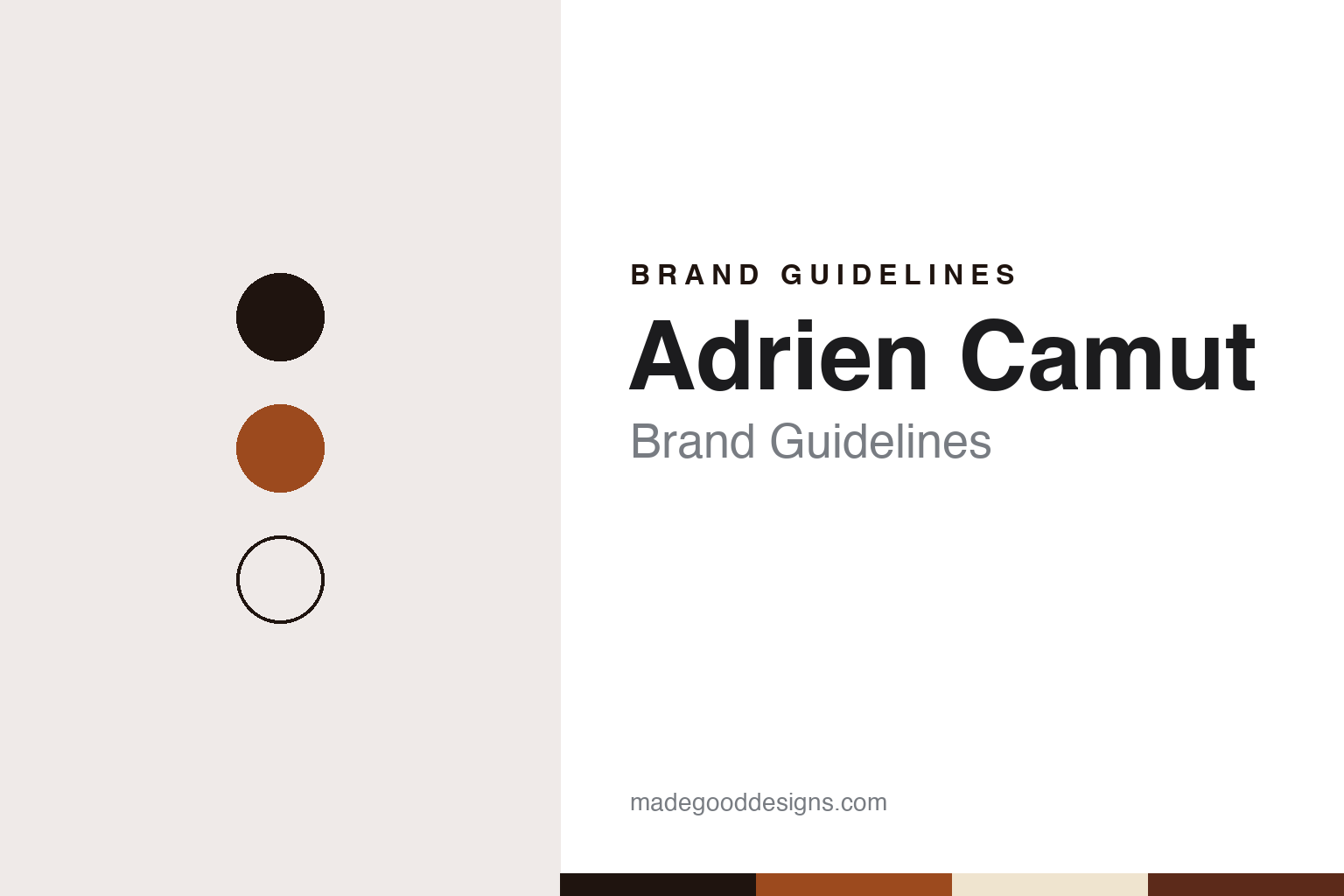
Adrien Camut Brand Guidelines
The Camut family’s long-aged Calvados from Semainville.
Aa
Two constants: an old Calvados, russet and farmhouse cream palette and an old-style serif register. Abstract homage — not an Adrien Camut product or mark; no label, logo or bottle is reproduced.
Gustave, Adrien and Claude
A farm on the edge of the Pays d’Auge.
Calvados Adrien Camut comes from the family estate at La Lande-Saint-Léger, a village that French Wikipedia places in the Eure department, on its border with Calvados. The commune was formed in the 1960s by joining La Lande and Saint-Léger-sur-Bonneville, and its coat of arms carries apples for the cider and Calvados made there. The estate’s old name, Domaine de Semainville, survives on the bottles: the British merchant Fareham Wine Cellar says the Réserve Semainville blend is named in honour of it. Skurnik, the family’s American importer, places the domaine at the gateway to the Pays d’Auge.
Accounts of how far back the family goes differ. Skurnik says the Camuts have made Calvados at Semainville for seven generations, and the writer Thad Vogler, in his 2017 book By the Smoke and the Smell, wrote that the family had been making Calvados since the 1800s. David Driscoll of the Californian retailer K&L Wines wrote in December 2015 that Gustave Camut built the estate in 1900 and that brandy had been distilled there ever since.
The name on the label is that of Gustave’s son, Adrien Camut. Driscoll wrote that Adrien improved the domaine’s equipment and distilling, that he had once sold a popular cider under the name “Le Père Camut,” and that he later gave up cider altogether to concentrate on Calvados, travelling to restaurants and shops to promote it and pressing for higher standards across the region. Fareham Wine Cellar says it was Adrien who perfected the family’s distillation methods, and Skurnik credits him with designing six stills.
The estate then passed down two more generations. According to Driscoll, Adrien handed the business to his son Claude Camut, who in turn passed it to his children.
Colour
Fallen apples, a wood fire and very old casks.
The Camut method is described most fully by visitors. Driscoll wrote in 2015 that the orchards are entirely high-stem trees, grazed by animals that keep down the weeds and feed the soil, and that all of the fruit goes into Calvados rather than cider for sale. Fareham Wine Cellar puts the planting at about 4,000 trees and says the family uses at least 25 apple varieties, among them Bedan, Bisquet and Fréquin Rouge.
Vogler, whose visit was published by Punch in September 2017, described apples gathered from the ground and made into a naturally fermented cider, then distilled in a brick-encased pot still about a century old; the only thing added at any stage, he wrote, is fire. Skurnik also calls the stills firewood-heated. Driscoll wrote that the still in use was the one Adrien built in 1950, while Fareham says the domaine has several pot stills, the oldest from the 1920s and the newest from 1975. Vogler noted that the family maintains all of its own equipment, in a property that includes a Napoleonic farmhouse and eighteenth-century buildings with cellars and a stillroom.
Age is the house signature. Driscoll wrote that the brandies rest in large wooden casks, many of them coopered before the First World War, and Vogler described tasting casks thirty to seventy years old with the family, and sharing over dinner a bottled blend whose brandies averaged about thirty-five years. Its long-aged bottlings include the Réserve Semainville, a blend sold as 25 years old, Fareham Wine Cellar says.
Typography
Design and documentation.
The seven brands in this group are all calvados and fruit-spirit names: Roger Groult, Adrien Camut, Massenez, Schladerer, Reisetbauer, Capovilla and Clear Creek. Calvados and fruit-spirit distillers in general sit at many different points in the trade, from family houses that still carry a founder’s name to labels that now belong to much larger drinks groups, and a single brand can be sold everywhere from a corner shop to a restaurant list.
A calvados or fruit-spirit brand’s identity is usually carried less by a single bottle than by a label, a name and the place it promises, because the company behind the name may have changed hands, moved its production or grown far beyond the place where it started. That makes the questions behind each name worth asking plainly: who started it, who owns it now, and where its spirits are actually distilled and bottled.
Each guide separates what independent sources record from what the company says about itself — its founding story, its owners over time, where its spirits are made and how its labels have changed — and marks plainly what rests only on the company’s own word.
Aa
An old-style serif for a grandfather’s name on a farm brandy. (Specimen set in Libre Caslon Text, a serif STAND-IN; NOT the Adrien Camut logo.)
Adrien Camut
Three brothers and a grandfather’s name.
The estate remains in the family. Driscoll named the three brothers who run it as Emmanuel, Jean-Michel and Jean-Gabriel Camut, and wrote that Jean-Gabriel still sorts the apples by hand. Skurnik also describes three brothers running Calvados Adrien Camut, and calls Emmanuel the most outspoken of them.
Emmanuel has built side projects around the family stills. Skurnik says he reduces apple must over a wood stove and ages it in barrels as a vinegar in the balsamic style, drawn from a solera; makes a pommeau-style aperitif called Ambrosia; and has run beer and molasses through the Camut stills to make a whisky and a rum. It adds that he is building a new distillery, EC Distillery, to house two of the stills his grandfather designed. Of the six, Skurnik says, four had been sold to other properties; Emmanuel bought two of those back, and one of the others no longer exists. The importer says the vinegar was aged for twelve years before he began to sell it. Driscoll also mentioned beekeeping. None of this changes the Calvados itself, which is still made, aged and bottled under Adrien’s name.
Other Calvados names in this library offer a comparison. Père Magloire and Boulard are long-established brands, while Christian Drouin and Roger Groult are family estates that, like the Camuts, carry a founder’s name.
For a design guide, Adrien Camut shows how a grandfather’s name and an estate’s old title can do the work of a brand — a farm, a fire and casks older than the people tending them. Compare Roger Groult and Christian Drouin. For this guide we use old Calvados, russet, pasture green and farmhouse cream with an old-style serif, an unofficial interpretation; no product or logo is reproduced.
Explore & save
Keep Adrien Camut’s identity on hand — save it to a board in the Made Good inspiration library.
Adrien Camut identity set
Pin the Adrien Camut old Calvados, russet and farmhouse cream palette and the old-style serif register to your own board.