Boulard Brand Guidelines
A Pays d’Auge calvados house since 1825.
Aa
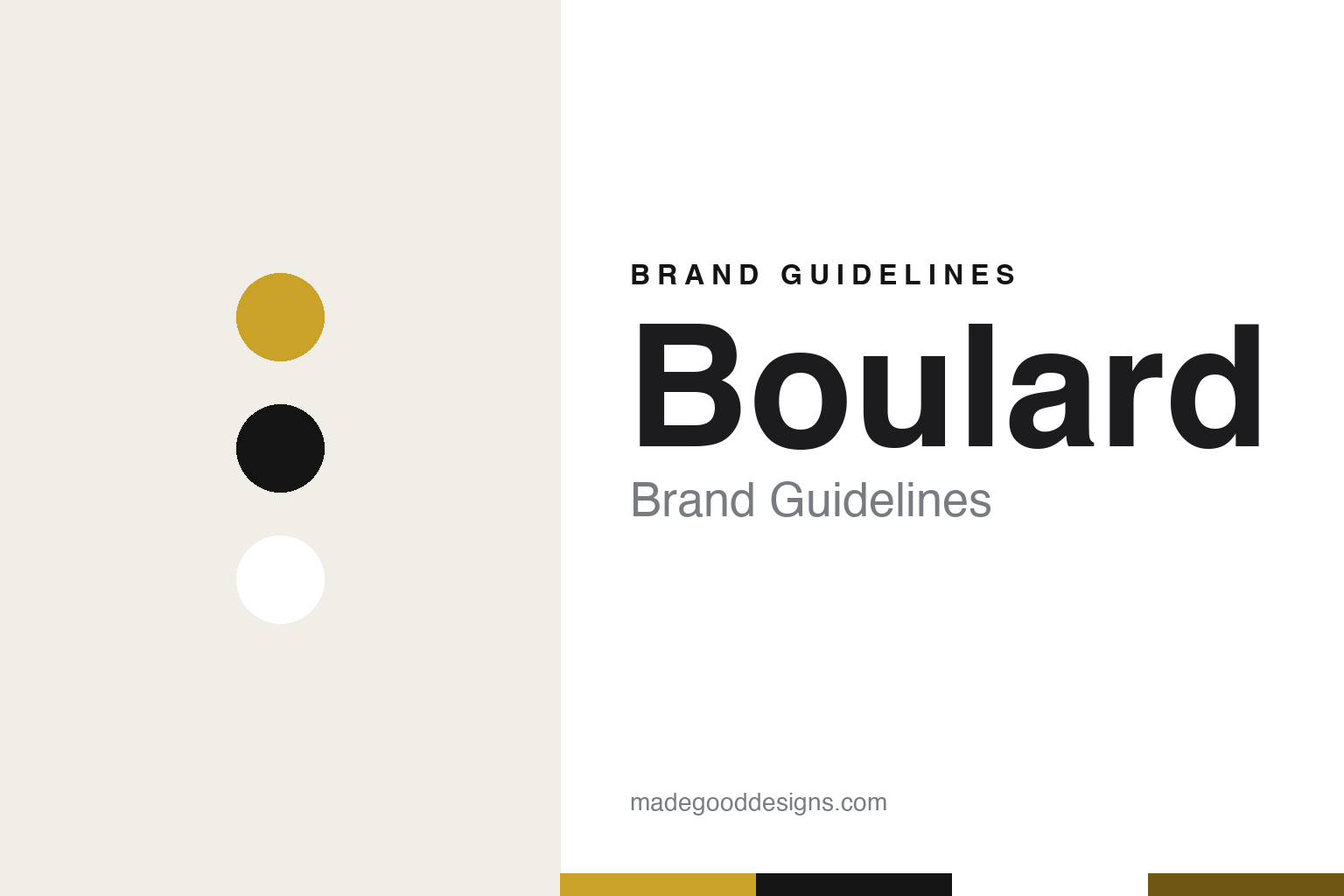
Two constants: a calvados gold, matte black and square white palette and a high-contrast Didone serif register. Abstract homage — not a Boulard product or mark; no label, logo or bottle is reproduced.
Pierre-Auguste Boulard
An apple brandy house in the Pays d’Auge.
Boulard is a calvados house in the Pays d’Auge, in Normandy. The company says it was founded in 1825 by Pierre-Auguste Boulard, who set up his distillery in the Pays d’Auge, and that four generations followed him. Its family tree names his son Gustave, his grandson Lucien, his great-grandson Pierre and his great-great-grandson Vincent Boulard; Le Journal des Entreprises described Vincent Boulard in 2016 as a spokesman for the group that now owns the house.
The distillery stands at Coquainvilliers, in the Pays d’Auge. The regional tourist board lists it as a working distillery open for technical visits, covering double distillation and the ageing cellars and ending with a tasting. The company says the site holds one of the oldest pot-still distilleries in the region and four ageing cellars.
Double distillation is the house’s founding claim. The company says Boulard adopted double distillation for all its calvados from the start, and that the family campaigned for the method to be tied to a protected appellation, which came in 1942 with the creation of the appellation Calvados Pays d’Auge. The company also says the 1942 appellation was created on the family’s initiative. Its press release of January 2025 called Boulard a pioneer of double distillation in the Pays d’Auge.
Export came early. The company says Boulard was sold across Europe and Africa in the 1930s, and that in 1947 it shipped its first cases to the United States, Canada and Scandinavia, with Japan soon after. North America, Scandinavia and Japan are still among its key markets, Spirit France’s chief executive told Drinks Intel in 2025, with France taking less than a fifth of the group’s sales.
Colour
A white square, a gold liquid and a black neck.
The house’s visual signature is a simple shape. When Boulard unveiled new packaging on 24 January 2025, at the start of its 200th year, its press release described the white branded square as the Boulard emblem since the 1970s, and said the redesign kept and enlarged it together with a prominent use of gold.
The same release explained the other choices. A matte black neck recalls the frosted bottles the house once used and sets off the golden colour of the calvados, and a refined colour palette now distinguishes each expression in the range. Serge Der Sahaguian, chief executive of Spirit France Diffusion, said in the release that the group was proud to introduce the new packaging to mark the brand’s 200th anniversary. The release did not name a design agency. The trade site Packaging Gateway reported the redesign on 27 January 2025.
The anniversary had a bottle of its own. Drinks Intel reported in 2025 that the house released a limited 200th Anniversary Cuvée, an 18-year-old Calvados Pays d’Auge, in an edition of 7,000 bottles, and that it won a silver medal at the 2025 San Francisco World Spirits Competition.
Experiment has also become part of the brand. In 2018, the company says, Boulard launched the 12-Barrel Collection, a series of calvados blends finished in casks that had held other drinks, which its current range lists as including bourbon, rye whiskey, wheat whiskey, rhum agricole and Japanese Mizunara oak. The core range runs from Grand Solage through VSOP and XO. The company says it uses French oak casks that mix fine-grained and medium-grained staves, and names Sylvain Pluchard as cellar master since 2020.
Typography
Design and documentation.
The seven brands in this group are all whisky, gin, grappa, calvados and rosé names: Tomatin, Jura, Edinburgh Gin, Roku, Poli, Boulard and Minuty. Spirits and wine brands in general sit at many different points in the trade, from family houses that still carry a founder’s name to labels that now belong to much larger drinks groups, and a single brand can be sold everywhere from a corner shop to a restaurant list.
A spirit or wine brand’s identity is usually carried less by a single bottle than by a label, a name and the place it promises, because the company behind the name may have changed hands, moved its production or grown far beyond the place where it started. That makes the questions behind each name worth asking plainly: who started it, who owns it now, and where its spirit or wine is actually made and bottled.
Each guide separates what independent sources record from what the company says about itself — its founding story, its owners over time, where its spirit or wine is made and how its labels have changed — and marks plainly what rests only on the company’s own word.
Aa
A high-contrast Didone serif for a family name in a white square. (Specimen set in Bodoni Moda, a serif STAND-IN; NOT the Boulard logo.)
Boulard
A family house inside a Normandy spirits group.
Boulard no longer stands alone. Spirit France’s chief executive told Drinks Intel in 2025 that the group was formed in the 1990s when two Normandy families combined their houses, the Boulards with Calvados Boulard and the Pellerin family with Calvados Lecompte, with the shared aim of buying Père Magloire from Veuve Clicquot, and that the founding families later sold the group. Boulard’s own history page records the alliance with the Pellerin family and the house’s place in Spirit France.
The group has since reached beyond calvados. Drinks International reported in October 2014 that Spirit France had bought a majority stake in the Armagnac house Janneau from the Giovinetti family, and listed the group’s brands as Père Magloire, Boulard, Lecompte and Armagnac Le Marque. Le Journal des Entreprises described Spirit France in March 2016 as a subsidiary of Spirit Capital, a Swiss investment company focused on wine and spirits. Calvados makes up about 70 per cent of the group’s sales, its chief executive told Drinks Intel in 2025, and he called Boulard the world’s best-selling calvados, a claim the company makes for itself. The house’s site lists Spirit France Diffusion, in Normandy, as its publisher.
The name needs a little care. Francis Boulard & Fille is an unrelated Champagne grower, and the calvados house’s own site is calvados-boulard.com.
For a design guide, Boulard shows how one constant mark, a white square held since the 1970s, can carry a two-hundred-year-old house through a change of owner and a full redesign. Compare Bénédictine, the liqueur from Fécamp on the Normandy coast, and Martell, the cognac house. For this guide we use calvados gold, matte black and square white with a serif, an unofficial interpretation; no product or logo is reproduced.
Explore & save
Keep Boulard’s identity on hand — save it to a board in the Made Good inspiration library.
Boulard identity set
Pin the Boulard calvados gold, matte black and square white palette and the high-contrast Didone serif register to your own board.