Château de Laubade Brand Guidelines
The Lesgourgues family’s Bas-Armagnac estate in Sorbets.
Aa
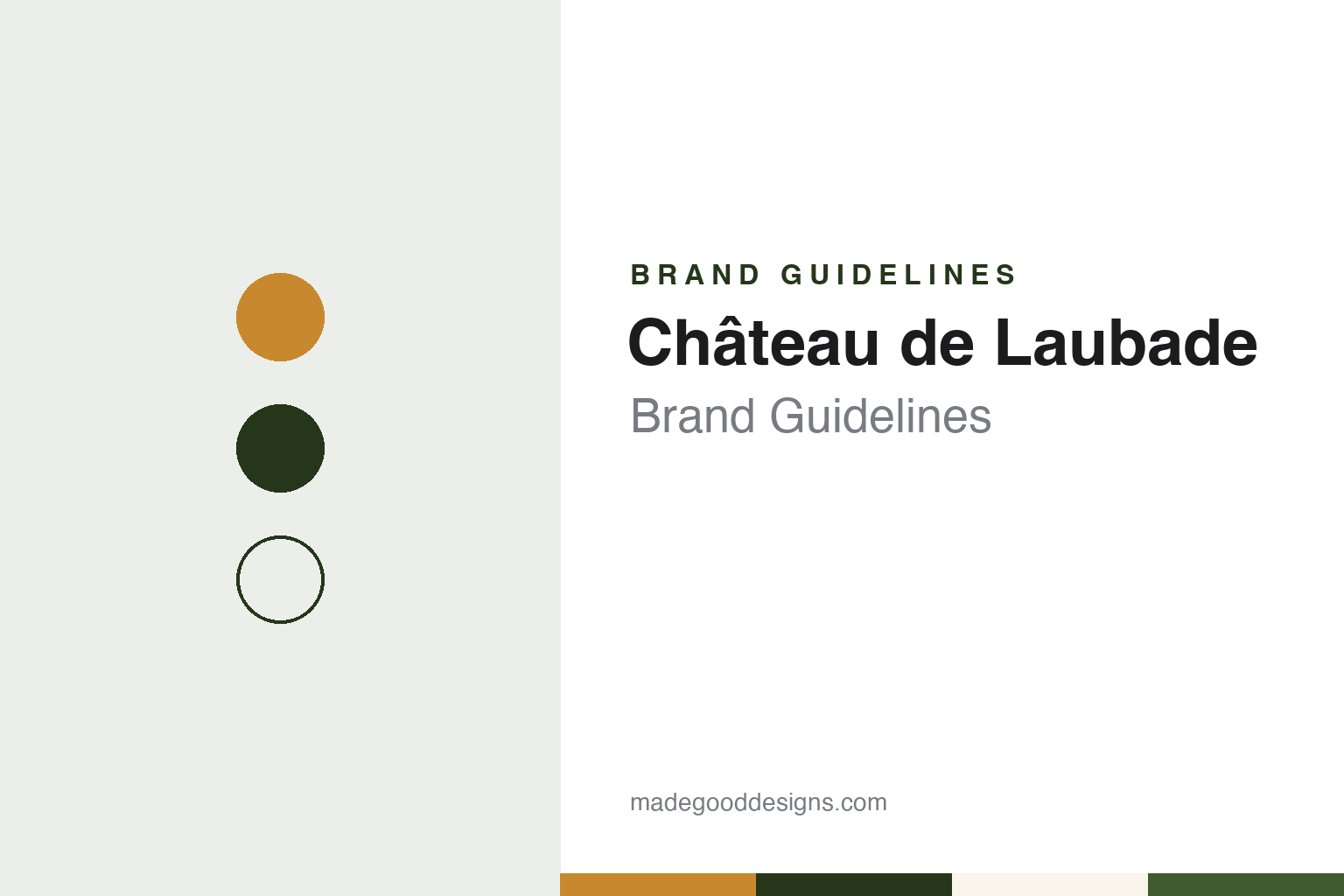
Two constants: a Gascon oak green, Bas-Armagnac gold and château stone palette and a high-contrast display serif register. Abstract homage — not a Château de Laubade product or mark; no label, logo or bottle is reproduced.
A diplomat’s house in the Gers
From a Belle Époque château to a family Armagnac estate.
Château de Laubade stands at Sorbets, in the Gers, in the Bas-Armagnac district of Gascony. The company dates the estate and its château to 1870 and describes it as an agricultural and wine-growing property in a single block around the house. It names as an early owner Joseph Noulens, together with his wife, the Paris couturière Jeanne Paquin. French Wikipedia describes Noulens as a politician and diplomat who was France’s ambassador at Petrograd during the Russian Revolution and mayor of Sorbets, and records Paquin’s second marriage, to him. The company says the couple gave the house much of its Belle Époque character.
The family that owns it now arrived a century later. Difford’s Guide, in a tasting note on the estate’s Extra, says Maurice Lesgourgues bought the property in 1974, and the family’s holding company, Famille Lesgourgues, says on its own site that the business was born that year. The château’s site says that in the 1970s Alice and Maurice Lesgourgues restored the house, and that Anne-Marie and Jean-Jacques Lesgourgues followed.
The holding company says that, succeeding Maurice and then Jean-Jacques, the third generation now runs the group. The estate’s site names Denis Lesgourgues, assisted by his sister Jeanne and his brother Arnaud. Famille Lesgourgues describes itself as a producer and distributor of wines and spirits, with five properties in Bordeaux and the south-west of France, a distribution business, Maison Léda, and the importer Baron Francois, which it says was founded in 1982 by Adrien Baron and has been a subsidiary since 2000.
The company says it is one of the first three Armagnac houses to receive the French state’s Entreprise du Patrimoine Vivant label, in 2015.
Colour
Its own vines, its own still and its own oak.
The company says it distils wine from its own vineyard on site. White wines made without added sulphites are distilled soon after fermentation in a single Armagnac-type column still, which the company says was custom-built in 1974. Each grape variety is distilled separately; the company says six are grown on the estate, among them Baco, Ugni Blanc, Folle Blanche and Colombard, and that it has worked to bring back local varieties including Baco and Plant de Graisse.
Wood is also local. The company says it selects and seasons staves from Gascon pedunculate oaks grown on the estate, has them made into barrels by local coopers, and ages its spirits by grape variety and vintage in nearly 3,000 barrels of 420 litres across nine cellars. It credits the long-ageing approach to Maurice Lesgourgues, and names François Laura as cellar master, tasting each batch with the family.
Those habits shape the labels. The company says every bottle and decanter is marked with its bottling date and batch number, and the range is organised around age and year: blends such as VSOP, XO and the Intemporel line, single-estate vintages including cask-strength bottlings, and an unaged Blanche Armagnac. Difford’s Guide notes a detail of the packaging: the tree shown on the bottle of the Extra stands for the first tree Maurice Lesgourgues planted after he bought the property.
The wine blog Les 5 du Vin reported in May 2022, in an interview with Denis Lesgourgues, that the family created its first Curiosités, small experimental bottlings, in 2018. The trade title Décision Boissons reported in April 2022 on XF, a Bas-Armagnac from a single cask with an extra-heavy toast, released in 943 bottles of 50 centilitres.
Typography
Design and documentation.
The seven brands in this group are all cognac and Armagnac names: Pierre Ferrand, Frapin, Darroze, Château de Laubade, Larressingle, Janneau and Tariquet. Cognac and Armagnac houses in general sit at many different points in the trade, from family estates that still carry a founder’s name to labels that now belong to much larger drinks groups, and a single brand can be sold everywhere from a corner shop to a restaurant list.
A cognac or Armagnac brand’s identity is usually carried less by a single bottle than by a label, a name and the place it promises, because the company behind the name may have changed hands, moved its production or grown far beyond the place where it started. That makes the questions behind each name worth asking plainly: who started it, who owns it now, and where its brandy is actually distilled, aged and bottled.
Each guide separates what independent sources record from what the company says about itself — its founding story, its owners over time, where its brandy is made and how its labels have changed — and marks plainly what rests only on the company’s own word.
Aa
A high-contrast display serif for a château name and a vintage year. (Specimen set in Playfair Display, a serif STAND-IN; NOT the Château de Laubade logo.)
Château de Laubade
An estate that treats art as part of the brand.
Laubade presents contemporary art as part of what the estate is. The company says young artists, most of them French, are invited to stay at the château and make permanent works — sculptures, installations and architecture — that respond to the land, and that visitors walk among them on tours that end with a tasting. The family also says it pursues its interest in art through Quasar Donation Lesgourgues, a collection of work from the artistic movement of the 1980s and 1990s, and the holding company lists contemporary art, under the word “Beauty,” as one of its values alongside tradition and innovation.
The estate describes its farming in the same register. The company says it keeps a flock of sheep for manure, grows cereals to improve the soil, keeps woods of Gascon oak and poplar, favours the disease-resistant Baco grape, and since 2025 has drawn much of its electricity from solar panels on the property. It says it holds ISO 9001 quality certification and has done so since 2008.
Its current website credits its design to the studio Lasuite Atelier, with photography by Miguel Ramos, Flavio Pagani and Mathieu Drouet. The brand is written Château de Laubade, and its site is chateaudelaubade.com.
For a design guide, Château de Laubade shows how a single estate can make a brand of continuity: one family, one still and one block of land, with every bottle dated and numbered. Compare Darroze, the Roquefort house that bottles other growers’ estates under their own names, and Tariquet, another family estate in the Gers. For this guide we use Gascon oak green, Bas-Armagnac gold and château stone with a serif, an unofficial interpretation; no product or logo is reproduced.
Explore & save
Keep Château de Laubade’s identity on hand — save it to a board in the Made Good inspiration library.
Château de Laubade identity set
Pin the Château de Laubade Gascon oak green, Bas-Armagnac gold and château stone palette and the high-contrast display serif register to your own board.