Silver Oak Brand Guidelines
The Duncan family’s American-oak Cabernet house, since 1972.
Aa
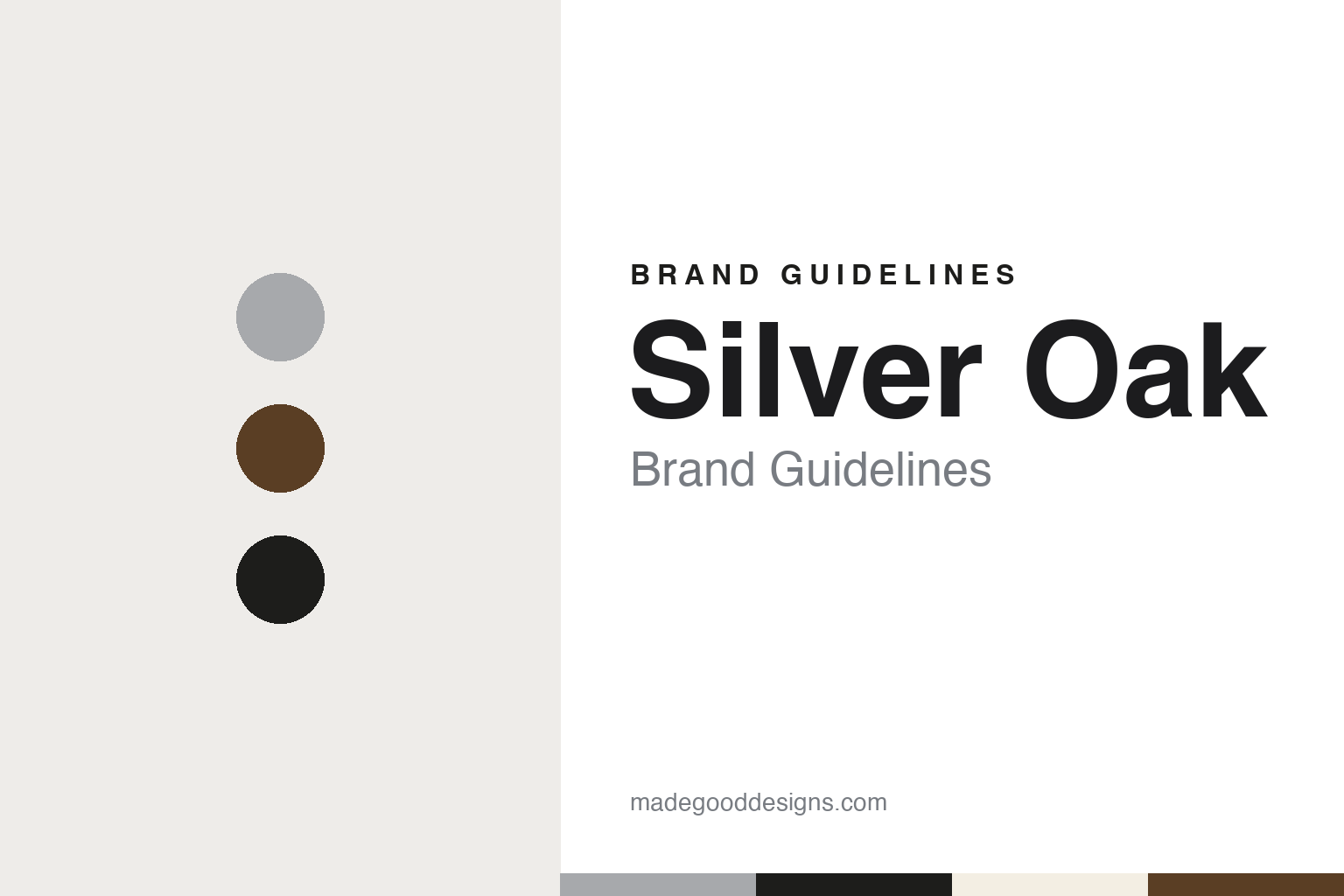
Two constants: a silver, oak brown and tower black palette and a bookish Caslon-style serif register. Abstract homage — not a Silver Oak product or mark; no label, logo or bottle is reproduced.
A handshake and a single grape
An oilman, a winemaker and a dairy farm in Oakville.
Silver Oak Cellars is a family-owned California winery founded in 1972 by Ray Duncan and Justin Meyer. The company describes its beginning as a handshake between two friends and one idea: to concentrate on a single variety, Cabernet Sauvignon, and do it exceptionally well. English Wikipedia, citing the company’s earlier history page, says Duncan, an entrepreneur in oil, had bought Franciscan Vineyards and asked Meyer, then working at the Christian Brothers winery, to plant and manage his vineyards; Meyer agreed and started Silver Oak on the side, with Duncan as his investor. The name, the same source says, comes from the site’s position between Oakville and the Silverado Trail.
The first home was agricultural. English Wikipedia says Duncan bought a dairy farm in Oakville in 1972, the site where the Napa Valley winery stands today, and that the first wine, a 1972 North Coast Cabernet Sauvignon, was made there from grapes grown in the Alexander Valley. The partners planted their first Napa Valley vineyard the same year. Ground was broken for a winery on the old dairy site in 1981, and it was completed in 1982. In 1994 Meyer brought in Daniel Baron as his successor in the cellar, English Wikipedia says.
The partnership became a family business in 2001. Wines & Vines reported in February 2001 that Meyer had sold his share of the company to Ray Duncan, and the winery says Justin retired that year, selling his share to the Duncan family. The company says Ray’s sons, David R. Duncan and Tim Duncan, are second-generation vintners at the winery today. Shanken News Daily reported in June 2025 that the Duncan family owns the winery, describing David Duncan as proprietor and executive chairman and noting that the company had recently appointed Jared Fix, formerly of Constellation Brands, as chief executive.
Colour
A water tower on the label, American oak in the barrel.
The label came first, and the buildings followed it. The winery says that when Meyer and Duncan agreed in 1972 that a water tower should anchor the label, they took their cue from the label of Château Latour, their favourite red wine, and chose the tower as a tribute to California agriculture, where such towers were a common working sight. The company says Bonny Meyer, Justin’s wife, led the creative process and photographed water towers around the region; the one the group chose stood off Trancas Avenue in the north-east corner of downtown Napa. The image began as a pen-and-ink drawing by the artist John Ferrell, the winery says, and later became two real water towers at its wineries, built in the early 1980s and the 1990s. A touring replica marked the winery’s 40th anniversary in 2012.
The label has barely moved since. In an August 2026 release announcing a limited bottling with a label by the designer Sean Wotherspoon, built around the water tower and oak tree, the winery’s chief marketing officer Lauren Larrabee said the label has remained consistent over the years because it is part of who the company is.
The other half of the identity is wood. The company says its Cabernet is aged exclusively in American oak, and English Wikipedia quotes Meyer’s view that American oak gave less wood tannin than French. Silver Oak formed a partnership with the Missouri barrel maker A&K Cooperage in 2000 and bought it in 2015, English Wikipedia says, citing the San Francisco Chronicle; the company now calls it The Oak Cooperage and says it selects white oak, seasons the staves and toasts the barrels to its own specifications.
The Oakville site has been rebuilt once. English Wikipedia records a flood on New Year’s Day 2006 and, in February 2006, a fire that destroyed the original dairy barn; the rebuilt winery opened in October 2008, the St. Helena Star reported, using reclaimed stone from a dismantled mill in Coffeyville, Kansas, with the water tower moved twelve feet. Wine Spectator reported in August 2016 that the Oakville winery had earned LEED Platinum certification from the U.S. Green Building Council, and in July 2018 that the new Alexander Valley winery in Healdsburg had done the same in the new-construction category.
Typography
Design and documentation.
The seven brands in this group are all Napa and California wineries: Opus One, Silver Oak, Ridge Vineyards, Shafer, Screaming Eagle, Joseph Phelps and Heitz Cellar. Wineries in general sit at many different points in the trade, from family estates that still carry a founder’s name to labels that now belong to much larger owners, and a single wine can be sold everywhere from a winery’s own tasting room to a restaurant list.
A winery’s identity is usually carried less by a single bottle than by a label, a name and the place it promises, because the company behind the name may have changed hands, bought or sold vineyards or grown far beyond the place where it started. That makes the questions behind each name worth asking plainly: who started it, who owns it now, and where its grapes are grown and its wine is made.
Each guide separates what independent sources record from what the company says about itself — its founding story, its owners over time, its vineyards and how its labels have changed — and marks plainly what rests only on the company’s own word.
Aa
A bookish Caslon-style serif for a pen-and-ink label tradition. (Specimen set in Libre Caslon Text, a serif STAND-IN; NOT the Silver Oak logo.)
Silver Oak
One Cabernet house, and a family of labels around it.
The Duncans have built a group of wineries around Silver Oak. English Wikipedia says the family established Twomey Cellars in 1999; Shanken News Daily describes it as focused on Pinot Noir from the Russian River and Anderson valleys. Wine Spectator reported in August 2012 that Silver Oak had bought the Alexander Valley winery Sausal, and in April 2017 that it had bought Ovid, a Napa Valley estate on Pritchard Hill. David Duncan told Shanken News Daily in June 2024 that Timeless Napa Valley, launched in 2017, was the family’s last brand built from scratch before Prince Hill Vineyards, an Oregon label named for a 34-acre Dundee Hills vineyard the family acquired from the winemaker Dick Erath in 2017.
The name needs a little care online. Silver Oak is also a name used by unrelated businesses; the winery’s own site is silveroak.com.
For a design guide, Silver Oak shows how a single drawing can carry a winery for more than half a century: a pen-and-ink water tower borrowed from California farm country, repeated on every label and then built as real towers at the wineries themselves. Compare Caymus, the Wagner family’s Rutherford Cabernet house of the same founding year, and Joseph Phelps, another Napa Valley Cabernet name. For this guide we use silver, oak brown and tower black with a serif, an unofficial interpretation; no product or logo is reproduced.
Explore & save
Keep Silver Oak’s identity on hand — save it to a board in the Made Good inspiration library.
Silver Oak identity set
Pin the Silver Oak silver, oak brown and tower black palette and the bookish Caslon-style serif register to your own board.