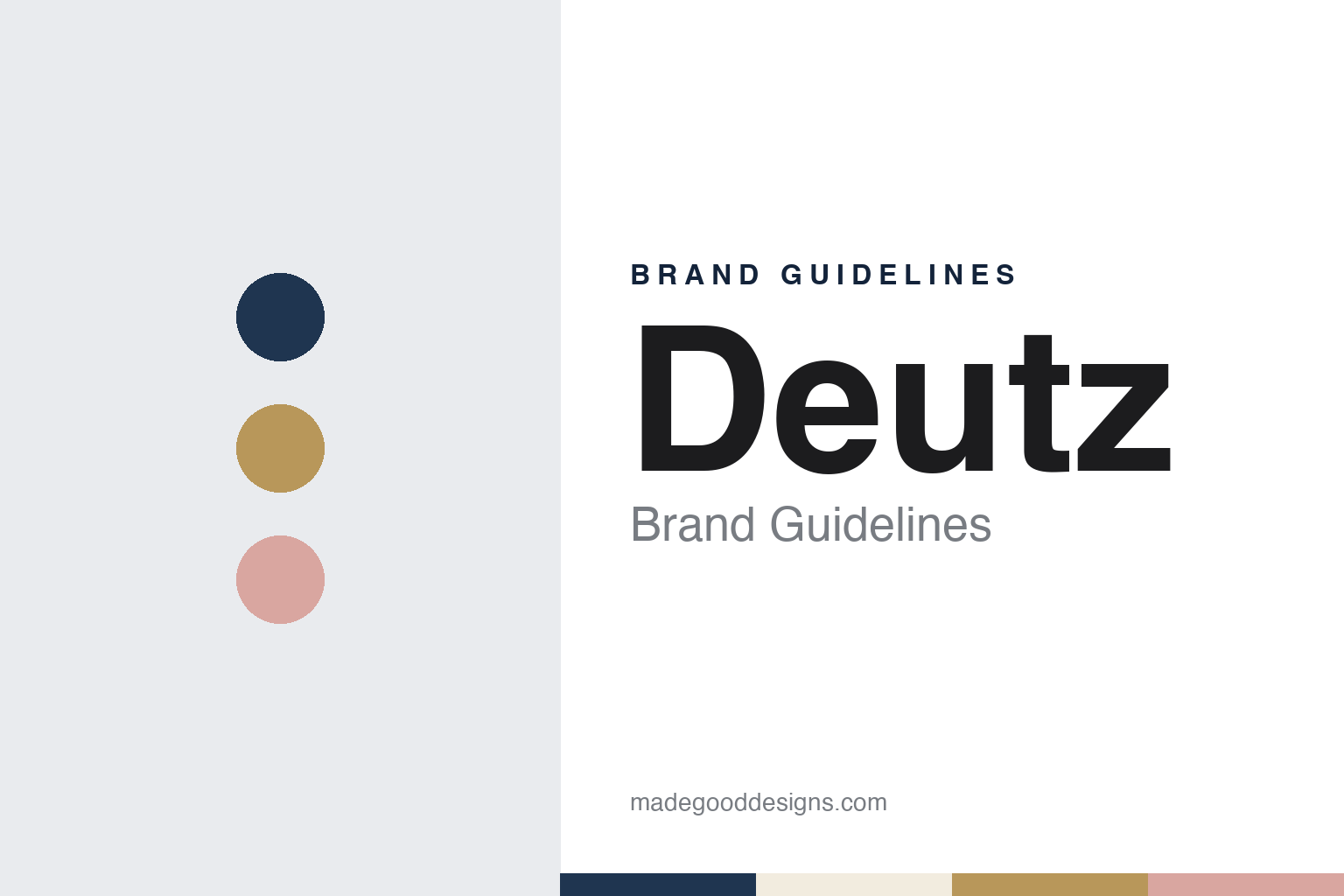
Deutz Brand Guidelines
The Aÿ house founded by two Aachen merchants in 1838.
Aa
Two constants: an Aÿ slate, gilt and rosé palette and a classical Caslon serif register. Abstract homage — not a Deutz product or mark; no label, logo or bottle is reproduced.
Two merchants from Aachen
Deutz & Geldermann, a trading house in Aÿ.
Deutz was founded in 1838 in Aÿ, in the Marne department of Champagne. Its founders were William Deutz and Pierre-Hubert Geldermann, and French Wikipedia says both came from families in Aix-la-Chapelle, the city Germans call Aachen. They had settled in Champagne in 1830, French Wikipedia says; Deutz worked as a representative for Bollinger, another Aÿ house, from 1832, while Geldermann traded in wine, before the two opened their own wine house in 1838.
The firm traded at first as Deutz & Geldermann, English Wikipedia says, and the name was later shortened to Deutz. The house still uses its founding date as its signature line: its website describes Deutz as a Champagne house founded at Aÿ in 1838, and opens its manifesto with the words “since 1838.”
The house has been through hard times. The Champagne writer Richard Juhlin, writing for the Champagne Club in May 2024, says Deutz was hit hard during the Champagne riots of 1911. English Wikipedia says Deutz was at one time one of the most popular Champagne brands in Britain, exporting almost 600,000 bottles there at its peak, though it does not date that peak; it adds that the house’s main markets today are domestic. Juhlin writes that the house was long run by André Lallier, who also invested in other wine regions.
Colour
A founder’s name on the prestige bottle, and a cuvée called Amour.
The house built its top range around its founder. English Wikipedia lists, alongside the Brut Classic, the rosé and the vintage wines, a Cuvée William Deutz, an Hommage à William Deutz and two versions of Amour de Deutz, a blanc de blancs and a rosé. Juhlin notes that the William Deutz name now appears on a white wine and on the Hommage, the rosé version having been dropped. He writes that Deutz launched Amour de Deutz with the 1993 vintage as a prestige Champagne, and names Michel Davesne as the house’s winemaker.
Most of the grapes are bought in. Juhlin writes that about three-quarters of the fruit comes from grand cru and premier cru villages, supplied by around 80 growers, and that Deutz owns land in five villages. French Wikipedia gives a total supply of about 200 hectares, 42 of them owned, and a production of about 2.5 million bottles a year, with blends that are about 80 per cent grand cru and premier cru. Both English and French Wikipedia place the house in Aÿ, where its site says it was founded.
The colour of the range is set by the grapes. The company’s current site presents a limited edition of its Brut Rosé called Sakura, which it describes as made entirely from premier and grand cru grapes, joining the Pinot Noir of Aÿ with Chardonnay from the Côte des Blancs. The site also says that a new version of it is in preparation.
Deutz also lent its name to sparkling wine outside France. English Wikipedia, citing The Sotheby’s Wine Encyclopedia, says the house formed a partnership with Montana Wines in 1988 to make sparkling wine in Marlborough, New Zealand, and, citing Wine Spectator in 1997, that a Californian venture, Maison Deutz, formed in the early 1990s with Beringer Wine Estates, was sold by 1997 and renamed Laetitia.
Typography
Design and documentation.
The seven brands in this group are all Champagne names: Louis Roederer, Salon, Jacques Selosse, Deutz, Philipponnat, Drappier and Jacquesson. Champagne houses and growers in general sit at many different points in the trade, from family houses that still carry a founder’s name to grower estates that make wine from their own vines and houses that now belong to much larger wine or drinks groups, and a single name can be sold everywhere from a wine shop to a restaurant list.
A Champagne brand’s identity is usually carried less by a single bottle than by a label, a name and the place it promises, because the company behind the name may have changed hands, changed its vineyards or grown far beyond the cellar where it started. That makes the questions behind each name worth asking plainly: who started it, who owns it now, and where its wine is actually made and bottled.
Each guide separates what independent sources record from what the company says about itself — its founding story, its owners over time, where its wine is made and how its labels have changed — and marks plainly what rests only on the company’s own word.
Aa
A classical Caslon serif for a founder’s name and an 1838 date. (Specimen set in Libre Caslon Text, a serif STAND-IN; NOT the Deutz logo.)
Deutz
From the Lallier family to the Louis Roederer group.
The house’s independence ended in the early 1990s. Juhlin writes that in 1993 Louis Roederer gained a majority stockholding in Deutz, and English Wikipedia says the house has been part of the Louis Roederer portfolio since 1993. English Wikipedia lists Champagne Deutz in the group of Louis Roederer, which it describes as remaining in the ownership of the founding family’s Rouzaud descendants, alongside Ramos Pinto in Portugal, Domaines Ott in Provence and Roederer Estate in California.
Under the group, Deutz has had long-serving management. Shanken News Daily reported on 23 December 2022 that the Roederer Collection group had named Marc Hoellinger chief executive of Champagne Deutz and of the Rhône producer Delas Frères from 1 January 2023, succeeding Fabrice Rosset, who had led the two companies for 26 years. Hoellinger had previously run The Glenmorangie Company for LVMH and served as chief commercial officer of Moët & Chandon, the report said.
The name needs care online. Deutz AG, the engine maker, takes its name from Deutz, a district of Cologne, and Deutz-Fahr is a tractor brand; neither has any link to the Champagne house, which uses the domain champagne-deutz.com.
For a design guide, Deutz shows how an old Champagne house can carry its founder’s name and founding date at the centre of its identity through changes of owner, keeping the name William Deutz on its top cuvée more than 180 years on. Compare Bollinger, the Aÿ house Deutz once represented, and Louis Roederer, its owner since 1993. For this guide we use Aÿ slate, gilt and rosé with a classical serif, an unofficial interpretation; no product or logo is reproduced.
Explore & save
Keep Deutz’s identity on hand — save it to a board in the Made Good inspiration library.
Deutz identity set
Pin the Deutz Aÿ slate, gilt and rosé palette and the classical Caslon serif register to your own board.


