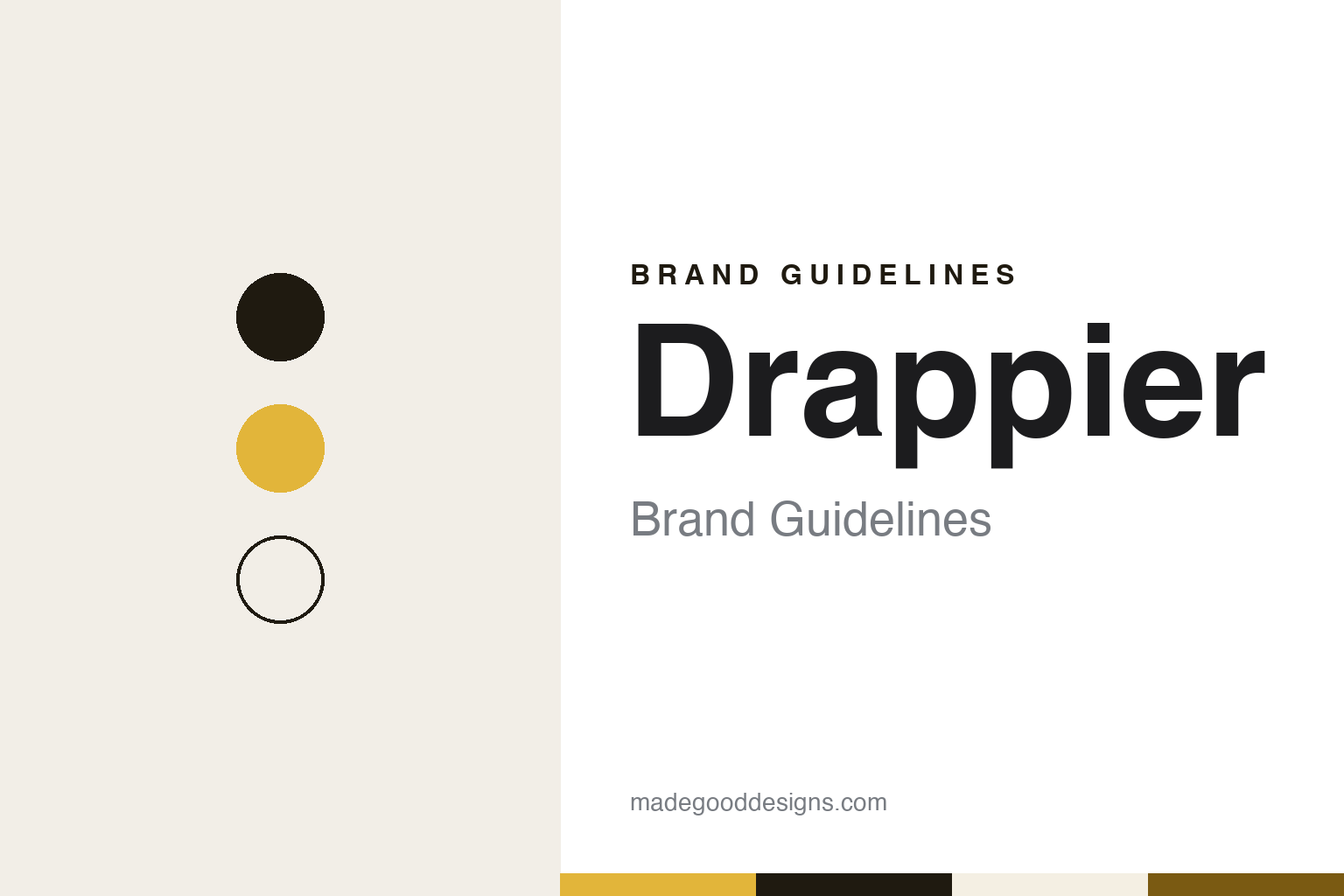
Drappier Brand Guidelines
A family house in the Aube since 1808, around cellars older than the bubbles.
Aa
Two constants: a yellow, stone and cellar black palette and a bookish serif register. Abstract homage — not a Drappier product or mark; no bottle, label or logo is reproduced.
Urville, 1808
A family, a village in the Aube and a monks’ cellar.
Drappier is a family house of the Côte des Bar, the southern part of Champagne in the Aube département, well to the south of Reims and Épernay. The company dates the house to 1808, when, it says, François Drappier settled in the village of Urville and began working a vineyard of a few hectares. French Wikipedia gives the same year and describes the business as a négociant-manipulant, a house that makes its own wine from its own and bought-in grapes, with its head office in Urville. The family traces its name further back: the company, and the American magazine France Today in a 2013 interview with Michel Drappier, both name a Reims cloth merchant, Rémy Drappier, born in 1604, as the family’s earliest known ancestor.
The house is built around a building older than Champagne itself. The company says Saint Bernard, founder of the Abbey of Clairvaux, had the cellars at Urville built in 1152 as an annex of the abbey, and that the family bought these Cistercian cellars and moved in after the Second World War. French Wikipedia repeats the link to the monks of Clairvaux. In 1988, the company says, the house added deep chalk cellars in Reims, dug in the reign of Napoleon III, where it keeps some of its largest bottles.
The vineyard is dominated by one grape. The company says Pinot Noir makes up about 70 per cent of its vines, and credits Georges Collot, Michel Drappier’s maternal grandfather, with being the first to replant Pinot Noir in the area in the early 1930s. French Wikipedia puts the family’s vineyard at about 57 hectares, most of it around Urville, with a split of roughly 70 per cent Pinot Noir and 15 per cent each of Chardonnay and Pinot Meunier. On its home page the house also lists old Champagne varieties it still grows: Fromenteau, Arbanne, Petit Meslier and Blanc Vrai.
Colour
A yellow label, a nearby president and a cuvée in his name.
The house’s best-known label came from the generation of André Drappier. The company says André and Micheline Drappier created the Carte d’Or cuvée in 1952, recognisable by its yellow label, and that after a severe frost in 1957 André planted Pinot Meunier for its better resistance to spring frosts. The merchant iDealwine, in an article of March 2025, credits the Carte d’Or with putting the house on the map and dates the first vintage of another cuvée, La Grande Sendrée, from a single parcel at Urville, to 1975.
The house’s most famous customer was a president. Charles de Gaulle’s private home was at Colombey-les-Deux-Églises, a village in the Haute-Marne. The company says that in 1965 a Drappier Pinot Noir was served to the General’s family at Colombey, and iDealwine reported in 2025 that he opened Drappier Champagne with his family there. In 1990, for the 50th anniversary of de Gaulle’s appeal of 18 June 1940, the house created a Charles de Gaulle cuvée, the company and iDealwine both say; it remains in the range, and French Wikipedia lists it among the house’s wines.
The family is now in its eighth generation. The company says Michel Drappier took over the winemaking in 1979, while his father André kept watch over the vines. iDealwine reported that André Drappier died in March 2025. Since 2016, the company says, Michel and his wife Sylvie have been joined by their children Charline, Hugo and Antoine, the eighth generation. The company says Charline leads the commercial side, Hugo is in charge of the vines and the winemaking, and Antoine farms part of the vineyard organically with a draft horse. French Wikipedia also gives the family as the house’s owner.
Typography
Design and documentation.
The seven brands in this group are all Champagne names: Louis Roederer, Salon, Jacques Selosse, Deutz, Philipponnat, Drappier and Jacquesson. Champagne houses and growers in general sit at many different points in the trade, from family houses that still carry a founder’s name to grower estates that make wine from their own vines and houses that now belong to much larger wine or drinks groups, and a single name can be sold everywhere from a wine shop to a restaurant list.
A Champagne brand’s identity is usually carried less by a single bottle than by a label, a name and the place it promises, because the company behind the name may have changed hands, changed its vineyards or grown far beyond the cellar where it started. That makes the questions behind each name worth asking plainly: who started it, who owns it now, and where its wine is actually made and bottled.
Each guide separates what independent sources record from what the company says about itself — its founding story, its owners over time, where its wine is made and how its labels have changed — and marks plainly what rests only on the company’s own word.
Aa
A bookish transitional serif for a family-name, old-house register. (Specimen set in Libre Caslon Text, a serif STAND-IN; NOT the Drappier logo.)
Drappier
Low dosage, carbon claims and the biggest bottles.
In recent decades the house has built its name on a drier, more natural style. French Wikipedia says Drappier uses very low levels of sulphites and makes a Brut Nature Sans Soufre cuvée, and the company presents that wine as the outcome of its approach. iDealwine reported in 2025 that under the current generation the house has moved towards lower dosage, and that in 2016 it received the Ecoact label, describing it as the first carbon-neutral Champagne house in France; the company itself calls Drappier the first “Carbone Neutre” house. The company marks two of its cuvées, Clarevallis and Quattuor, as certified organic.
The house is also known for size. French Wikipedia says Drappier bottles its wines in formats from a quarter bottle up to the 30-litre Melchizédech, and France Today credited Michel Drappier in 2013 with creating the Melchizédech, which the magazine called the largest Champagne bottle in the world.
French Wikipedia says the Drappier family has run the house since its founding, with its head office at Urville in the Aube, and the company describes the Urville cellars as the family’s home. The house’s own site is champagne-drappier.com.
For a design guide, Drappier shows how a family name, a medieval cellar, a yellow label and one famous customer can carry a house from a small village in the Aube to the cellars of a president. Compare Pol Roger, the Épernay family house whose cuvée honours Winston Churchill, and Taittinger, the family-led Reims house. For this guide we use Carte d’Or yellow, stone and cellar black with a serif, an unofficial interpretation; no product or logo is reproduced.
Explore & save
Keep Drappier’s identity on hand — save it to a board in the Made Good inspiration library.
Drappier identity set
Pin the Drappier yellow, stone and cellar black palette and the bookish serif register to your own board.