Fonseca Brand Guidelines
The Port house of the Guimaraens family, since 1815.
Aa
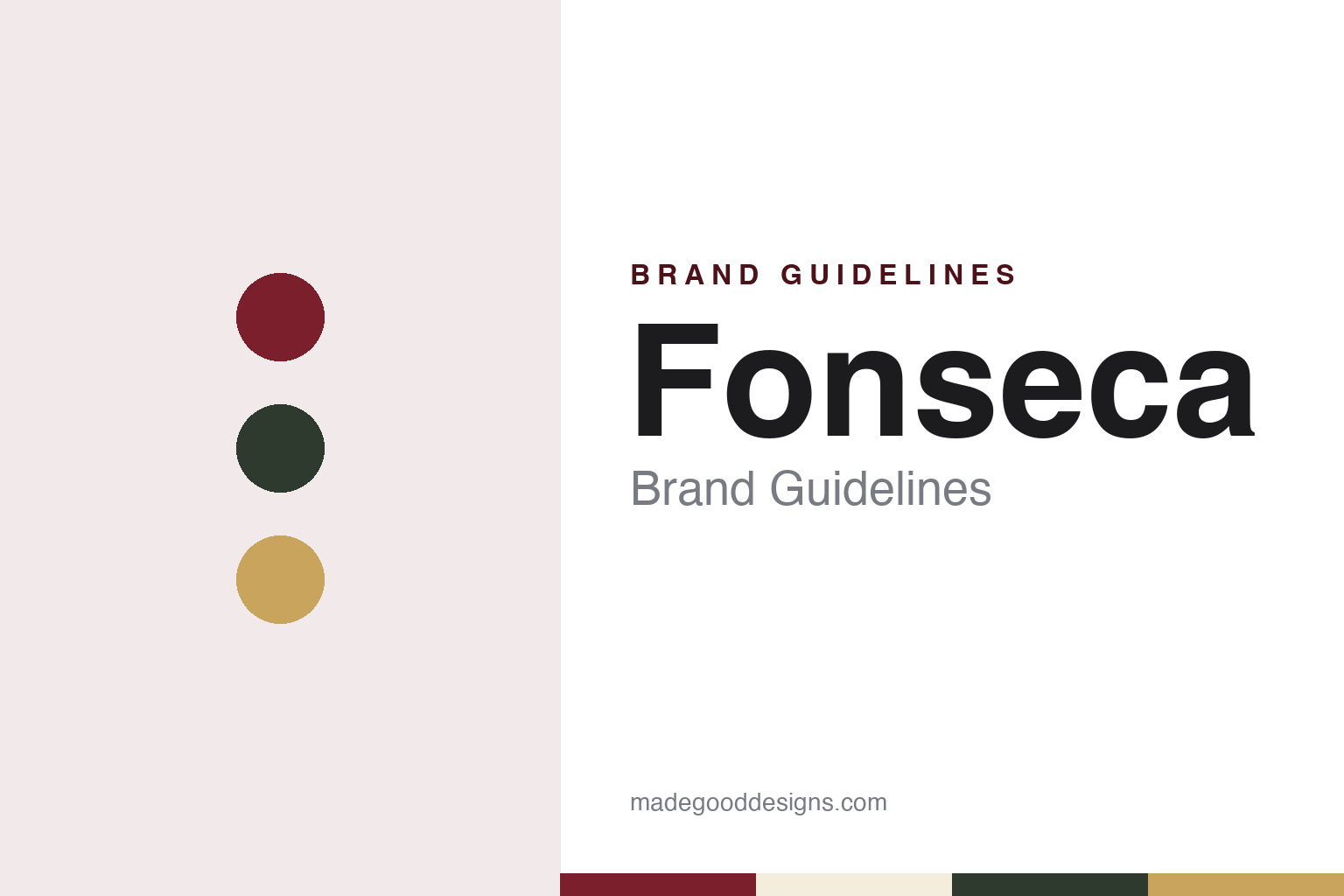
Two constants: a Bin ruby, Távora green and insignia gold palette and a classical display serif register. Abstract homage — not a Fonseca product or mark; no label, logo or bottle is reproduced.
A ledger entry of 1815
João dos Santos Fonseca, the Monteiros and a young man bound for London.
Fonseca dates itself to a single line in a ledger. The company’s history says the first evidence of the firm trading in Port is an entry dated 8 April 1815 in the books of the Real Companhia Velha, the royal monopoly company, recording a purchase of Port by its founder, João dos Santos Fonseca. His first documented sale followed that September, the company says, and his first overseas shipment in 1816. When the house marked its bicentenary in March 2015, it cited the same record.
By 1820, according to the company, Fonseca had taken a partner, Francisco José Gomes Monteiro, from a prominent merchant family, and the business traded as Fonseca & Monteiro. The name that came to define the house arrived soon after. The company says Manoel Pedro Guimaraens, a young member of the firm who is believed to have joined around 1818, sailed for England in June 1822. He was an outspoken supporter of Portugal’s constitutionalist, liberal movement and hoped to escape persecution, but the company stresses that the move was also commercial: a receipt shows Fonseca & Monteiro paid his passage on a brig named Enterprise, and he was to sell in London the wine the Porto firm bought and shipped.
English Wikipedia tells the story differently. It says the company was established in 1822, when Manoel Pedro Guimaraens and his brother João Gonçalves Salgueiro acquired control of Fonseca & Monteiro, on condition that the Fonseca name be kept as the brand. It also repeats a tale that Guimaraens fled Portugal hidden in an empty Port barrel. The company’s own account, built on its archive, gives 1815 as the founding and a paid passage on the brig as the means of travel; the two accounts differ on both the date and the journey.
In London, the company says, Guimaraens opened premises in Tokenhouse Yard in 1823 and later moved to Abchurch Lane, trading under his own name and under several names that combined Fonseca with Monteiro, Guimaraens or both. He supported Portuguese liberal exiles during the civil war that ended in 1834, and Queen Maria II made him a knight of the Order of Christ, according to the same history.
Colour
A family of winemakers, three Douro estates and a painted bottle.
Fonseca’s reputation rests on Vintage Port. The company calls its 1840 the first Vintage Port sold under the Fonseca name; English Wikipedia and the enthusiast site For the Love of Port date the first Fonseca Vintage Port shipped to England to 1847, so the two dates refer to different milestones in different sources. The house says the Guimaraens family led the firm for more than a century, and its 2015 bicentenary release said the family had made the wines from 1860 onward.
That line of winemakers is unusually long. English Wikipedia, citing the Oxford Companion to Wine, says nearly every Fonseca vintage from 1896 was made by Frank Guimaraens, his great-nephew Bruce Guimaraens and Bruce’s son David Guimaraens, with one exception: the 1955, made by Frank’s daughter Dorothy. For the Love of Port says Bruce took over in 1960 and David became the Portmaker in 1994, and describes David as the great-great-great-grandson of the founder.
The wines come from the Douro. For the Love of Port lists three estates and the years Fonseca bought them: Quinta do Cruzeiro in 1973, Quinta do Panascal in 1978 and Quinta de Santo António in 1979. The company says Cruzeiro, near Vale de Mendiz on the east bank of the Pinhão river, has supplied its Vintage Port blend since 1912, and that Panascal, on the Távora river about four kilometres west of Pinhão in the parish of Valença do Douro, was bought from the Pacheco family. At Panascal, the company says, grapes are trodden in lagares on the first floor of the farmhouse, and the estate has released single-quinta Vintage Ports for more than thirty years. For the Love of Port says all Fonseca Vintage Port is made by treading in lagares.
The wine most drinkers know is Bin 27. The company says it was launched in Britain in 1972, developed by Alistair Robertson after talks with the firm’s London agents, as a fruity reserve Port that could be served by the glass without decanting. The name revived an old habit of naming crusted Ports after the numbered cellar compartments, or bins, where they lay. For the design record, the company says the first bottles had the name painted on in white with the Fonseca insignia in red, a look it says other houses copied, and that a paper label replaced the paint in the mid-1980s. Bin 27 is blended from the house’s own estates and from independent growers, the company says, and aged in large oak vats. The company also calls its Terra Prima the first organic Port.
One name trap: Fonseca the Port house is not José Maria da Fonseca, an unrelated Portuguese wine producer based on the Setúbal peninsula, a confusion English Wikipedia notes, citing the Oxford Companion to Wine.
Typography
Port houses and their owners.
The seven brands in this group are all sherry and port houses: Lustau, Hidalgo La Gitana, Fonseca, Quinta do Noval, Niepoort, Ramos Pinto and Warre’s. Sherry and port houses in general sit at many different points in the trade, from family houses that still carry a founder’s name to houses that now belong to much larger drinks or insurance groups, and a single name can be sold everywhere from a corner shop to a restaurant list.
A sherry or port house’s identity is usually carried less by a single bottle than by a label, a name and the place it promises, because the company behind the name may have changed hands, moved its production or grown far beyond the place where it started. That makes the questions behind each name worth asking plainly: who started it, who owns it now, and where its wine is actually made, aged and bottled.
Each guide separates what independent sources record from what the company says about itself — its founding story, its owners over time, where its wine is made and how its labels have changed — and marks plainly what rests only on the company’s own word.
Aa
A classical serif for a house with an 1815 ledger date. (Specimen set in Cormorant Garamond, a serif STAND-IN; NOT the Fonseca logo.)
Fonseca and Taylor’s
Sister houses under one family-owned group.
The Guimaraens family did not keep ownership. English Wikipedia, citing the Oxford Companion to Wine, says Taylor, Fladgate & Yeatman bought Fonseca in 1948 but allowed it to remain a separate house; For the Love of Port also gives 1948 and links the sale to financial difficulties across the Port trade after the Second World War, while Taylor’s own history gives 1949. The combined business later traded as Taylor Fonseca. The company describes this as the fourth family chapter in its history: after the Fonsecas and Monteiros and the Guimaraens came the Yeatmans and their descendants, who ran the firm through the second half of the 20th century.
Today Fonseca belongs to The Fladgate Partnership, the family-owned group that, according to the Oxford Companion to Wine, was formed in 2001 when Taylor Fonseca bought the Croft and Delaforce houses from Diageo; Delaforce was later sold. For the Love of Port has named Adrian Bridge as the group’s managing director, and says David Guimaraens is also responsible for Croft’s Ports. Fonseca’s wines are made from Douro grapes, from its own quintas and, for Bin 27, from independent growers too, the company says, and it receives visitors at its Port cellars in Vila Nova de Gaia, across the river from Porto, and at Quinta do Panascal.
For a design guide, Fonseca shows how a house can carry two founding stories, a family name it no longer owns and a product number that became a brand of its own. Compare Taylor’s, its sister house in the same group, and Cockburn’s, another 19th-century Port name. For this guide we use a deep ruby, a Douro green and a muted gold with a serif, an unofficial interpretation; no product or logo is reproduced.
Explore & save
Keep Fonseca’s identity on hand — save it to a board in the Made Good inspiration library.
Fonseca identity set
Pin the Fonseca ruby, Douro green and gold palette and the classical serif register to your own board.