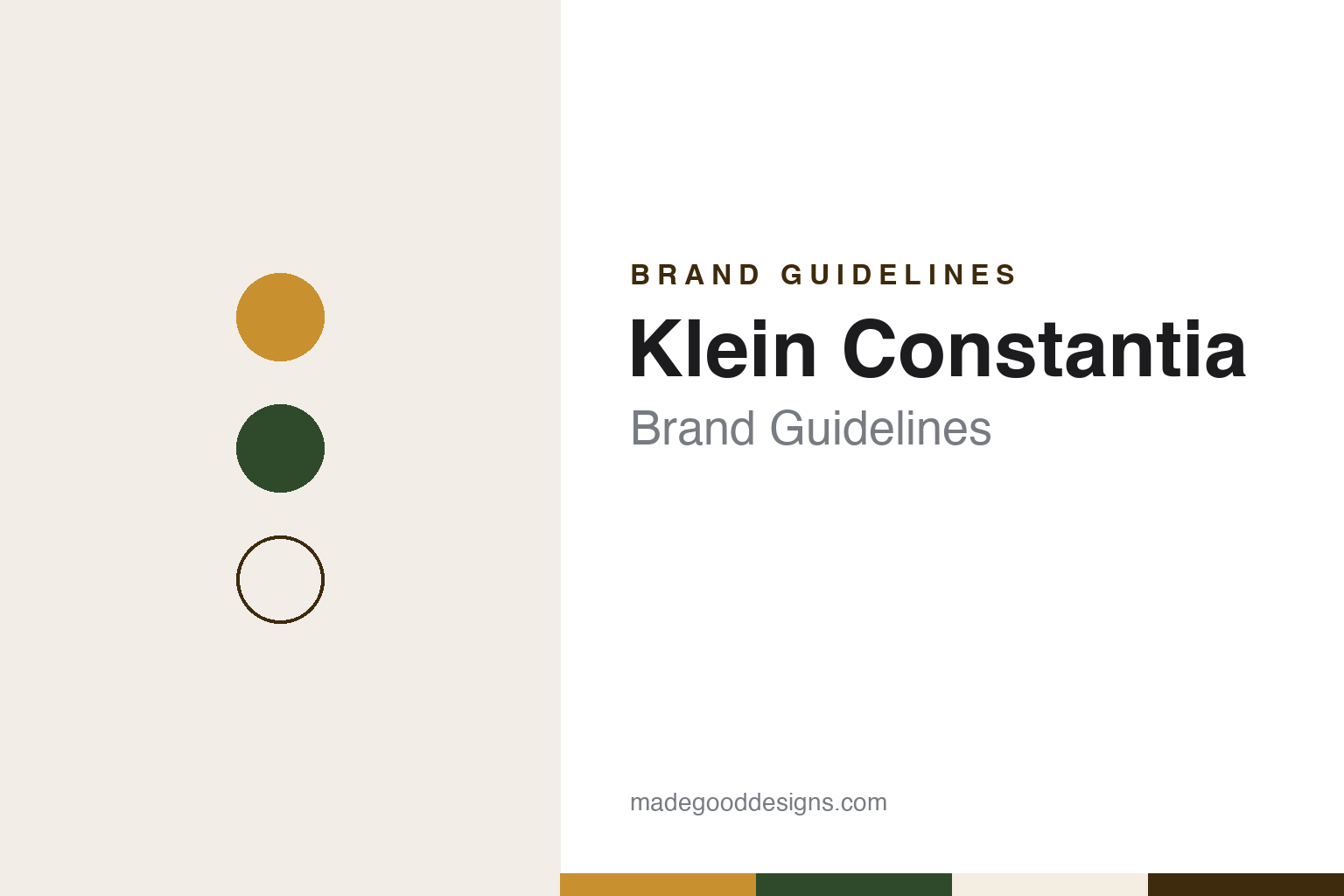
Klein Constantia Brand Guidelines
The Constantia estate that revived Vin de Constance.
Aa
Two constants: a Constance amber, valley green and gable white palette and a classical serif register. Abstract homage — not a Klein Constantia product or mark; no label, logo or bottle is reproduced.
A piece of the first Constantia
From a governor’s farm to a family estate on the slopes above False Bay.
Klein Constantia is a wine estate in Constantia, a suburb of Cape Town. Its story starts with a larger farm. English Wikipedia says Simon van der Stel, the Dutch East India Company’s governor at the Cape, established Constantia in 1685, and the estate’s own timeline gives the same year. After van der Stel’s death in 1712 the farm was divided, and its parts became Groot Constantia, Klein Constantia and Bergvliet, English Wikipedia says.
The name Klein Constantia, “little Constantia,” came later. English Wikipedia says the Cloete family bought the core of the old farm in 1778 and planted vineyards of Frontignac, Pontac and Muscadel, and that when the estate was divided again in 1818 the upper portion passed to Johan Gerhard Cloete under the name Klein Constantia. In 1913 it was bought by Abraham Lochner de Villiers of Paarl and his American wife, Clara Hussey, and in 1955 it passed to their nephew Jan de Villiers.
The modern estate dates from 1980. The estate says Duggie Jooste bought Klein Constantia that year and rebuilt it with the winemaker Ross Gower, the architect Gawie Fagan and Professor Chris Orffer of Stellenbosch University. English Wikipedia says Jooste’s son Lowell joined the business and that a new cellar and tasting room were finished by the mid-1980s. The first vintage of the modern era was released in 1986, according to both the estate and English Wikipedia.
Colour
A sweet wine with a literary past, recreated for a modern bottle.
The estate’s name is bound up with one wine. In the 18th and 19th centuries the sweet wine of Constantia was shipped to Europe and became one of the best-known wines of its day. English Wikipedia, citing Bloomberg, says Napoleon had Constantia wine shipped to him on St Helena during his exile there from 1815. Writers mentioned it too: in Jane Austen’s Sense and Sensibility Mrs Jennings offers Marianne a glass of Constantia, Charles Dickens has the Reverend Septimus served a glass of it in The Mystery of Edwin Drood, and Charles Baudelaire names it in the poem “Sed non satiata” in Les Fleurs du mal. The estate itself says the wine was enjoyed by Napoleon and praised by Austen.
The wine that carries this story today is Vin de Constance, made from Muscat de Frontignan. Joanna Simon wrote in The World of Fine Wine in October 2025 that Duggie Jooste recreated it in the 1980s, working from 18th-century notes by Lambertus Johannes Colyn. English Wikipedia credits Jooste, Orffer and Gower with the recreated wine, made from Muscat Blanc à Petits Grains, the international name for the same grape.
The presentation leans on that history. Lot notes from the auction house Strauss & Co in 2020 describe the wine as sold in specially made 500 ml bottles in a hand-blown style, and call it the re-creation of the legendary Constantia wine of the 18th and 19th centuries. The wine also has its own website, separate from the estate’s, under the line “Over 300 years of history in every bottle.”
The cellar has changed hands only a few times since the revival. The World of Fine Wine reported that Ross Gower left in 2003, that Adam Mason made the wine until the change of ownership, and that Matt Day, then the assistant, was given the 2012 vintage and has been winemaker since; the estate calls him the third winemaker since the revival. Simon also reported that seven barrels of the 2010 vintage were held back for almost 15 years and bottled at the end of 2024.
Typography
Design and documentation.
The seven brands in this group are all South African wine estates: Kanonkop, Meerlust, Sadie Family Wines, Boekenhoutskloof, Klein Constantia, Vergelegen and Hamilton Russell Vineyards. Wine estates in general sit at many different points in the trade, from family farms that still carry a founder’s name to properties that now belong to investors or much larger drinks groups, and a single estate’s wine can be sold everywhere from a cellar-door shop to a restaurant list.
A wine estate’s identity is usually carried less by a single bottle than by a label, a name and the place it promises, because the people behind the name may have changed, the farm may have changed hands, and the wine may be made from grapes grown well beyond the estate’s own boundary. That makes the questions behind each name worth asking plainly: who started it, who owns it now, and where its wine is actually grown, made and bottled.
Each guide separates what independent sources record from what the estate says about itself — its founding story, its owners over time, where its wine is made and how its labels have changed — and marks plainly what rests only on the estate’s own word.
Aa
A classical serif for an estate whose identity rests on an 18th-century wine. (Specimen set in Cormorant Garamond, a serif STAND-IN; NOT the Klein Constantia logo.)
Klein Constantia
New owners from 2011, and a Stellenbosch partner from 2012.
The Jooste era ended in May 2011. James Molesworth reported in Wine Spectator on 27 May 2011 that Lowell Jooste had agreed to sell the estate to Zdeněk Bakala and Charles Harman, investment bankers linked to the BXR Group, in which Bakala was the principal shareholder and Harman, a Briton who had led J.P. Morgan’s UK investment banking, the chief executive. The price was not disclosed. Wine Spectator put the estate at about 200 acres of vines and described a range built on Chardonnay, Riesling and Sauvignon Blanc as well as Vin de Constance, and quoted Harman promising “business as usual.”
A year later the estate grew. English Wikipedia, citing the estate’s press office, says that in June 2012 Klein Constantia merged with Anwilka, a Stellenbosch vineyard co-owned by Lowell Jooste, Hubert de Boüard of Château Angélus and Bruno Prats, formerly of Château Cos d’Estournel, and that de Boüard and Prats became shareholders in Klein Constantia; the estate’s timeline also dates the merger to 2012. Anwilka makes a red wine under its own name.
The estate’s own account today puts its vineyards at 146 hectares, with Matt Day in charge of the wine and Craig Harris of the vines. Its range runs from the estate wines to single-vineyard Sauvignon Blanc and a Méthode Cap Classique, English Wikipedia says, with Vin de Constance at the top. Harman told The World of Fine Wine in 2025, “We risk getting submerged by our rich history,” and Day said the future mattered more to the team than the past.
The name needs care. Klein Constantia is a separate property from Groot Constantia, the other large estate made from van der Stel’s farm, and Constantia is also the name of the suburb and of the Constantia Valley wine ward. The estate’s site is kleinconstantia.com; the sweet wine has a second site at vindeconstance.com.
For a design guide, Klein Constantia shows how an estate can build an identity around a single historic wine, its literary record and a bottle that recalls the 18th century, while selling a modern range alongside it. Compare Château d’Yquem, the Sauternes house of another celebrated sweet wine, and Vergelegen, the Somerset West estate founded by van der Stel’s son. For this guide we use Constance amber, valley green and gable white with a classical serif, an unofficial interpretation; no product or logo is reproduced.
Explore & save
Keep Klein Constantia’s identity on hand — save it to a board in the Made Good inspiration library.
Klein Constantia identity set
Pin the Klein Constantia amber, valley green and gable white palette and the classical serif register to your own board.