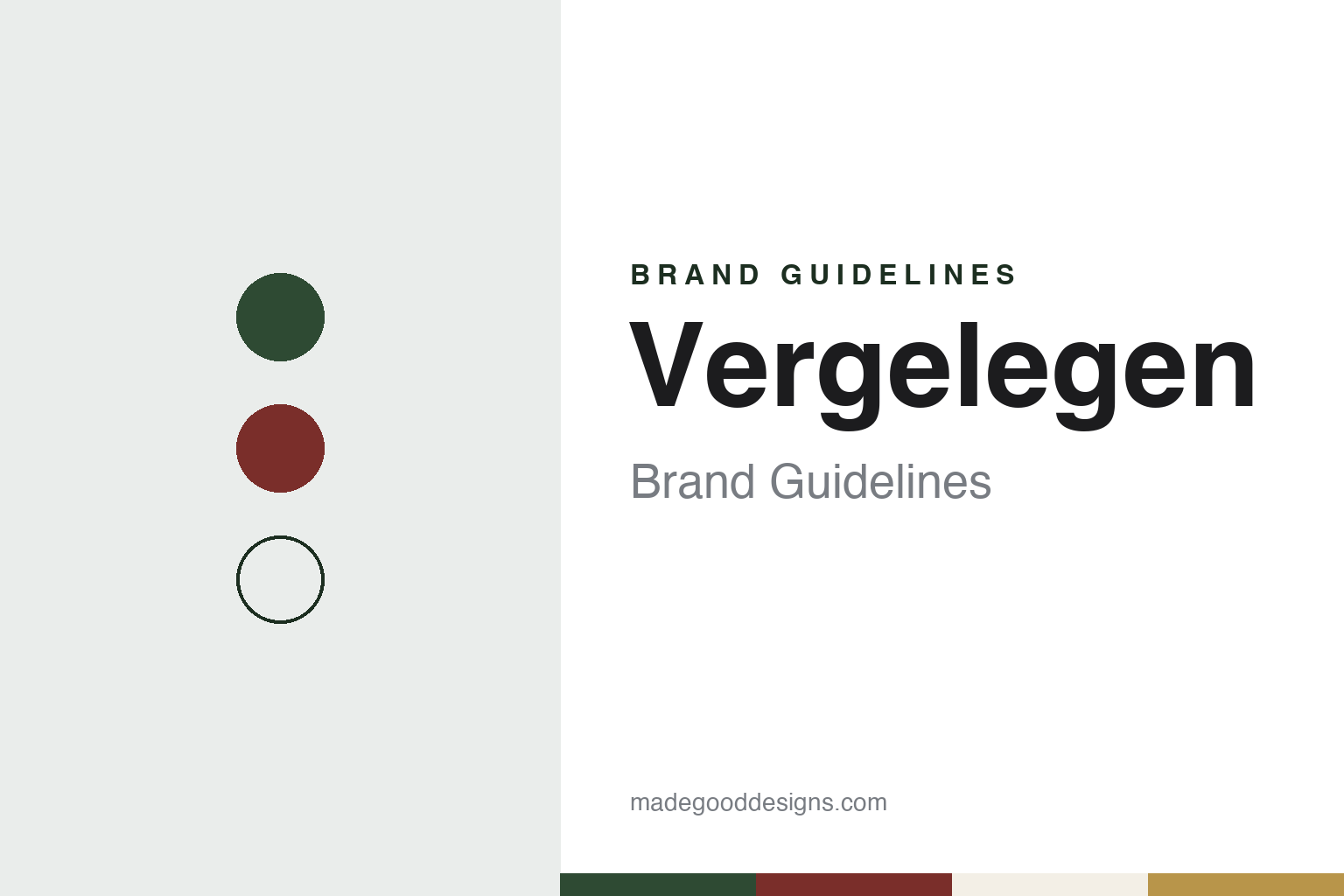
Vergelegen Brand Guidelines
The Somerset West estate founded in 1700, owned by Anglo American since 1987.
Aa
Two constants: a camphor green, cellar red and whitewash palette and an old-style serif register. Abstract homage — not a Vergelegen product or mark; no label, logo or bottle is reproduced.
Situated far away
A governor’s farm below the Hottentots-Holland mountains.
Vergelegen is a wine estate in Somerset West, east of Cape Town, below the Hottentots-Holland mountains. Its name is Dutch: English Wikipedia translates it as “remotely situated,” and the estate itself says “situated far away.” The estate gives its founding date as 1 February 1700, the year Willem Adriaan van der Stel succeeded his father, Simon van der Stel, as governor of the Cape for the Dutch East India Company.
The estate says Willem Adriaan built a Cape Dutch homestead and a corn mill there and in 1706 planted camphor and oak trees. In Winemag in April 2019 the writer Joanne Gibson recounted the petition drawn up by free burghers in 1706 that led to his dismissal as governor in 1707, after which the estate was divided; the estate dates the division into four farms to 1709.
The owners after that are well recorded. The estate and English Wikipedia say the Theunissen family took over in 1798 and grew grapes until phylloxera struck in the late 19th century. In 1917 the mining magnate Sir Lionel Phillips bought Vergelegen for his wife, Lady Florence Phillips, who removed the vineyards, restored the homestead with the architect C. Percy Walgate and turned the old winery into a library for her husband’s books, according to the estate. In June 1941 the estate and its contents were sold at auction to the Barlow family, the estate says; South African History Online records that Charles “Punch” Barlow ran it first and Tom Barlow from 1966.
Colour
A mining group, a hilltop cellar and a new label.
The modern wine business began with a sale to a mining company. The estate says Anglo American bought Vergelegen in October 1987; South African History Online names the buyer as its farming arm, Anglo-American Farms Limited, and the seller as Tom Barlow. English Wikipedia says no grapes were being grown when the company arrived, and that the first vintage under its ownership was harvested in 1992.
That year the estate opened a new cellar. The estate describes it as a multi-levelled, sunken hilltop winery, opened by Baron Eric de Rothschild. English Wikipedia says the winery is built in an octagonal form and that the octagon is mirrored on the estate’s labels. The shape has deep roots on the property: early-1700s drawings of the estate, reproduced by English Wikipedia, show an octagonal courtyard, and the estate’s tasting room today overlooks what it calls an extensive octagonal-shaped garden.
Three cellar masters have led the wine. In a January 2025 article on his site Wine Anorak, Jamie Goode wrote that Martin Meinert left in 1997, that André van Rensburg took over in 1998 and that Luke O’Cuinneagain, previously at Glenelly in Stellenbosch, arrived in 2022. Goode put the vineyards at 133 hectares on a property of about 3,200 hectares, and listed wines including the flagship V, the Reserve Cabernet Sauvignon and the Estate Red and Estate White.
The labels changed in 2024. The local magazine Bolander Lifestyle reported on 30 October 2024 that the estate had relaunched its range at an event on 19 October, calling it the first major rebrand in more than 30 years, and quoted managing director Wayne Coetzer on ushering in the new “without losing sight of the old.” The estate now groups its wines in four ranges, Heritage, Icon, Reserve and Estate.
Typography
Design and documentation.
The seven brands in this group are all South African wine estates: Kanonkop, Meerlust, Sadie Family Wines, Boekenhoutskloof, Klein Constantia, Vergelegen and Hamilton Russell Vineyards. Wine estates in general sit at many different points in the trade, from family farms that still carry a founder’s name to properties that now belong to investors or much larger drinks groups, and a single estate’s wine can be sold everywhere from a cellar-door shop to a restaurant list.
A wine estate’s identity is usually carried less by a single bottle than by a label, a name and the place it promises, because the people behind the name may have changed, the farm may have changed hands, and the wine may be made from grapes grown well beyond the estate’s own boundary. That makes the questions behind each name worth asking plainly: who started it, who owns it now, and where its wine is actually grown, made and bottled.
Each guide separates what independent sources record from what the estate says about itself — its founding story, its owners over time, where its wine is made and how its labels have changed — and marks plainly what rests only on the estate’s own word.
Aa
An old-style serif for an estate that leads with its date and its homestead. (Specimen set in Libre Caslon Text, a serif STAND-IN; NOT the Vergelegen logo.)
Vergelegen
A heritage site, a nature reserve and a working winery.
Much of Vergelegen is now protected. English Wikipedia, citing a Western Cape Government list of 2002, says the camphor trees planted in van der Stel’s time are a provincial heritage site. In 2019 the protection was extended. Tourism Tattler reported on 4 November 2019 that Heritage Western Cape had declared the estate’s historic core a provincial heritage site, with a plaque unveiled on 28 October 2019 by the province’s minister of cultural affairs, Anroux Marais. The declaration covered the homestead and its buildings, 17 gardens and the working farm, about 1,120 of the estate’s 3,020 hectares; the magazine said the remaining land had been promulgated as a private nature reserve the year before.
The owner has not changed since 1987. Tourism Tattler named Anglo American plc as the owner in 2019, Jamie Goode called the company the current owner in January 2025, and the estate’s own history page heads its latest chapter “Anglo era.” When Anglo American’s farming arm sold the nearby Boschendal estate in 2003, Wine Spectator reported, Vergelegen was the wine estate it kept. The wine is made in the estate’s own hilltop winery, which Goode dates to 1992, and the estate says it receives about 100,000 visitors a year to its gardens, homestead and tasting room.
The estate’s own site is vergelegen.co.za.
For a design guide, Vergelegen shows how a founding date, a homestead and a single geometric shape, the octagon, can carry an estate’s identity from a courtyard of the 1700s to a cellar and a label of today. Compare Klein Constantia, the Constantia estate carved from the farm of van der Stel’s father, and Nederburg, the Paarl wine farm granted in 1791. For this guide we use camphor green, cellar red and whitewash with an old-style serif, an unofficial interpretation; no product or logo is reproduced.
Explore & save
Keep Vergelegen’s identity on hand — save it to a board in the Made Good inspiration library.
Vergelegen identity set
Pin the Vergelegen camphor green, cellar red and whitewash palette and the old-style serif register to your own board.