Lark Brand Guidelines
The Tasmanian single malt that reopened distilling on the island in 1992.
Aa
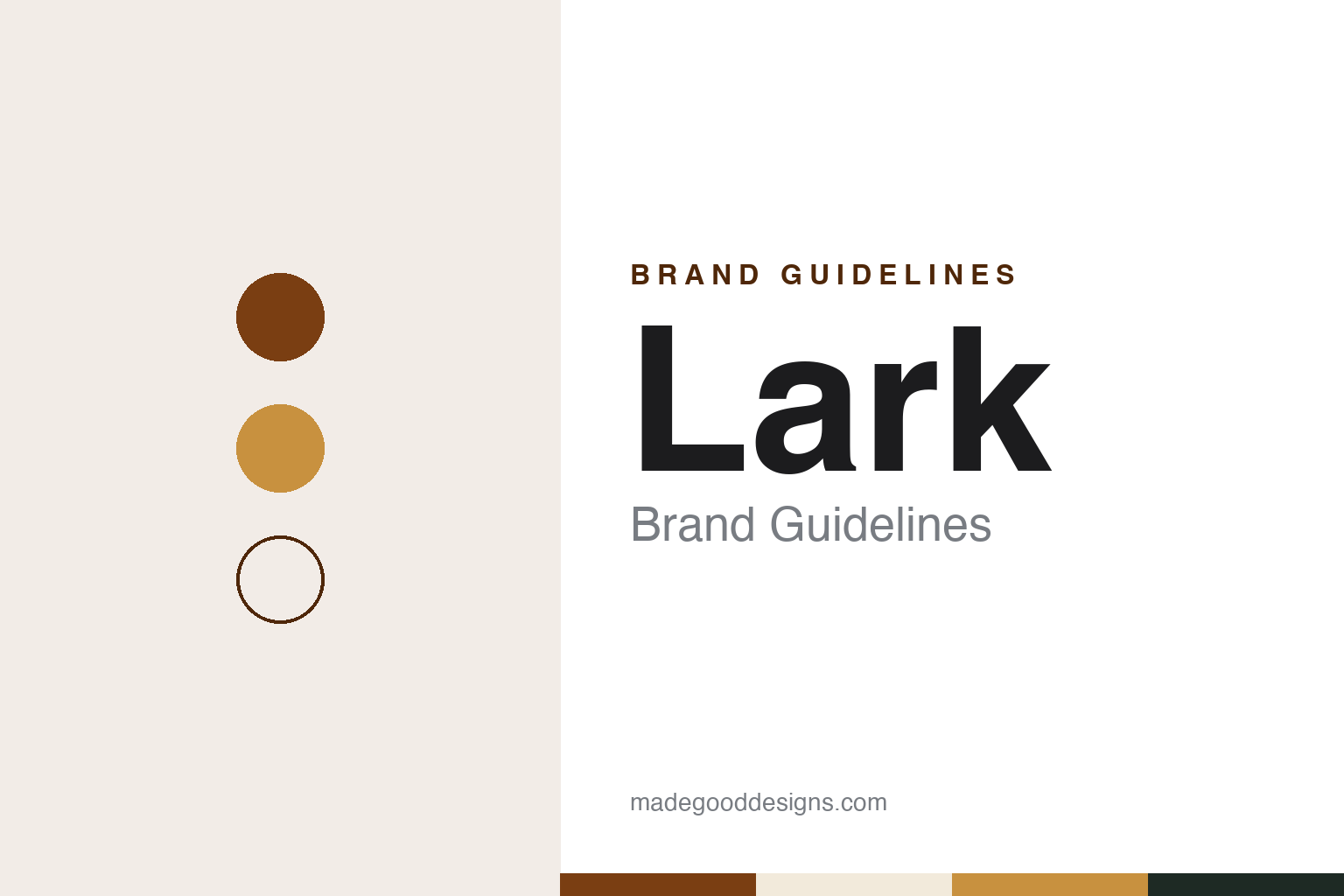
Two constants: a tawny cask, malt gold and highland cream palette and a soft old-style serif register. Abstract homage — not a Lark product or mark; no label, logo or bottle is reproduced.
A fishing trip and an old law
Bill and Lyn Lark, a lake in the highlands and a licence granted in 1992.
Lark is the whisky that restarted legal distilling in Tasmania. The company traces its story to 1989, when, it says, Bill Lark was fishing on Lake Sorell in the Tasmanian highlands with his father-in-law and the two asked whether the place, its essence and its purity could be captured in a fine single malt. Lark’s own history page says that distillation had been restricted in Tasmania since 1839, and that Bill and his wife Lyn Lark, who the company says took the lead, set out to change the law that stood in their way.
The obstacle was federal. Writing in Whisky Magazine in April 2014, Claire Smith reported that when Australia federated in 1901 it adopted distilling rules that effectively shut out small operators, and that Bill Lark had bought a second-hand still only to find he could not legally use it. He told the story to the federal MP Duncan Kerr during a walk through Hobart; Kerr saw a possible new industry for Tasmania and took the case to Barry Jones, who undertook to change the law. Whisky Magazine said the letters between the two politicians hang framed at Lark’s whisky bar on the Hobart waterfront.
The result came in May 1992. The festival Tasting Australia, in its profile of Bill Lark as a patron of its spirit awards, says that with help from the federal minister responsible for customs, who helped amend the Distillation Act 1901, Bill and Lyn Lark obtained Tasmania’s first distillation licence since 1839. Lark marks the year on its own site as the date it was established, and English Wikipedia, citing the Australian Financial Review, gives the same founding year.
Colour
Single malt, fortified casks and a house distiller.
From the start the aim was a Tasmanian single malt, and the company says that it began without any existing local industry to learn from. Lark says that casks which once held fortified wine, among them vintage tawny port and sherry casks, are central to its house style, and that some of the casks it uses are more than a hundred years old. Curiosity about casks and flavour, the company says, has driven the brand since its first years.
Bill Lark became a figure for the whole Australian craft spirits trade, not only for his own brand. Tasting Australia says he was a founding member of the Australian Distillers Association and of the Tasmanian Whisky & Spirits Association, which later gave him lifetime membership, that he was the inaugural head judge of the Australian Gin Awards, and that he was inducted into the World Whisky Hall of Fame in 2015. Lark’s history page says he earned the nickname “The Godfather of Australian Whisky.”
Inside the distillery, the company says, Chris Thomson joined in his early twenties, rose from apprentice and became Master Distiller in 2010. A company release of February 2026 lists three brands under the Lark roof: LARK single malt whisky, Forty Spotted Gin, made with native botanicals such as Tasmanian pepperberry, and KURIO, a Tasmanian blended malt whisky. The same release names a Hobart cellar door, The Still whisky and cocktail bar in Hobart, and daily tours at the distillery in Pontville as the places where visitors meet the brand.
Typography
Design and documentation.
The seven brands in this group are all whisky distilleries from India, Japan and Australia: Paul John, Rampur, Indri, Chichibu, Kanosuke, Starward and Lark. Whisky distilleries in general sit at many different points in the trade, from small houses that still carry a founder’s name to labels that now belong to much larger drinks groups, and a single brand can be sold everywhere from a corner shop to a bar list.
A whisky brand’s identity is usually carried less by a single bottle than by a label, a name and the place it promises, because the company behind the name may have changed hands, moved its production or grown far beyond the place where it started. That makes the questions behind each name worth asking plainly: who started it, who owns it now, and where its whisky is actually distilled and bottled.
Each guide separates what independent sources record from what the company says about itself — its founding story, its owners over time, where its whisky is made and how its labels have changed — and marks plainly what rests only on the company’s own word.
Aa
A soft old-style serif for a single malt first licensed in 1992. (Specimen set in Fraunces, a serif STAND-IN; NOT the Lark logo.)
Lark
From a family distillery to an ASX-listed company.
The Lark family did not keep sole ownership for long once whisky became a business. English Wikipedia, citing Oz Whisky Review in 2022, says that in June 2013 Bill and Lyn Lark sold the business while keeping a 25 per cent stake. In January 2014 Lark bought the Old Hobart Distillery, maker of the Overeem whisky, The Spirits Business reported at the time, and in February 2014 the ASX-listed investment company Montec International took a 32 per cent stake in Lark, English Wikipedia says. Montec renamed itself Australian Whisky Holdings in late 2015.
In May 2020 Australian Whisky Holdings took the name of its best-known brand and became Lark Distilling Co., which trades on the Australian Securities Exchange under the code LRK, English Wikipedia says; in June 2020 it sold the Overeem business to Sawford Distillery. In October 2021 Lark agreed to buy the Kernke family’s Shene Estate and its Pontville Distillery, north of Hobart, SmartCompany reported on 19 October 2021, adding that the deal would give Lark a third Tasmanian distillery alongside its sites at Bothwell and Cambridge and that a larger new distillery was planned there. By February 2026 the company described the historic Pontville Distillery as its home, recently redeveloped to add capacity.
The leadership has changed with it. Food & Drink Business reported in September 2025 that Stuart Gregor, co-founder of Four Pillars Gin, president of the Australian Distillers Association from 2014 to 2022 and a Lark director since 2024, would become managing director and chief executive from 1 January 2026, with Domenic Panaccio as chairman. Lark Distilling Co. remains the owner of the brand today, and the whisky is distilled in Tasmania.
For a design guide, Lark shows how a founder’s campaign against an old law and a single island setting can carry a brand through a sale, a listing and a change of distillery. Compare Starward, the Melbourne whisky, and Amrut, the Bengaluru single malt. For this guide we use tawny cask, malt gold and highland cream with a soft serif, an unofficial interpretation; no product or logo is reproduced.
Explore & save
Keep Lark’s identity on hand — save it to a board in the Made Good inspiration library.
Lark identity set
Pin the Lark tawny cask, malt gold and highland cream palette and the soft old-style serif register to your own board.