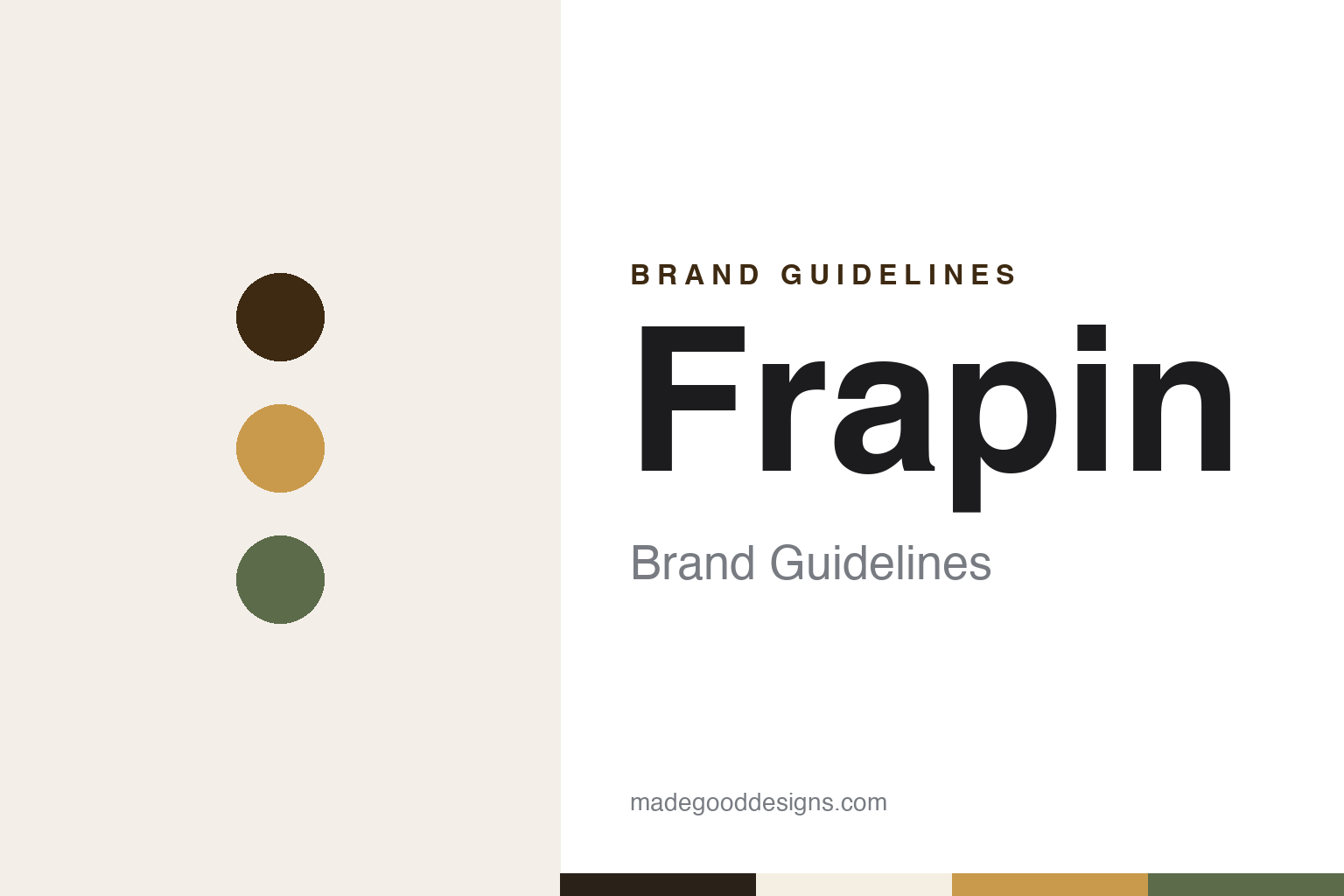
Frapin Brand Guidelines
The Segonzac estate cognac of the Renaud-Cointreau family.
Aa
Two constants: a Fontpinot gold, oak brown and vine green palette and a humanist old-style serif register. Abstract homage — not a Frapin product or mark; no label, logo or bottle is reproduced.
A family of winegrowers since 1270
Vines near Segonzac, a famous writer and a château with three towers.
Frapin is a cognac house in Segonzac, in the heart of Grande Champagne, the first growth of the Cognac region. Its headquarters are at Château Fontpinot, surrounded by the family’s vineyards. The house says the Frapin family settled near Segonzac as winegrowers in 1270 and presents that year as its founding date; The Spirits Business, in an April 2020 brand history by Tom Bruce-Gardyne, also dates the family’s arrival in the Charente to 1270, and the house marked its 750th anniversary in 2020. Over the centuries, the house says, the winegrowers became distillers.
Frapin ties its story to one of France’s great writers. The company says François Rabelais, born in 1494, was the son of Anne-Catherine Frapin, and it honours him with its Rabelais cuvées and with the feather that appears on the Frapin logo. The château took its present form in the nineteenth century: the company says Henri Frapin added the three towers of Château Fontpinot in 1872, completing the building, and The Spirits Business gives the same date in its timeline.
The house then rebuilt after phylloxera, the vine pest that ravaged the Cognac vineyards in the late nineteenth century. The company says Pierre Frapin replanted the vines the insect had destroyed and received an award from the Comice Agricole de Cognac in 1898 for doing so. In 1945, it says, Albert Frapin developed the vineyard around Château Fontpinot. English Wikipedia, citing the company, says the estate covers about 300 hectares, 240 of them under vine, all classed in Grande Champagne; the Dutch cognac reference site Cognac-ton gives a larger figure, across three estates, Gabloteaux, Fontpinot and Chez Piet.
Colour
Exhibitions, an Eiffel cellar and a single family estate.
Frapin’s early reputation was made at the great international exhibitions. The company says its cognac received a first degree of merit at the New Orleans exposition of 1885, a date The Spirits Business repeats. One of the estate’s buildings carries a famous engineering name: the company and The Spirits Business both say that Gustave Eiffel and his team built the iron framework of Frapin’s cellars at Segonzac in 1892, and the company calls it the only Eiffel work in the region.
For much of the twentieth century Frapin sold eaux-de-vie to the larger houses. The Spirits Business reported in 2020 that Frapin used to sell to Rémy Martin and changed course in the 1980s to keep its whole production; the magazine said the house keeps every drop it makes and does not buy in grapes or spirit, and that its entry-level cognac carries the strapline “single family estate.” Cognac-ton describes the sourcing differently and says Frapin also buys from other producers. The same 2020 report said around nine-tenths of Frapin’s volume is VSOP or older.
The range is led by older cognacs. The Spirits Business names Château Fontpinot XO and Frapin XO VIP among its signatures, and in 2018 the house launched Frapin 1270 to replace its VS. The cellar master is Patrice Piveteau, according to The Spirits Business and Cognac-ton, which also describes how the house moves its casks between dry and humid cellars as the spirit develops.
Typography
Design and documentation.
The seven brands in this group are all cognac and Armagnac names: Pierre Ferrand, Frapin, Darroze, Château de Laubade, Larressingle, Janneau and Tariquet. Cognac and Armagnac houses in general sit at many different points in the trade, from family estates that still carry a founder’s name to labels that now belong to much larger drinks groups, and a single brand can be sold everywhere from a corner shop to a restaurant list.
A cognac or Armagnac brand’s identity is usually carried less by a single bottle than by a label, a name and the place it promises, because the company behind the name may have changed hands, moved its production or grown far beyond the place where it started. That makes the questions behind each name worth asking plainly: who started it, who owns it now, and where its brandy is actually distilled, aged and bottled.
Each guide separates what independent sources record from what the company says about itself — its founding story, its owners over time, where its brandy is made and how its labels have changed — and marks plainly what rests only on the company’s own word.
Aa
A humanist old-style serif for a house that claims a 1270 founding. (Specimen set in Cormorant Garamond, a serif STAND-IN; NOT the Frapin logo.)
Frapin
From the Frapins to the Renaud-Cointreau family.
Frapin’s link to the Cointreau family runs through marriage and through Rémy Martin. Cognac-ton says that in 1920 André Renaud married Marie Frapin, Pierre Frapin’s daughter; English Wikipedia, citing Le Point and Les Echos, says André Renaud bought Rémy Martin in 1924. According to Cognac-ton, the Renauds’ daughter Geneviève married Max Cointreau, of the Angers liqueur family, in 1946 and inherited Frapin, and their daughter Béatrice Cointreau became Frapin’s managing director in 1984.
Frapin is not part of Rémy Cointreau. That group was formed in 1990 by the merger of Rémy Martin and Cointreau, English Wikipedia says, and Cognac-ton says Max and Geneviève Cointreau were bought out at that point while keeping Frapin. Today Frapin belongs to the Renaud-Cointreau family group, which English Wikipedia says bought the Champagne house Gosset in 1994. The Spirits Business said in 2020 that Jean-Pierre Cointreau, of the twenty-first generation, had been chief executive and president of the parent company since 2007, and that the next generation had recently joined the business. The company says Jean-Pierre Cointreau, grandson of Marie Frapin, became President of Cognac Frapin in 2024.
For a design guide, Frapin shows how a family estate can tell its whole story through one place — a château, its vines and an Eiffel cellar — and through a writer’s feather. Compare Gosset, the Champagne house owned by the same family group, and Rémy Martin, the cognac house André Renaud bought in 1924. For this guide we use Fontpinot gold, oak brown and vine green with a humanist serif, an unofficial interpretation; no product or logo is reproduced.
Explore & save
Keep Frapin’s identity on hand — save it to a board in the Made Good inspiration library.
Frapin identity set
Pin the Frapin Fontpinot gold, oak brown and vine green palette and the humanist old-style serif register to your own board.


