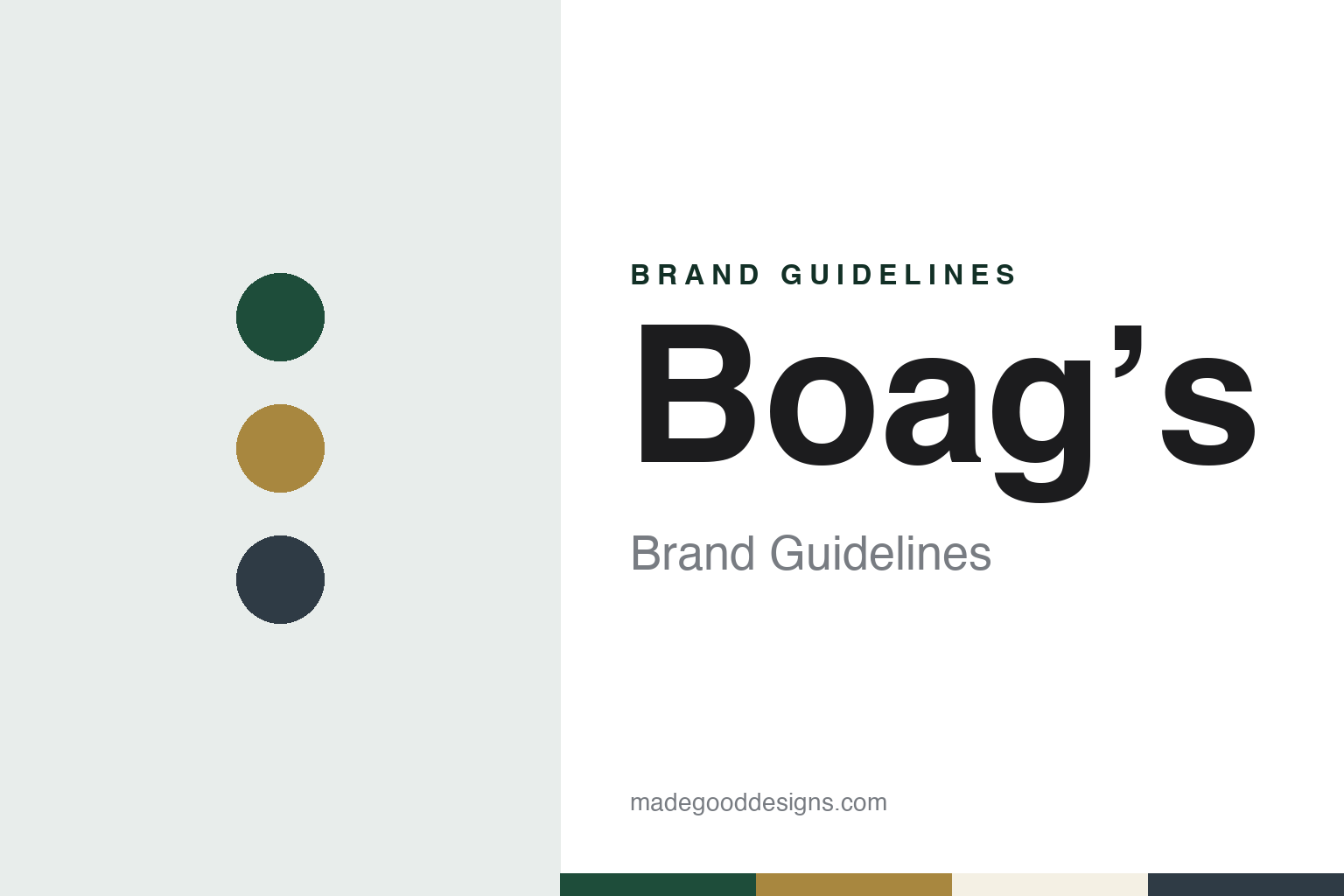
Boag’s Brand Guidelines
The Launceston brewer founded by J. Boag & Son in 1883.
Aa
Two constants: an Esk green, brass and river slate palette and a transitional serif register. Abstract homage — not a Boag’s product or mark; no label, logo or bottle is reproduced.
A father and son on the North Esk
A Scottish brewer’s family took over a Launceston brewery in 1883.
Boag’s begins with a family from Paisley. The Australian Dictionary of Biography, in Ross Smith’s entry on James Boag, says he migrated with his family to Victoria in 1853, spent a few months on the goldfields and settled in Launceston, in what was then Van Diemen’s Land. There he worked as manager and chief brewer at John Fawns’s Cornwall Brewery, where his son, also James, joined him in 1870.
The brewery that still carries the family name was not theirs to begin with. English Wikipedia says the Esk Brewery was established in 1881 on the banks of the North Esk River by Charles Stammers Button. The ADB records that in February 1883 father and son formed J. Boag & Son and bought the Esk cordial manufactory and brewery; English Wikipedia adds that the name Esk Brewery was kept, though people increasingly called it Boag’s.
The business stayed in the family for almost a century. English Wikipedia says J. Boag & Son bought the Cornwall Brewery in 1898 and merged it with the Esk Brewery; in 1919 James Boag II was followed by his son, James Boag III, who had trained at Tooth and Co.’s brewery in Sydney and served as managing director until 1944. The last family member in the business, George Boag, retired in 1976.
Colour
Tasmania itself became the brand’s strongest asset.
For decades the identity leaned on place. The ABC reported in June 2024 that the brand relied heavily on Tasmanian identity and water, quoting the company’s website as saying the brewery “still insists on using the softest Tasmanian water” and that its beers “could only be made in Tasmania.” In June 2026 the ABC noted that the brand had marketed itself as “from the pure waters of Tasmania,” and described the long-running north–south rivalry between Boag’s in Launceston and Cascade in Hobart.
The best-known beer arrived late in the company’s history. English Wikipedia says James Boag’s Premium was first released in 1994, a European-style lager brewed with pilsner malts and fermented at a lower temperature than most Australian lagers. When production of mainland-sold Premium moved off the island in 2024, the ABC reported, Lion said the beer would still be brewed “to the highest quality” but no longer advertised Tasmanian water on it.
The brewery has also been part of the brand experience. English Wikipedia says the company bought a nearby former hotel, which opened in 1826 as The Lame Dog and later traded as The Tamar Hotel, and restored it in the late 1990s as a visitor centre for tours. The ABC reported that tours closed in January 2023 and reopened with $1 million in support from the Tasmanian Government. Pulse Tasmania reported in September 2024 a $1.8 million redevelopment, with the museum display modernised and moved to the ground floor and the beer garden relocated around a heritage-listed walnut tree.
Typography
Design and documentation.
The seven brands in this group are all Australian beers: Victoria Bitter, Carlton Draught, XXXX, Tooheys, James Squire, Boag’s and Cascade. Between them they belong to just two groups, both owned from Japan. Victoria Bitter, Carlton Draught and Cascade belong to Carlton & United Breweries, which was formed in Melbourne in 1904 from a merger of six breweries, became part of Elders IXL in 1983 and so of the Foster’s group, passed to SABMiller in 2011 and to Anheuser-Busch InBev in 2016, and has been owned by Asahi since June 2020, English Wikipedia records. Cascade joined CUB in 1993, the Tasmanian Business Reporter says.
XXXX, Tooheys, James Squire and Boag’s belong to Lion, which took shape in October 2009 when Kirin bought the brewer Lion Nathan, English Wikipedia says. The Queensland and New South Wales names came first: Castlemaine Perkins, the Brisbane home of XXXX, merged with Tooheys of Sydney in 1980, the combined company was bought by the Bond Corporation in 1985, and Lion Nathan took full control in 1992. James Squire is younger: it was launched at the Malt Shovel Brewery in Camperdown, Sydney, founded as the Hahn Brewery by Chuck Hahn in 1988, backed by Lion from 1993 and renamed in 1998 after the tavern of the First Fleet convict-brewer James Squire. Boag’s, the Launceston brewery formed as J. Boag & Son in 1883, was bought by San Miguel in 2000 and by Lion Nathan in November 2007.
A beer brand’s identity is carried less by a recipe than by a name, a label and the place it promises — a brewery tower, a home state, a founder’s story — even after the company behind it has changed hands several times. Each guide separates what independent sources record from what the company says about itself: who started it, who owns it now, where it is brewed and how its look has changed.
Aa
A transitional serif for a nineteenth-century Tasmanian brewer’s name. (Specimen set in Libre Baskerville, a serif STAND-IN; NOT the Boag’s logo.)
Boag’s
From a Philippine owner to Lion, and from Launceston to the mainland.
Ownership left Tasmania in this century. English Wikipedia, citing Asia Times, says the previously listed J. Boag & Son was acquired by San Miguel Corporation in 2000, which kept the existing Tasmanian management in place. In 2004, English Wikipedia adds, the brewery grew to fill the whole block bounded by William, Tamar and Shield Streets and The Esplanade. Then, The Age reported in November 2007, San Miguel sold it to Lion Nathan. Japan’s Kirin completed its takeover of Lion Nathan in 2009, so Boag’s has belonged to the Kirin group, through Lion, since then — alongside James Squire.
Where the beer is made has changed fast. The ABC reported in June 2024 that Lion would move production of Boag’s beer sold on the mainland, including James Boag’s Premium, to mainland breweries, with 13 redundancies, and that the company was spending more than $1.5 million a year transporting beer back to the mainland; Lion’s managing director James Brindley said, “What’s consumed on the mainland will now be made on the mainland.” On 2 June 2026 the ABC reported that Lion would stop brewing at Launceston by November 2026, affecting 42 jobs, citing a long-term decline in the national beer market and cost inflation, with the brewery running at about a fifth of capacity. Lion said the brand would continue to be brewed at its other breweries and that the redeveloped Boag’s Brewhouse in Launceston would stay open while options for the site were explored.
The name needs care online. The company’s site is jamesboag.com.au, and English Wikipedia also lists boags.com.au for the Premium lager.
For a design guide, Boag’s shows how a regional brewer can make an island and its water the heart of a brand — and how that promise is tested when production moves away. Compare Cascade, its Hobart rival, and James Squire, a fellow Lion brand. For this guide we use Esk green, brass and river slate with a transitional serif, an unofficial interpretation; no product or logo is reproduced.
Explore & save
Keep Boag’s’s identity on hand — save it to a board in the Made Good inspiration library.
Boag’s identity set
Pin the Boag’s Esk green, brass and river slate palette and the transitional serif register to your own board.