Cascade Brand Guidelines
The Hobart brewery that began as a sawmill in 1824.
Aa
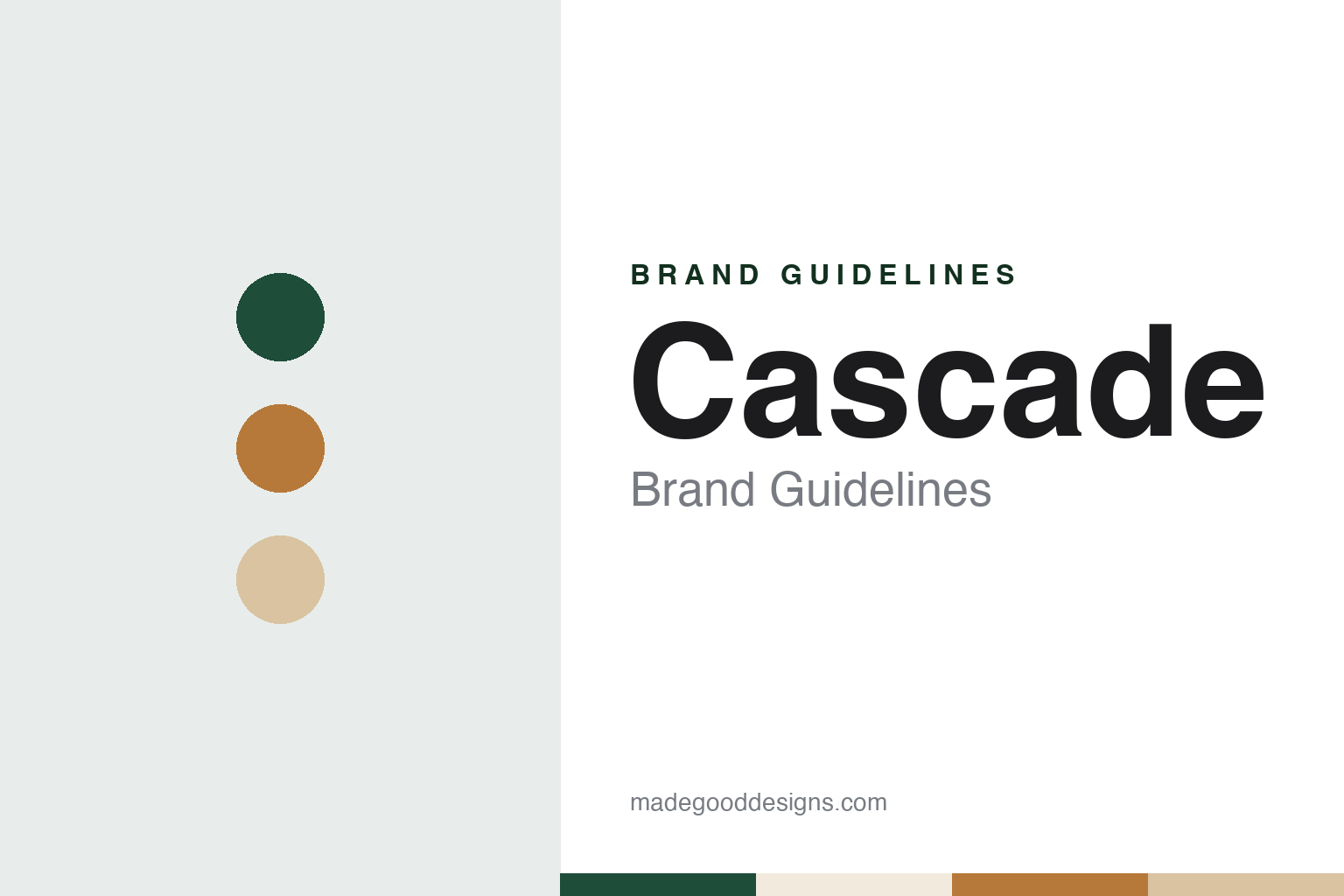
Two constants: a rivulet green, tiger ochre and sandstone palette and a colonial book serif register. Abstract homage — not a Cascade product or mark; no label, logo or bottle is reproduced.
A sawmill, a gaol term and a brewery
Two partners, a land grant on the mountain and a brewery that came eight years later.
Cascade did not begin as a brewery. Its owner, Asahi Beverages, says the story started in 1824, when Peter Degraves and Hugh Macintosh used a 2,000-acre grant to set up a sawmill on the lower slopes of kunanyi/Mount Wellington in South Hobart. English Wikipedia says the mills, run by a partnership called Macintosh and Degraves, began operating in 1825. The company is plain that brewing came later: in its own words, the site “didn’t commence brewing until 1832,” and the 200-year anniversary it marked in 2024 counts from the sawmill, not the first brew.
Who founded the brewery has itself become part of the story. For most of its history the business was credited to Degraves alone; the Guide to Australian Business Records still says he built the brewery in 1824. English Wikipedia records that research by the historian Greg Jefferys for a master’s thesis, completed around 2011 and held by the University of Tasmania, showed that Macintosh, a retired East India Company officer who had sailed out with Degraves on the ship Hope, was the major partner. In 1826 Degraves was taken into custody over debts incurred in England and held until 1832; Wikipedia says the brewery was founded beside the Hobart Rivulet in 1832 by Macintosh with Degraves’s nephews Henry and Charles, and that Degraves ran and expanded it after his release. The Tasmanian Business Reporter, marking the bicentenary in June 2024, put it simply: from the 1830s the founding was linked mainly to Degraves for the next 190 years. Asahi’s own account now names both men.
Wikipedia says control passed in 1852 to Degraves’s eldest son Henry, and two years later to James Wilson, the husband of Degraves’s youngest daughter. The Guide to Australian Business Records says The Cascade Brewery Company Ltd was incorporated in Tasmania in May 1883 to take over the assets and business of the Degraves interests.
Colour
A seven-storey sandstone brewery, a fire and a tiger on the label.
The building is the brand’s most recognisable asset. Asahi describes it as a seven-storey sandstone brewery, and the original homestead on the site now houses the Cascade Brewery Bar. In 1967 the Black Tuesday bushfires swept south-east Tasmania and, English Wikipedia says, almost completely destroyed the brewery building; it was brewing again three months later. The Tasmanian Business Reporter adds that Boag’s and Carlton & United bottled beer for Cascade while it was rebuilt. The brewery is listed on the Tasmanian Heritage Register, and in November 2025 Asahi announced a restoration of the façade costing more than $1 million — which it called the most significant repair to the building since the post-fire rebuild — with plans approved by Heritage Tasmania. In August 2026 the company said that restoration was complete.
The label carries an animal that no longer exists. English Wikipedia says that in 1987 Cascade adopted for its label a nineteenth-century illustration of the Tasmanian tiger, or thylacine, printed by Henry Constantine Richter for John Gould’s The Mammals of Australia.
Cascade has also used its range to make points about place and process. Wikipedia says the brewery runs its own maltings, using locally grown barley for its mainstream beers, and that it has brewed an annual First Harvest ale with unkilned Tasmanian hops since 2002; the Tasmanian Business Reporter notes the beer was relaunched in 2021. In March 2008 Cascade launched Cascade Green, sold as a carbon-neutral beer with vegetable-ink labels and a lighter bottle; it was renamed Cascade Pure in November 2010, Wikipedia says. Wikipedia says a Tasmanian range, among them Cascade Draught, is sold only in the state. Its non-alcoholic drinks went a different way: Wikipedia says the Cascade Beverages range of cordials, syrups and mixers was acquired by Coca-Cola Amatil in 2013.
Typography
Design and documentation.
The seven brands in this group are all Australian beers: Victoria Bitter, Carlton Draught, XXXX, Tooheys, James Squire, Boag’s and Cascade. Between them they belong to just two groups, both owned from Japan. Victoria Bitter, Carlton Draught and Cascade belong to Carlton & United Breweries, which was formed in Melbourne in 1904 from a merger of six breweries, became part of Elders IXL in 1983 and so of the Foster’s group, passed to SABMiller in 2011 and to Anheuser-Busch InBev in 2016, and has been owned by Asahi since June 2020, English Wikipedia records. Cascade joined CUB in 1993, the Tasmanian Business Reporter says.
XXXX, Tooheys, James Squire and Boag’s belong to Lion, which took shape in October 2009 when Kirin bought the brewer Lion Nathan, English Wikipedia says. The Queensland and New South Wales names came first: Castlemaine Perkins, the Brisbane home of XXXX, merged with Tooheys of Sydney in 1980, the combined company was bought by the Bond Corporation in 1985, and Lion Nathan took full control in 1992. James Squire is younger: it was launched at the Malt Shovel Brewery in Camperdown, Sydney, founded as the Hahn Brewery by Chuck Hahn in 1988, backed by Lion from 1993 and renamed in 1998 after the tavern of the First Fleet convict-brewer James Squire. Boag’s, the Launceston brewery formed as J. Boag & Son in 1883, was bought by San Miguel in 2000 and by Lion Nathan in November 2007.
A beer brand’s identity is carried less by a recipe than by a name, a label and the place it promises — a brewery tower, a home state, a founder’s story — even after the company behind it has changed hands several times. Each guide separates what independent sources record from what the company says about itself: who started it, who owns it now, where it is brewed and how its look has changed.
Aa
A colonial book serif for a brewery that counts its age from 1824. (Specimen set in Libre Caslon Text, a serif STAND-IN; NOT the Cascade logo.)
Cascade
From a Tasmanian listed company to Carlton & United, and on to Asahi.
For most of the twentieth century Cascade was an independent Tasmanian company. The Guide to Australian Business Records says it acquired Traders Pty Ltd in 1933 and took over J. Boag & Son of Launceston in 1957; the Tasmanian Business Reporter dates the first link with Boag’s to 1922 and says the two breweries largely ran independently. Control changed in January 1984, when Industrial Equity Ltd took a controlling interest, and the company left the Australian Stock Exchange in June 1985 after a takeover by Cascade (Tasmania) Pty Ltd, the same guide says.
The brewery joined the mainland majors in 1993, when Carlton & United Breweries bought it from the Cascade Group, the Tasmanian Business Reporter says. CUB was then part of the Foster’s group, and Cascade followed it through each change of owner: SABMiller bought Foster’s in December 2011, Anheuser-Busch InBev took over SABMiller in October 2016, and Japan’s Asahi completed its purchase of CUB in June 2020, English Wikipedia and the brewing trade site Brews News record. Cascade has been owned by Asahi since then. Asahi says Cascade still brews at the South Hobart site, which its 2025 announcement said draws around 300,000 visitors a year; in 2018 Carlton & United invested $10 million to modernise and expand it. In August 2026 Asahi launched Cascade Draught 3.5%, which it believes is the brewery’s first mid-strength beer, sold only in Tasmania.
One practical note: Cascade Brewing in Portland, Oregon, is an unrelated American brewery, and several other drinks share the Cascade name, so the Hobart link matters when searching.
For a design guide, Cascade shows how a brewery can borrow its authority from a building and a landscape — a sandstone tower under a mountain — and from a native animal on the label rather than a founder’s face. Compare Boag’s, the Launceston brewery that shared its history for decades, and Lark Distillery, another Tasmanian drinks name built on local provenance. For this guide we use rivulet green, tiger ochre and sandstone with a book serif, an unofficial interpretation; no product or logo is reproduced.
Explore & save
Keep Cascade’s identity on hand — save it to a board in the Made Good inspiration library.
Cascade identity set
Pin the Cascade rivulet green, tiger ochre and sandstone palette and the colonial book serif register to your own board.


