Stella & Chewy’s Brand Guidelines
The raw pet food started in a Manhattan kitchen and made in Wisconsin.
Aa
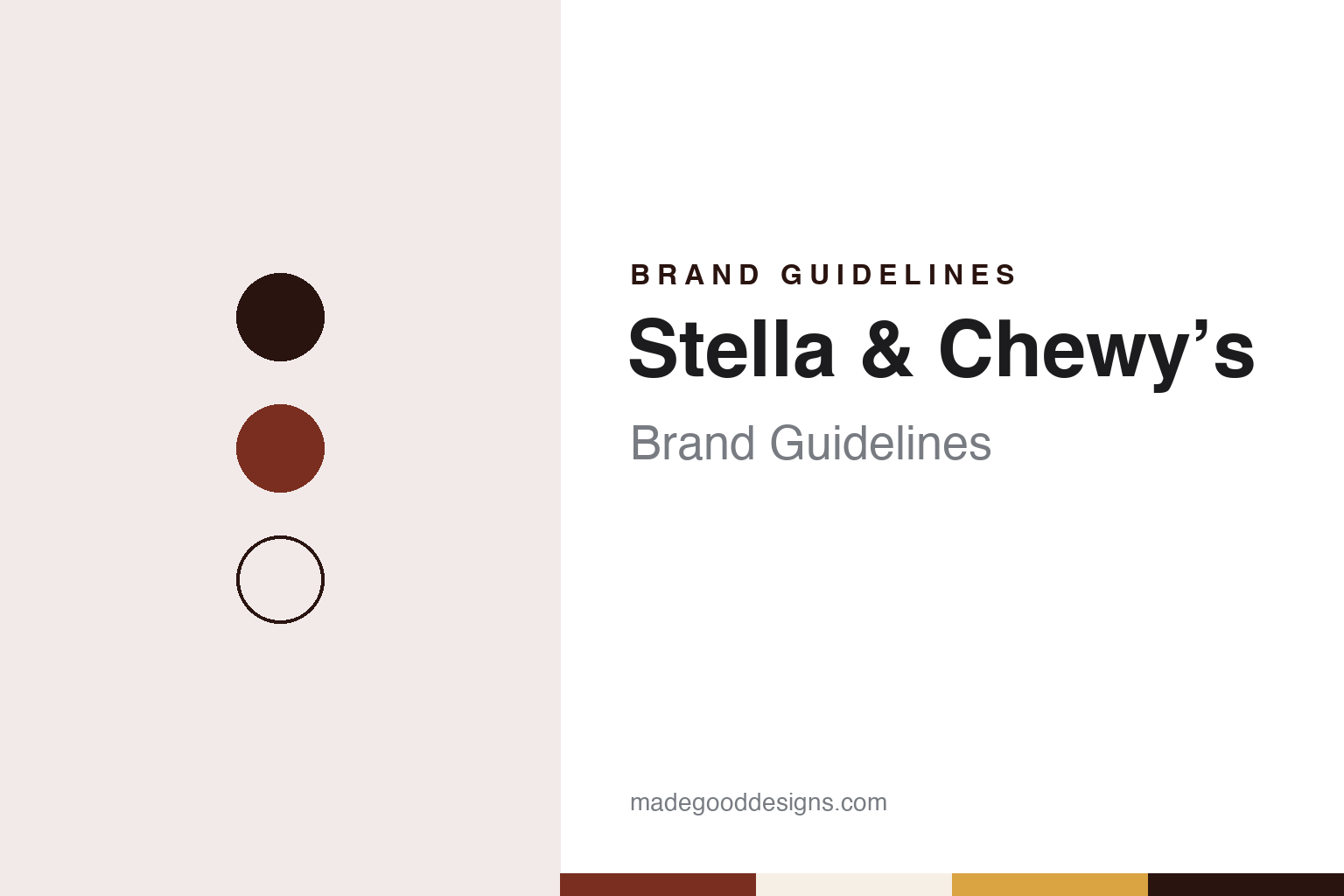
Two constants: a brick, cream and mustard palette and a friendly geometric sans register. Abstract homage — not a Stella & Chewy’s product or mark; no bag, logo or label is reproduced.
Stella and Chewy
A fashion rep, two rescue dogs and a home freezer.
Stella & Chewy’s is named after two dogs. Its founder, Marie Moody, was working in New York as a sales and marketing representative for fashion labels, NBC News reported in June 2010, when she adopted a dog called Chewy, described in that report as an Airedale and Shar-Pei mix, who was seriously ill when he came to her. A veterinarian suggested a raw diet, and Moody began making his meals herself from raw meat, bones, vegetables and fruit. Her other dog, Stella, a terrier mix, joined the household too; the company’s own account dates Stella’s adoption from a shelter to 1997, while the 2010 report puts Chewy first, so the order of the two adoptions differs between sources.
Moody started the business in 2003 from the kitchen of her Manhattan apartment, NBC News reported, using a loan from her father to buy freezers for pet stores in New York City and making deliveries by taxi. At first she prepared, marketed and sold the food herself, the report says, with her dogs as her only co-workers, and by 2010 she was donating part of the company’s profits and products each year to animal rescue and welfare groups. Stripes, the New York growth investor that later backed the company, gives the same founding year and story in its portfolio profile.
Moody told NBC News that the raw diet “made perfect sense” to her because “animals don’t cook for themselves,” and that she wanted a food with the benefits she saw in raw feeding that was also convenient and safe to handle. Her home recipes, the report says, used free-range meat raised without antibiotics or hormones, organic produce and no grains.
The company’s own About page tells the story through the dogs rather than the business. It says Chewy “helped write the company’s history,” and it frames the brand around Moody’s decision to turn what she had learned feeding her own pets into a company.
Colour
From Manhattan to Muskego to Oak Creek.
New York did not stay the base for long. In 2007, NBC News reported, Moody outgrew her apartment and, finding New York property too expensive, returned to her home area of Muskego, a suburb of Milwaukee, Wisconsin, where she started in a factory with two employees; by 2010, the report said, she had already filled that space and was looking to expand further. The same report says she worked with a professor at Kansas State University on a patented food-safety process designed to kill harmful bacteria without cooking the food, and that each batch was tested by an outside laboratory; those details come from the company as reported by NBC News.
Outside money followed. Stripes, the New York growth-equity firm, lists Stella & Chewy’s as an investment it has held since 2013; its profile, which it says reflects information as of October 2019, says Moody was not seeking investors when she chose to partner with the firm, and that the products were then made exclusively in the company’s own plant in Milwaukee. Stripes named its partners Ken Fox and Karen Kenworthy, and a former operating partner, Ron Doornink, on the company’s board, and the same profile described Moody as president and founder. The profile also said the food was then sold nationally through specialty pet retailers.
The leadership has since changed several times. In June 2025 the company announced Jay Thompson as chief executive, with Moody, who had served as interim chief executive from 2024, remaining as founder and Ken Fox as chairman of the board, according to a Pet Insight report dated 30 June 2025. The company’s website now gives its address in Oak Creek, Wisconsin, just south of Milwaukee.
Typography
Design and documentation.
The seven brands in this group all sell to people who keep pets: Hurtta, LickiMat, ORIJEN, Tiki Cat, Wellness, Stella & Chewy’s and Frisco. Some make food and treats, some make the gear around the bowl — coats, mats, crates and toys — and they reach owners through very different routes, from specialist pet shops to large online retailers.
They also sit at different points in the trade, and two examples show the range. ORIJEN is made by Champion Petfoods, which Mars Petcare has owned since 2023, when the closing of its purchase from an investor group was announced. Frisco is not a separate company at all but an own label of the online retailer Chewy, which says it launched the brand in 2016 as its first private brand for durable goods.
A pet brand’s identity is usually carried by its packaging, its name and the story it tells about where its products come from, and those can stay the same while the company behind them changes hands or moves production. That makes the plain questions worth asking: who started the brand, who owns it now, and where its products are actually made.
Each guide separates what independent sources record from what the company says about itself — its founding story, its owners over time, where its products are made and how its packaging and marks have changed — and marks plainly what rests only on the company’s own word. None of these guides makes any claim about the health effects of a product.
Aa
A friendly geometric sans — the register of a brand named after two dogs. (Specimen set in Poppins, a sans STAND-IN; NOT the Stella & Chewy’s logo.)
Stella & Chewy’s
Raw food in a convenient form.
The brand’s range is built on raw food in forms that can be stored and served easily. Stripes described the products in 2019 as dinners for dogs, dinners for cats and treats for dogs in the freeze-dried and frozen categories, alongside kibble; in 2025 Moody summed up the company’s purpose as “premium raw nutrition, delivered in the most convenient form possible,” Pet Insight reported.
The company makes a series of claims about its ingredients on its own website. It says the animal proteins in its recipes are “grass-fed, cage-free, wild-caught, and farm-raised,” that it uses organic fruit and vegetables, and that it does not use artificial preservatives, colours or flavours; those are the company’s statements rather than independent findings.
The name joins the two dogs with an ampersand, and the company’s About page tells its history through Stella and Chewy rather than through the factory. The brand is unrelated to the online pet retailer Chewy, whose name is similar.
For a design guide, Stella & Chewy’s shows how a founder’s own pets can become the whole identity of a brand. Compare Wellness Pet Food, a natural pet-food brand with a much older company behind it, and ORIJEN, another premium food built around meat-first recipes. For this guide we use a brick red, cream and mustard with a sans, an unofficial interpretation; no product or logo is reproduced.
Explore & save
Keep Stella & Chewy’s’s identity on hand — save it to a board in the Made Good inspiration library.
Stella & Chewy’s identity set
Pin the Stella & Chewy’s brick, cream and mustard palette and the friendly geometric sans register to your own board.