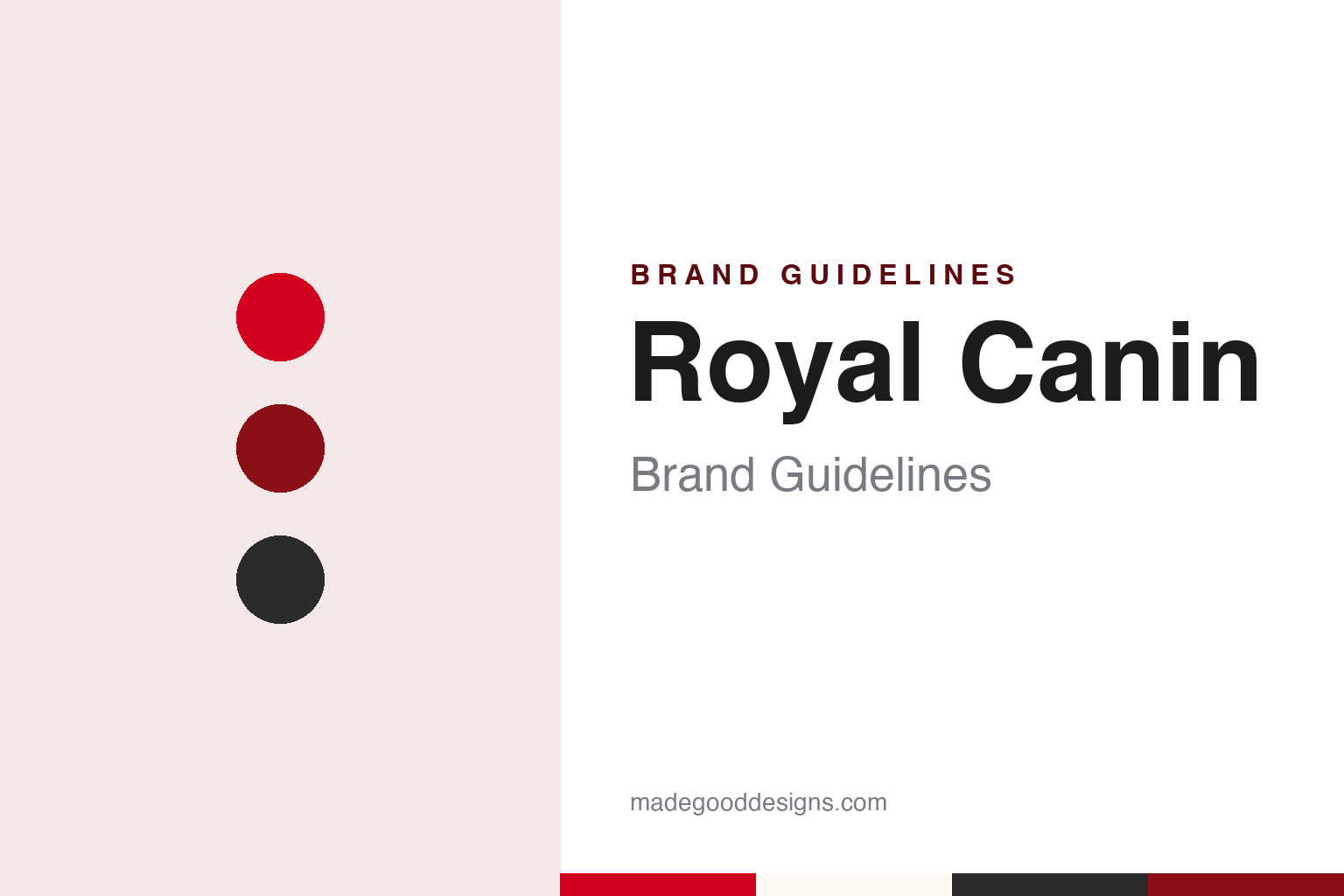
Royal Canin Brand Guidelines
A French veterinarian’s 1968 pet food, owned by Mars since 2002.
Aa
Two constants: a crown red, deep red and charcoal palette and a classic serif register. Abstract homage — not a Royal Canin product or mark; no bag, can, crown or logo is reproduced.
A veterinarian’s kitchen in the Gard
From a home-cooked recipe to a factory in Aimargues.
Royal Canin began with a veterinarian. French Wikipedia, citing the regional daily Midi Libre (2018), says Jean Cathary, a vet in the Gard département of southern France, filed the Royal Canin trademark at the chamber of commerce in Nîmes on 4 January 1968. The company tells the story as a “yellow soup” Cathary prepared for dogs. English Wikipedia, citing a 2006 business study by Jean-Claude Thoenig and Charles Waldman published by Palgrave Macmillan, adds that he first cooked a cereal-based food in his garage oven and later imported an extruder from the United States, the machine that turns dough into dry kibble.
The business soon outgrew the garage. Both Wikipedias say the first factory opened in Aimargues, a small town in the Gard, in 1970. In March 1972 Cathary sold the company to the Guyomarc’h group, a Breton family firm in animal feed founded in 1954; the company says Guyomarc’h brought money, research and strategy, and that by 1974 its food was sold in eight European countries. English Wikipedia dates a second French factory, in Cambrai, to 1975.
The next owners were financiers. In 1990 Paribas Affaires Industrielles bought the Guyomarc’h group, and the company says this was the start of its international growth. The brand had already crossed the Atlantic: Royal Canin says it launched in the United States in 1985 through four importers. In 1997 Royal Canin was listed on the Paris stock exchange, and English Wikipedia records that it bought Crown Pet Foods in 1999 and the British brand James Wellbeloved in 2000.
Then came Mars. WARC reported on 11 July 2001 that a deal for Mars to buy Royal Canin had been confirmed, and Les Echos reported on 18 February 2002 that Brussels had cleared the purchase; English Wikipedia says Paribas sold its holding to Mars in July 2002 and that the shares were then delisted. The company dates its entry into Mars to 2002, and Mars has owned the brand since then. Royal Canin is still run from France: French Wikipedia gives its head office as Aimargues, and LSA reported in June 2022 that Cécile Coutens would succeed Loïc Moutault as its chief executive.
Colour
A crown, a founding date and food sorted by breed.
The mark is a crown. On its French history page the company shows a red crown beside the line “Marque française depuis 1968” — French brand since 1968 — and presents the crown as a symbol of its expertise in cat and dog nutrition. The name itself does the rest of the work: canin is French for canine, so the brand name reads as “royal canine,” even on the cat range.
The way the range is organised is part of the identity. The company says it launched AGR, a complete food for large-breed puppies, in 1980; a range called RCFI, sold through breeders and veterinarians rather than supermarkets, in 1994; and in 1997 a programme called SIZE, which sorted dog food by the size and age of the dog. In 1999, the company says, it introduced a breed-specific food for Persian cats, with an almond-shaped kibble designed around the breed’s jaw and the way it picks up food, followed in 2002 by a food for Yorkshire Terriers.
Royal Canin has also published for the people who buy its food. The company says it issued a dog encyclopedia in 1997 and a cat encyclopedia in 1998, and French Wikipedia notes that from 1990 it distributed the magazine Veterinary Focus. In 2003, the company says, it launched its veterinary range, developed with the Waltham Centre for Pet Nutrition, the Mars research centre in England, and in 2009 it moved into pouches of wet cat food.
One advertisement became part of French popular culture. The company dates to 1982 a film of a dog running free, set to music from the film Le Professionnel; French Wikipedia describes a German Shepherd filmed in slow motion to Ennio Morricone’s “Chi Mai” in campaigns of 1986 and 1991, and notes that Alain Chabat parodied the scene in Astérix & Obélix : Mission Cléopâtre in 2002.
Typography
Design and documentation.
The seven brands in this group are all pet food names: Royal Canin, Purina Pro Plan, Hill’s, Pedigree, Whiskas, Felix and ACANA. Pet food brands in general sit at many different points in the trade, from names that began with a single founder or a small regional company to labels that now belong to much larger food and consumer-goods groups, and a single brand can be sold everywhere from a supermarket shelf to a specialist pet shop or a veterinary practice.
A pet food brand’s identity is usually carried less by the food itself than by a name, a bag or a can, an animal on the label and the promise the company makes about where its food comes from, because the company behind the name may have changed hands, moved its production or grown far beyond the place where it started. That makes the questions behind each name worth asking plainly: who started it, who owns it now, and where its food is actually made.
Each guide separates what independent sources record from what the company says about itself — its founding story, its owners over time, where its food is made and how its packaging and advertising have changed — and marks plainly what rests only on the company’s own word. None of the guides assesses the food, and none repeats a company’s claims about health or nutrition.
Aa
A classic serif for a crowned French name. (Specimen set in Cormorant Garamond, a serif STAND-IN; NOT the Royal Canin logo.)
Royal Canin
A French brand on factory sites around the world.
Under Mars the brand spread its production. French and English Wikipedia list plants opened at Dmitrov, near Moscow, in 2004; Niepołomice in Poland in 2007; and Guelph, Ontario, in 2008, while Mars bought a plant in North Sioux City, South Dakota, in 2007 that English Wikipedia says took the Royal Canin name in 2011. The company says its first Asian factory opened in 2009 and its fifteenth, at Gimje in South Korea, in 2018. Pet Food Processing reported in March 2021 on plans to grow its site in Lebanon, Tennessee. In 2004, The New York Times reported, Mars bought three veterinary pet food brands from Del Monte Foods for Royal Canin.
Inside Mars, Royal Canin sits beside very different pet food brands: the supermarket names Pedigree and Whiskas, and, since 2023, the Canadian maker of ORIJEN and ACANA. Royal Canin keeps its own name, its own crown and its own head office in the Gard. Les Echos reported in September 2021 that the company had launched a foundation to support research, and in 2018 the brand marked its fiftieth anniversary, which Capital covered under the headline “Royal Canin, 50 ans et toujours innovant.”
Its home town is part of the story. The company says its Aimargues campus opened in 2001, and French Wikipedia lists a logistics platform at Verdun from 2012. The brand’s own site is royalcanin.com, with editions for individual countries.
For a design guide, Royal Canin shows how a single crown, a founding date written into the mark and a range sorted by breed and size can carry a French veterinarian’s recipe into dozens of markets; compare it with the Mars stable mate Pedigree and the Nestlé rival Purina Pro Plan. For this guide we use crown red, deep red and charcoal with a classic serif, an unofficial interpretation; no product or logo is reproduced.
Explore & save
Keep Royal Canin’s identity on hand — save it to a board in the Made Good inspiration library.
Royal Canin identity set
Pin the Royal Canin crown red, deep red and charcoal palette and the classic serif register to your own board.