Whiskas Brand Guidelines
Mars’s purple cat food and the “8 out of 10 cats” line.
Aa
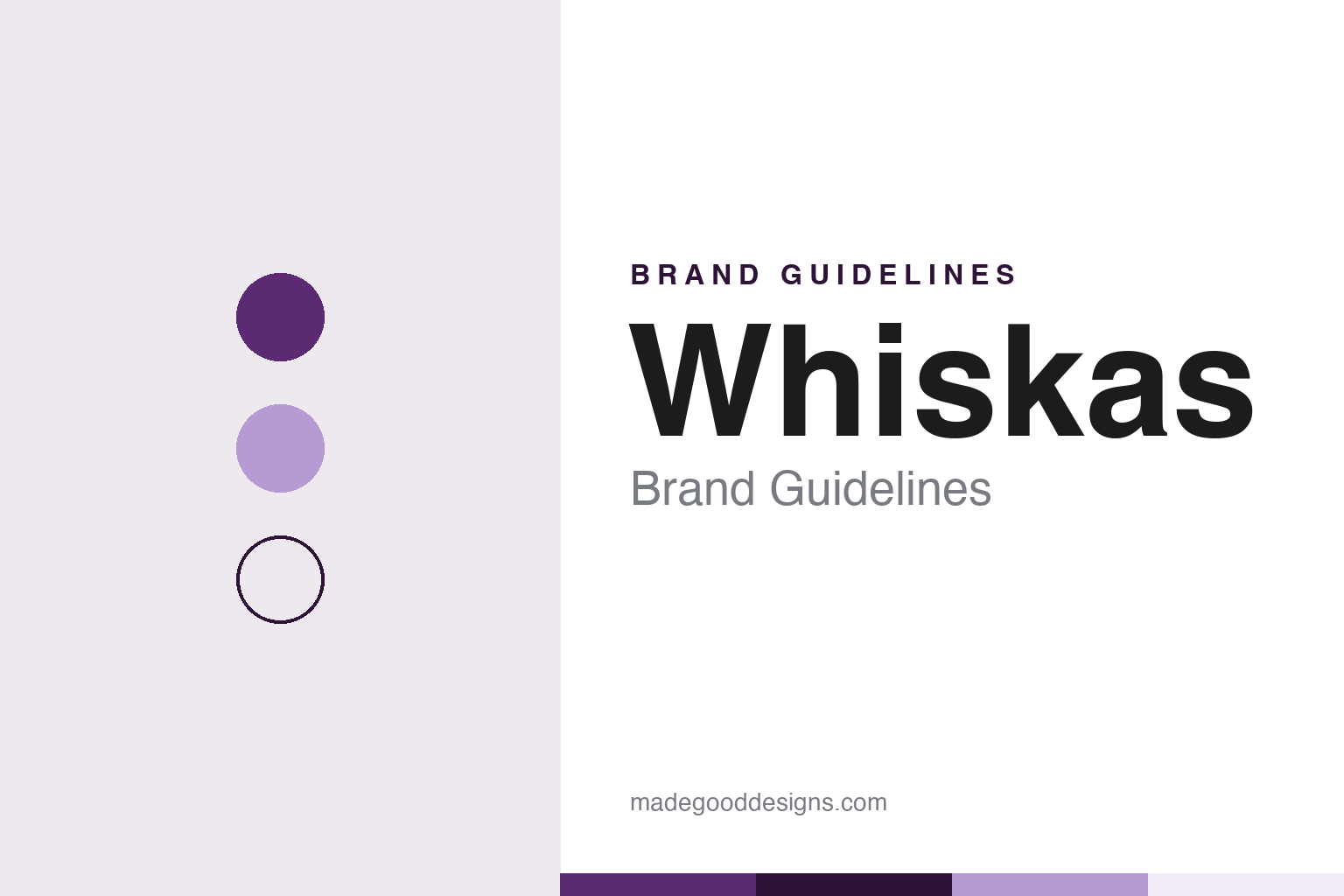
Two constants: a Whiskas purple and lilac palette and a Rounded sans register. Abstract homage — not a Whiskas product or mark; no pack, logo or cat’s-head silhouette is reproduced.
From Kal Kan to Whiskas
A British launch and an American rename.
Whiskas is the cat food brand of Mars, the American confectionery and pet care company, and it began in Britain. English Wikipedia, citing The Guardian in 2006, says the brand entered the UK market under the Whiskas name in 1958 and was later expanded across Europe. A company history published in 1998 in the International Directory of Company Histories gives a different year: it says Pedigree Petfoods, which it calls “an English company,” launched Whiskas cat food in Europe in 1959. We give both dates.
The British business behind it was Mars’s own. Forrest Mars Sr. had moved to Britain and started his own company, Mars Limited, in Slough in 1932, English Wikipedia says. The pet food company that launched Whiskas became known as Pedigree Petfoods; Wikipedia describes the Whiskas business as a subsidiary of Petfoods Ltd, “later re-named Pedigree Petfoods.”
In the United States the brand arrived the other way round, by renaming an existing one. The 1998 company history says Kal Kan began making pet food near Los Angeles in 1936, first as the Stirling Packing Company, and that Mars bought it in the 1960s; English Wikipedia gives 1968. Kal Kan cat food was later renamed Whiskas. The 1998 history dates that to 1988, adding that the Crave dry food became Whiskas Dry; English Wikipedia gives 1989 and says the change brought the cat food under a single international brand with aligned advertising, a year after Kal Kan dog food had become Pedigree. Wikipedia adds that Japan and some other markets still use the KalKan name.
Colour
Eight out of ten.
The line most people remember is “8 out of 10 cats prefer Whiskas,” and it is a misquotation. English Wikipedia, citing the 2014 textbook Advertising and Promotion by Chris Hackley and Rungpaka Amy Hackley, says the advertisements actually said that eight out of ten owners said their cat preferred it, and that after a complaint to the Advertising Standards Authority the wording became “In tests, 8 out of 10 owners who expressed a preference, said their cat preferred it.”
The phrase escaped the brand. The British comedy panel show 8 Out of 10 Cats takes its name from it, and other advertisers borrowed it: Wikipedia records a Red Stripe lager line from the 1980s, “9 out of 10 cats prefer it.”
In 2026 Whiskas returned to the formula itself. Its global campaign “Trust the Purr,” created with the agency AMV BBDO and reported by Creative Salon on 31 March 2026, called “8 out of 10 cats love WHISKAS” the brand’s “long-standing claim”. The films, Creative Salon reported, show real cats taste-testing the recipe, on the premise that “cats make the final decision.”
Elsewhere the brand built a related idea: that cats themselves would choose it. English Wikipedia lists local versions of a “cats would buy Whiskas” slogan in markets including Germany, Austria, France, Poland, Russia, Sweden and the Netherlands.
Whiskas has also aimed advertising at the animals directly. In 1999, Wikipedia records, it aired a television commercial addressed to cats in Britain and the United States. Its stunts have also reached sport. In 1999, English Wikipedia says, the Australian rules footballer Garry Hocking changed his name by deed poll to “Whiskas” as part of a Geelong Football Club promotion.
Typography
Pet food and documentation.
The seven brands in this group are all pet food names: Royal Canin, Purina Pro Plan, Hill’s, Pedigree, Whiskas, Felix and ACANA. Pet food brands in general sit at many different points in the trade, from names that began with a single founder or a small regional company to labels that now belong to much larger food and consumer-goods groups, and a single brand can be sold everywhere from a supermarket shelf to a specialist pet shop or a veterinary practice.
A pet food brand’s identity is usually carried less by the food itself than by a name, a bag or a can, an animal on the label and the promise the company makes about where its food comes from, because the company behind the name may have changed hands, moved its production or grown far beyond the place where it started. That makes the questions behind each name worth asking plainly: who started it, who owns it now, and where its food is actually made.
Each guide separates what independent sources record from what the company says about itself — its founding story, its owners over time, where its food is made and how its packaging and advertising have changed — and marks plainly what rests only on the company’s own word. None of the guides assesses the food, and none repeats a company’s claims about health or nutrition.
Aa
A rounded sans — WHISKAS in capitals. (Specimen set in Nunito, a rounded sans STAND-IN; NOT the Whiskas logo.)
Whiskas
Purple, and a cat’s head.
Whiskas’s look is built on colour. English Wikipedia describes its packaging as a recognisable purple and its logo as a stylised silhouette of a cat’s head. The brand sets its own name in capitals, as WHISKAS®, on its British website and in its campaign credits. No official colour values are published, so the purple and lilac here are our interpretation.
The range follows the formats of modern cat food. Wikipedia lists meaty pieces in sauce, gravy or jelly in tins, foil trays and pouches, small biscuits in cartons or pouches, and milk in small bottles. The brand’s British website organises its food into dry, wet, jelly, gravy, treats and milk, and by life stage, from kitten to senior.
The brand sits beside Mars’s other pet foods, and its history is tied to them. In the United States the same renaming that created Whiskas from Kal Kan cat food turned Kal Kan dog food into Pedigree, according to Wikipedia; in Britain both names belonged to the company that came to be called Pedigree Petfoods.
For a design guide, Whiskas shows how one colour and one advertising claim can carry a brand across languages for more than six decades. Compare Pedigree, its Mars stablemate for dogs, and Snickers, another Mars brand. For this guide we use a deep purple and a lilac with a rounded sans, an unofficial interpretation; no product or logo is reproduced.
Explore & save
Keep Whiskas’s identity on hand — save it to a board in the Made Good inspiration library.
Whiskas identity set
Pin the Whiskas purple and lilac palette and the Rounded sans register to your own board.