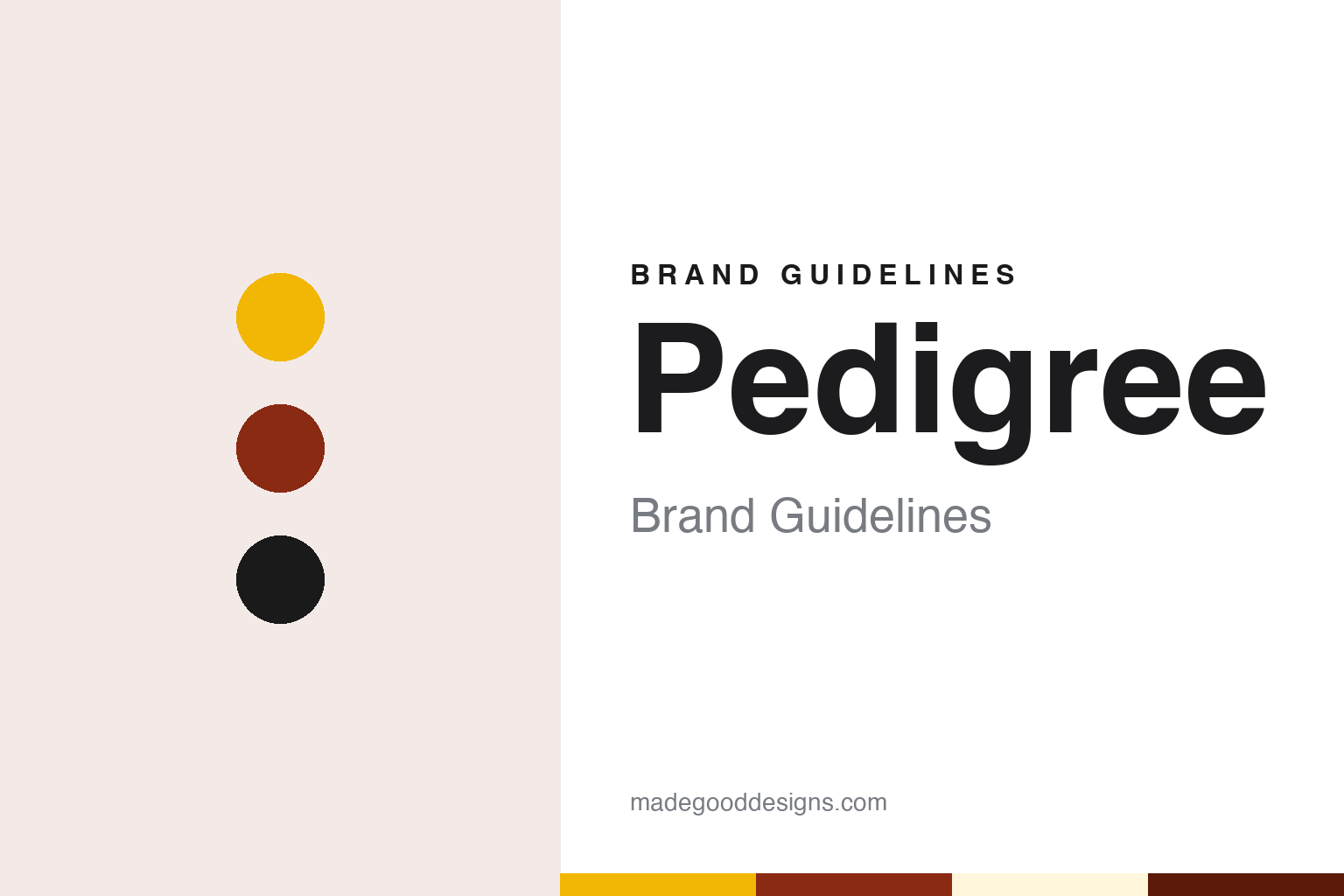
Pedigree Brand Guidelines
Mars’s dog food brand, from Pedigree Chum to “Feed the Good.”
Aa
Two constants: a kennel yellow, rust red and biscuit cream palette and a Bold grotesque sans register. Abstract homage — not a Pedigree product or mark; no pack, logo or label is reproduced.
Chappie, Pal and Pedigree Chum
A Mars pet business that began with a canner.
Pedigree is a dog food brand of Mars, and its story starts with that company’s first step into pet food. Mars’s own history says that in 1935 it acquired Chappel Brothers, a UK firm making Chappie canned dog food; English Wikipedia, citing Kenneth Hudson’s Industrial History from the Air (1984), dates the purchase of the Manchester company to 1934, by Mars’s British arm, based in Slough since 1932. The two sources differ by a year.
Other Mars pet brands came before Pedigree. Mars says Pal dog food was launched in the UK in 1954 under the name Meet, and that Whiskas cat food followed in Britain in 1958; it had already advertised Kitekat cat food in the UK in 1939, and it began making pet food at Wodonga, in Australia, in 1967. In 1965, the company says, it established the Waltham Centre for Pet Nutrition in the UK, whose science the Pedigree website still cites. Pedigree itself, by the brand’s own account, arrived in 1960, when Pedigree Chum wet dog food in cans was launched in the UK, “marking the brand’s entry into the pet food market.”
The British business came to carry the name as well. English Wikipedia’s article on Pedigree Petfoods describes it as a subsidiary of Mars Petcare, a division of Mars, Inc., and records that Chappie is still sold in the UK.
Colour
Kal Kan Pedigree, then Pedigree.
The name crossed the Atlantic through an acquisition. Mars says it acquired Kal Kan Foods of Los Angeles in 1968, and that Kal Kan began production at a new site in Columbus, Ohio, in 1972. According to the Pedigree website, the brand entered the United States through Kal Kan, and for about two decades its products were sold as “Kal Kan Pedigree.”
In 1988, the Chicago Tribune reported that August, as cited by English Wikipedia, Kal Kan renamed its dog food Pedigree, the name Mars already used outside the US; the same source says Mars applied its worldwide Whiskas name to its American cat food in 1989. A further rename followed in 1998, when, Advertising Age reported, Pedigree Select became Cesar in the US, the name already used in Europe and Asia. Mars dates its pet food business’s move into China to 1995.
The brand lists its later products by date: pouch packaging in the early 2000s, Dentastix treats in 2001 and an Adult Complete Nutrition dry food in 2003, followed by Drizzlers sauce and Tasty Biscuits in 2025 and 2026. It describes itself as “a community of dog lovers,” and its website styles the name in capitals, as PEDIGREE.
Typography
Design and documentation.
The seven brands in this group are all pet food names: Royal Canin, Purina Pro Plan, Hill’s, Pedigree, Whiskas, Felix and ACANA. Pet food brands in general sit at many different points in the trade, from names that began with a single founder or a small regional company to labels that now belong to much larger food and consumer-goods groups, and a single brand can be sold everywhere from a supermarket shelf to a specialist pet shop or a veterinary practice.
A pet food brand’s identity is usually carried less by the food itself than by a name, a bag or a can, an animal on the label and the promise the company makes about where its food comes from, because the company behind the name may have changed hands, moved its production or grown far beyond the place where it started. That makes the questions behind each name worth asking plainly: who started it, who owns it now, and where its food is actually made.
Each guide separates what independent sources record from what the company says about itself — its founding story, its owners over time, where its food is made and how its packaging and advertising have changed — and marks plainly what rests only on the company’s own word. None of the guides assesses the food, and none repeats a company’s claims about health or nutrition.
Aa
A bold grotesque sans — PEDIGREE in capitals. (Specimen set in Archivo, a sans STAND-IN; NOT the Pedigree logo.)
Pedigree
“Dogs rule,” then “Feed the Good.”
Pedigree’s identity has been built as much through sponsorship and causes as through packs. Chief Marketer reported on 1 March 2007 that Pedigree was the lead sponsor of the 131st Westminster Kennel Club Dog Show, whose television coverage it had sponsored for 20 years, and that the brand had shifted its show advertising from its food to pet adoption, under its trademarked tagline “Dogs rule.” That February a Pedigree-sponsored adoption centre opened in Times Square, and the commercials came from the agency Chiat. The show was broadcast on USA Network on 12 and 13 February, with commercial breaks given over to adoption; the actress Katherine Heigl attended the Times Square opening, and the agency Grey Interactive built the Pedigree website that carried the campaign. The brand says its first US Adoption Drive ran in 2005, and English Wikipedia records the US Pedigree Foundation making grants to shelters and breed rescues in 2008. The same 2007 report said Westminster and Pedigree had renewed their sponsorship for five more years.
In Britain the link to dog shows ended differently. Press Gazette reported on 12 December 2008 that the RSPCA, the Dogs Trust and “sponsor Pedigree” had all withdrawn their support for Crufts, as the BBC suspended its coverage of the show. Marketing Week reported in 2009 that Mars had pulled out of its Crufts sponsorship and was relaunching Pedigree under the banner “Good Honest Food,” with improved packaging, a TV and press campaign by TBWA featuring “real dogs” and their owners, and digital work by Tequila. The same report noted that Mars had recently run joint promotions with films, including Marley & Me, released that March.
The current platform is “Feed the Good,” which the brand dates to 2015, alongside the line “Dogs bring out the good in us. PEDIGREE brings out the good in them.”
For a design guide, Pedigree shows how a pet food brand can make its cause the centre of its identity. Compare Whiskas, the Mars cat food brand launched in Britain in 1958, and Snickers, a Mars confectionery brand. For this guide we use a yellow and a rust red with a sans, an unofficial interpretation; no product or logo is reproduced.
Explore & save
Keep Pedigree’s identity on hand — save it to a board in the Made Good inspiration library.
Pedigree identity set
Pin the Pedigree kennel yellow, rust red and biscuit cream palette and the Bold grotesque sans register to your own board.


