Hachette Boardgames Brand Guidelines
The book publisher’s games arm, built since 2019.
Aa
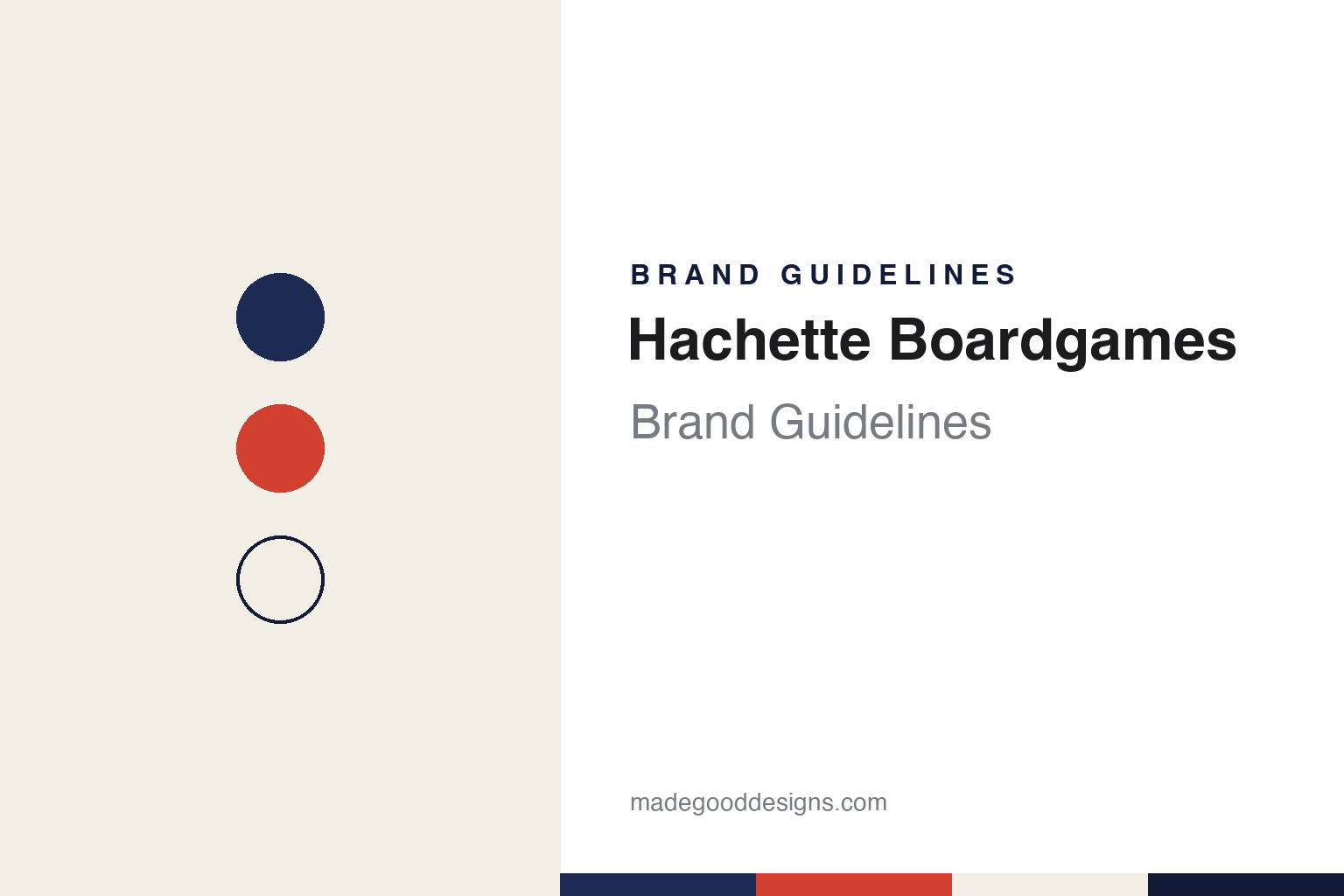
Two constants: a Hachette Boardgames navy, red and cream palette and a Bookish serif register. Abstract homage — not a Hachette Boardgames product or mark; no game, box, logo or artwork is reproduced.
From books to boxes
A publisher founded in 1826 buys a games maker.
Hachette Boardgames is the board game division of Hachette Livre, the French book publisher based in Vanves, outside Paris, and part of the Lagardère group. Its American website notes that Hachette Livre “was founded as a book publisher in Paris in 1826 by Louis Hachette,” and that the company moved into board games in 2019.
The move began with Gigamic. On 25 January 2019 Hachette Livre announced that it had entered exclusive negotiations to acquire all of the company’s shares. The announcement described Gigamic as founded 27 years earlier near Boulogne-sur-Mer and now based in Wimereux on the Côte d’Opale, and named its founders and directors as the brothers Jean-Christophe and Stéphane Gires; Livres Hebdo gave the founding year as 1991. Its catalogue included strategy games such as Quarto, Katamino and Quoridor, and family games such as Six qui prend, Bazar Bizarre and Wazabi.
Hachette said Stéphane Gires would continue to run the business he had built with his brother, and that the purchase fitted a strategy of exploring leisure activities next to publishing, especially games for a general audience; the group already published quiz and party games and had added mobile games in 2016. Its chairman and chief executive, Arnaud Nourry, said Gigamic would “be able to pursue its development while retaining its creative autonomy.” According to BoardGameWire, Hachette also bought the French distributor Blackrock Games that year and founded two in-house publishers, Studio H and Funnyfox.
Colour
A group of labels.
From there the division grew by buying studios, usually leaving their founders in charge. Hachette Livre acquired the Quebec studio Le Scorpion Masqué in late 2020, it said in June 2021, when it announced a link with the Randolph Group, a Quebec distributor and publisher founded in 2012 that also runs board game pubs. Under that deal Hachette took a stake in Randolph, Randolph became a co-shareholder in Le Scorpion Masqué, and Randolph was to distribute the studio’s games in Canada from 1 September 2021. The studio’s founder, Christian Lemay, stayed on to lead it.
The same month, Livres Hebdo reported that Hachette Livre had taken a majority of Hiboutatillus, the Paris party-game publisher behind Blanc Manger Coco, founded by Thibault Lorcy and Louis Roudaut; the magazine reported that it made its games entirely in France. Fabrice Bakhouche, Hachette Livre’s deputy chief executive, said the purchase showed the group’s strategic will to keep diversifying. In February 2022 Hachette signed an agreement to acquire a majority of La Boîte de Jeu, founded in 2013 at Arceau in Burgundy by Benoît Bannier, Benjamin Carayon and Timothée Gibelin and known for It’s a Wonderful World, Livres Hebdo reported.
In May 2023 it became majority shareholder of Catch Up Games of Lyon, founded in 2014 by Clément Milker and Sébastien Kihm, who were to keep running the studio. Livres Hebdo then counted eight publishers in the division: Funnyfox, Studio H, Sorry We Are French, Le Scorpion Masqué, Hiboutatillus, La Boîte de Jeu, Gigamic and Catch Up Games. In April 2025 Hachette Livre announced the purchase of 999 Games, the Dutch publisher and distributor founded in 1990 by Michael Bruinsma and based at Almere, near Amsterdam, BoardGameWire reported. The same report said Hachette ran board game operations in the United States, the United Kingdom and the Benelux countries.
Typography
S3
The seven brands in this group are all board game publishers and accessory makers: Stronghold Games, Ultra PRO, Indie Boards & Cards, Kolossal Games, Board&Dice, Hachette Boardgames and Lucky Duck Games. Names in this trade sit at many different points, from small studios still run by the people who started them to labels that now belong to much larger toy, book or games groups, and a single game can pass through a designer, a publisher, a crowdfunding page and a distributor before it reaches a table.
A board game publisher’s identity is usually carried less by one box than by a logo on many boxes, a name and the kind of game it promises, because the company behind the name may have changed hands, licensed its games abroad or had them manufactured far from where they were designed. That makes the questions behind each name worth asking plainly: who started it, who owns it now, and where its games are actually made.
Each guide separates what independent sources record from what the company says about itself — its founding story, its owners over time, where its games are made and how its look has changed — and marks plainly what rests only on the company’s own word.
Aa
A bookish serif for a publisher’s games arm. (Specimen set in Fraunces, a serif STAND-IN; NOT the Hachette Boardgames logo.)
Hachette Boardgames
Studios that keep their own names.
The division is run by Isabelle Jeuge-Maynart, named as its chief executive in Hachette’s 2021 and 2025 announcements and as its president by Livres Hebdo in 2023. When the 999 Games deal was announced, she called it a “strategic addition” that would let Hachette Boardgames continue its international growth.
Its most visible game in recent years came from Le Scorpion Masqué. Sky Team, a game for two players designed by Luc Rémond, carries the Spiel des Jahres 2024 badge on the German jury’s own website, which lists it under Kosmos and Scorpion Masqué. BoardGameWire noted that 999 Games publishes it in the Netherlands.
In its June 2021 announcement, Hachette split the division into two kinds of business: publishers and distributors, namely Gigamic and Blackrock Games, and creative studios, namely Studio H, Funnyfox, Le Scorpion Masqué and Sorry We Are French, with Hiboutatillus alongside them.
Hachette Boardgames is less a brand on the box than an umbrella over other brands. Its American website describes itself as “a small but powerful collection of independent publishers,” and its partner list runs beyond Hachette’s own studios to include Randolph, Super Meeple, GRRRE Games, Unfriendly Games and Pure Arts. BoardGameWire reported that Hachette had taken over American distribution of Super Meeple from Asmodee USA and British rights to Trefl games. Its American shop gives each publisher its own collection page, such as one for Gigamic.
For a design guide, Hachette Boardgames shows how a book publisher has built a games business by buying studios and keeping their names, rather than putting one mark on every box. Compare Asmodee, the French-founded games group it now competes with in the Netherlands, BoardGameWire reported, and Iello, another French publisher. For this guide we use a publisher navy, a card red and a page cream with a serif, an unofficial interpretation; no product or logo is reproduced.
Explore & save
Keep Hachette Boardgames’s identity on hand — save it to a board in the Made Good inspiration library.
Hachette Boardgames identity set
Pin the Hachette Boardgames navy, red and cream palette and the Bookish serif register to your own board.