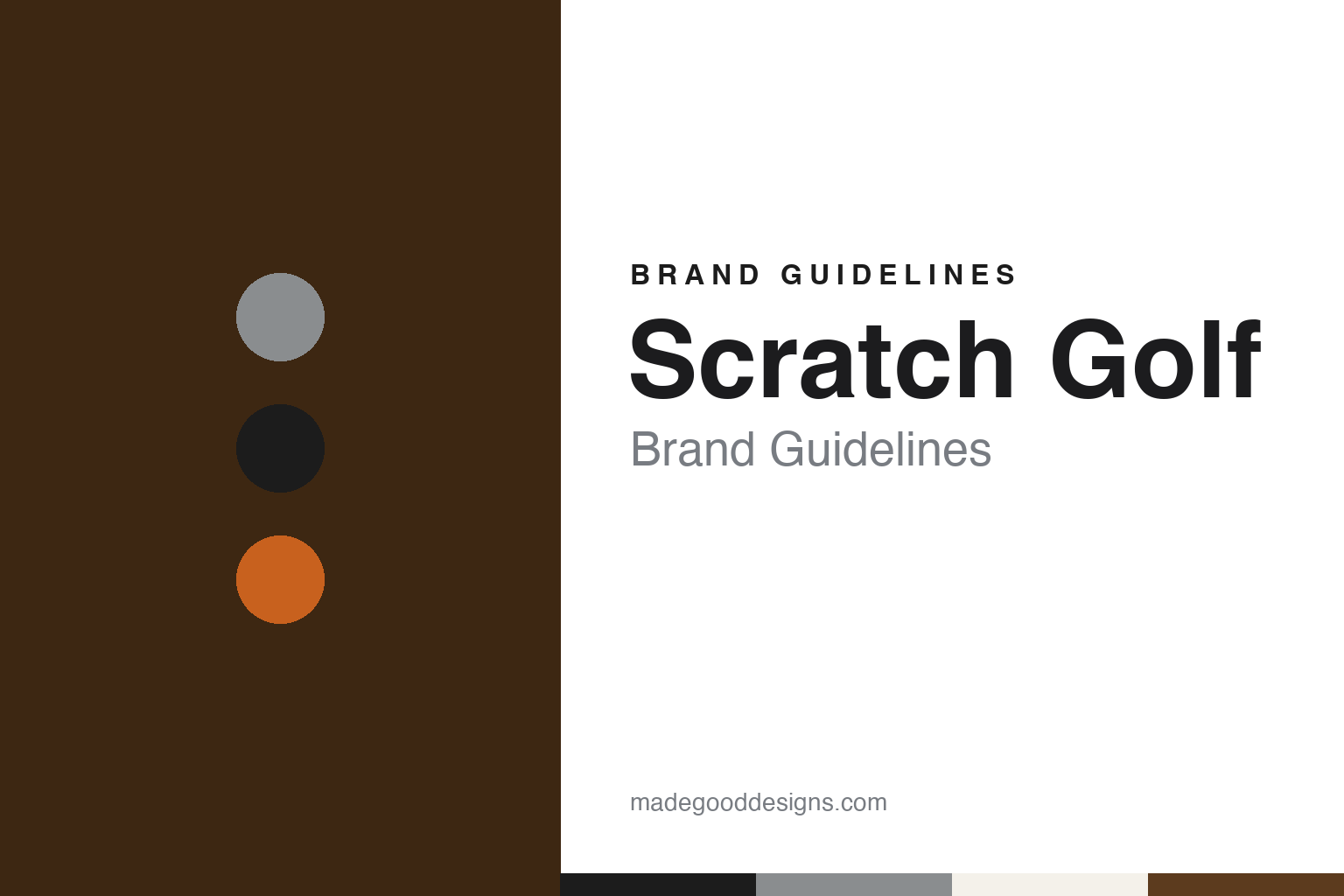
Scratch Golf Brand Guidelines
The custom wedge maker from a Eugene garage, 2003–2015.
Aa
Two constants: a raw steel, forge black and oiled bronze palette and a blackletter register. Abstract homage — not a Scratch Golf product or mark; no club, logo or emblem is reproduced.
Four golf professionals and a garage
Custom wedges, made one at a time.
Scratch Golf began in 2003 in a one-car garage in Eugene, Oregon, MyGolfSpy wrote in October 2013, in a piece marking the company’s tenth anniversary. In a 2009 interview with GolfWRX editor Richard Audi, republished by Golf Channel, president and co-founder Ari Techner named four founders: himself; Jeff McCoy, the company’s master craftsman; Paul Friedrich, who ran its tour operations; and his brother Chad Techner, the chief operating officer. Techner said that he, McCoy and Friedrich had met years earlier on the Professional Golf Management programme at Ferris State University in Michigan, and that McCoy had been grinding golf clubs since high school.
The idea, as Techner put it in 2009, was to fill a gap: nobody, in his view, was making custom wedges one at a time to fit the individual player. The founders spent a year on research, testing wedge grinds against different swings, and built a fitting system around three swing types they named the Sweeper/Slider, the Driver/Slider and the Digger/Driver. The first product was a line of Tour Custom wedges handmade by McCoy, followed by Tour Custom irons; MyGolfSpy dates the move into individually customised irons to 2005.
MyGolfSpy described the company as a brand that grew up alongside online golf forums, at a time when enthusiasts were learning the vocabulary of tour-issue equipment: raw finishes, precise grooves and grinds adjusted for a player and a turf. Scratch offered amateurs that level of customisation, with Japanese-forged wedges hand ground to the buyer’s chosen specification and finish.
Colour
An Old English “S” and a fitting vocabulary.
The company’s emblem was a letter. MyGolfSpy wrote in 2013 of “the Old English ‘S’” at the top of the business, a blackletter initial. The name itself borrows a golf term: a scratch golfer is a player with a handicap of zero.
Much of the identity lived in its language rather than its graphics. The three swing types gave customers a way to describe themselves at a fitting, and later retail wedge models were named after steel grades, 1018 and 8620, alongside a model called JLM, Techner said in 2009. By 2013, MyGolfSpy reported, every Scratch wedge and iron was forged from 1018 carbon steel, the company had stopped selling cast products, and its line was split into two tiers: ready-made Scratch FIT clubs in its most popular grinds, and handmade clubs built to order.
Tour play was part of the story. Techner said in 2009 that Friedrich, a former tour caddie, took a bag of wedges to the Nationwide Tour in 2006, and that the company did not pay players to use its clubs. He named Cristie Kerr as a winner with Scratch clubs on the LPGA Tour in 2009, and said Ryan Moore had switched to Scratch irons and wedges that autumn and joined as staff professional and part owner. MyGolfSpy reported in 2013 that Moore ended his contract at the end of 2010, and that David Duval spent about a year on staff before signing again with Nike Golf.
Retail tested the model. MyGolfSpy wrote that larger production runs of forged and stainless wedges went into big-box stores, where, Techner said, staff knew the major wedge brands better than they knew Scratch or its fitting process.
Typography
Design and documentation.
The seven brands in this group are all golf names: Sligo, Adams Golf, Scratch Golf, Wishon, Nike Golf, KJUS and Original Penguin. Golf brands in general sit at many different points in the trade, from small workshops that still carry a founder’s name to labels that now belong to much larger sporting-goods or apparel groups, and a single name can appear everywhere from a club pro shop to a department-store rail.
A golf brand’s identity is usually carried less by a single club or shirt than by a mark, a name and the game it promises, because the company behind the name may have changed hands, moved its production or narrowed or widened what it sells. That makes the questions behind each name worth asking plainly: who started it, who owns it now, and where its clubs or clothing are actually made.
Each guide separates what independent sources record from what the company says about itself — its founding story, its owners over time, where its products are made and how its marks have changed — and marks plainly what rests only on the company’s own word.
Ss
A blackletter display face for an Old English initial. (Specimen set in Pirata One, a blackletter STAND-IN; NOT the Scratch Golf logo or emblem.)
Scratch Golf
Oregon, Tennessee, Michigan, and a close.
The company moved twice. MyGolfSpy reported that the Nationwide Tour’s Oregon Classic in Junction City, which had given Scratch a place to meet touring professionals, left the schedule after 2008, and that Scratch relocated to Chattanooga, Tennessee, the site of the Chattanooga Classic; there it added the craftsman Don White to the team. Techner told MyGolfSpy that White and McCoy, the company’s two grinders, also served as its chief club designers. In 2013 the company moved again, to a storefront fitting studio in Berkley, Michigan, outside Detroit, partnering with the Scottsdale fitting-software firm Cool Clubs and stocking handmade putters by the London maker James Ingles. On 1 October 2013, MyGolfSpy noted, Scratch opened an online section called The Armory for handmade clubs ready to ship without the wait of a custom order.
The end came two years later. GolfWRX reported on 12 October 2015 that Scratch Golf would go out of business after a restructuring that, according to Techner, the departing president, “didn’t work out.” Techner thanked customers and paid tribute to White and McCoy, and GolfWRX reported that the company’s assets would change hands in the following weeks. The company’s own website was still showing its Signature Series and fitting pages in January 2016, according to the Internet Archive.
The name needs care online. The scratchgolf.com address now belongs to an indoor golf simulator and coaching business, which has nothing to do with the club maker from Eugene.
For a design guide, Scratch Golf shows how a small maker can build an identity from a blackletter initial, a fitting vocabulary and the names of steel grades rather than from advertising. Compare Titleist, the Massachusetts maker of balls and clubs, and Miura, the Japanese maker of hand-forged irons. For this guide we use raw steel, forge black and oiled bronze with a blackletter display face, an unofficial interpretation; no product or logo is reproduced.
Explore & save
Keep Scratch Golf’s identity on hand — save it to a board in the Made Good inspiration library.
Scratch Golf identity set
Pin the Scratch Golf raw steel, forge black and oiled bronze palette and the blackletter register to your own board.


