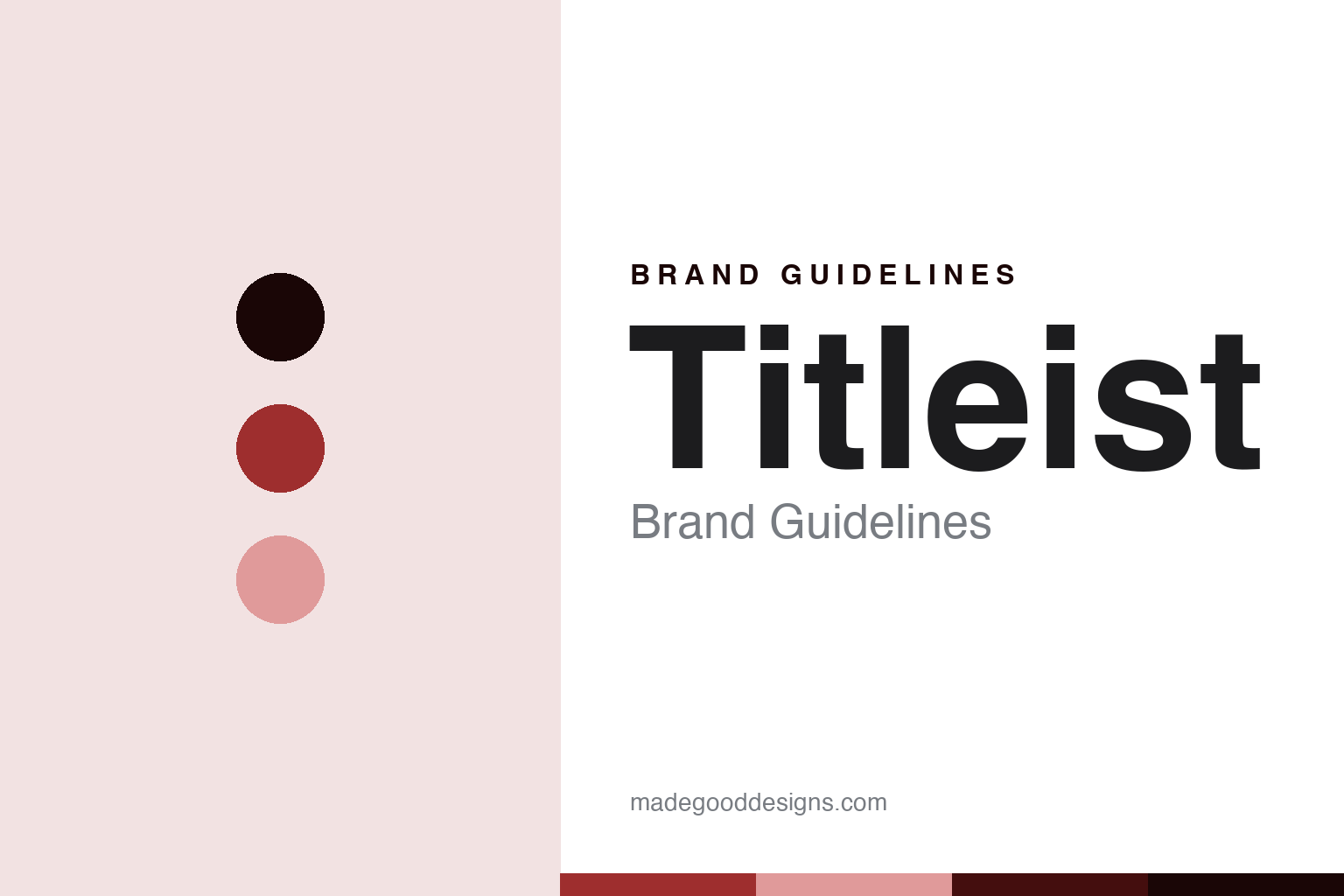
Titleist Brand Guidelines
The ball made in America.
Aa
Two constants: a golf-red palette and a tour-sans register. Abstract homage — not a Titleist product or mark.
The ball made in America
Titleist is the Acushnet ball house of 1932 — the Pro V1 made in Massachusetts, under Korean-led ownership.
Titleist follows Mizuno as the ball house — the Acushnet brand born a golf-ball company, whose Pro V1 is the best-selling premium ball in the game and is genuinely made in Massachusetts. Titleist makes golf balls and clubs, and its answer to a round about club makers is a US-made ball under a Korean-led owner: a domestic ball, a global company. A ball, made in America.
Its identity is the ball made in America. Titleist’s Pro V1, its Massachusetts ball plants and its Korean-led ownership are the story here. A ball, from New Bedford. The ball made in America.
(Honest notes, so the story stays precise. Titleist — at titleist.com — is the flagship of the Acushnet Company; golf balls are the identity, with the Pro V1 the number-one ball in golf, alongside clubs such as T-Series irons, TSR drivers, Vokey wedges and Scotty Cameron putters. It was founded in 1932 by Philip E. Young, a Massachusetts man and MIT graduate, with the name from “title-holder,” meaning best in class. On where it is made — a theme of this round — the balls are genuinely made in the USA, at Acushnet ball plants in Massachusetts, around North Dartmouth and New Bedford; honestly, there is also a plant in Thailand for some volume, and the clubs are largely made and assembled overseas, in Asia, so we frame it as US-made balls and offshore-made clubs. On ownership, the parent is Acushnet Holdings, listed on the New York Stock Exchange; Acushnet was bought from Fortune Brands in 2011 by a South Korean-led consortium of Fila Korea and Mirae Asset, and Fila Korea, through Magnus Holdings, is the controlling shareholder. Its marks are IP we describe but do not reproduce, and there is no official brand hex; these tones are an unofficial interpretation. This is design commentary and does not promote any product.)
Colour
Titleist lives in a golf red. Click a swatch to copy the hex.
Titleist’s identity is iconic, US-made and owned — a golf red, an ink, a rose, a deep red, and a paper. The palette leans golf red and rose: a classic register that nods to the brand’s script heritage and the traditions of the game. It signals a US-made ball house inside a global company. The honest caveat: with no published brand hex, these values are an original, unofficial interpretation, not first-party colours.
The lesson is a golf red signals an iconic, US-made identity. Titleist’s world is an iconic, made object with a corporate owner. For designers, it is a reminder that a classic golf red and a soft rose can carry a ball house — the tone of the traditional game. Because these tones can fail as small text, keep type dark and let the colour live in the accents, palette and band. The takeaways: make the ball at home; keep the club claim honest; name the owner; and treat any single hex as unofficial.
Typography
The register is a tour sans — classic, precise, made.
Titleist’s identity carries a classic, precise, made spirit — the number-one ball, not a fashion. A tour sans captures the mood: clean, exact and traditional, the register of a ball trusted at the highest level of the game. Set in a golf-red palette, the tour sans feels classic and precise — exactly the personality Titleist carries. It is performance rather than a logo, mirroring a urethane cover and a dimpled surface. (Titleist’s real wordmark, and Pro V1, are things we describe but do not reproduce, and the exact typeface is not ours to use.) Because it is not ours to use, the honest description is “a tour-sans spirit,” shown here in a stand-in. The type behaves like the ball: classic, precise and made.
Aa
A tour-sans spirit — classic and precise. (Specimen set in Space Grotesk, a tour-sans STAND-IN; NOT the Titleist logo.)
The club makers
Titleist stands for the ball made in America.
Titleist follows Mizuno as the ball house. A golf-red palette, a tour sans and a golf ball make one thing — the ball made in America — the whole identity: iconic, US-made and owned. The Massachusetts ball plants are the differentiator, and the Korean-led ownership is the meaning. The point is a ball company from 1932 whose Pro V1 is genuinely US-made while the company is controlled from Korea.
Put to work, the identity is a US-made ball told straight, as design. A maker in this spirit would make its icon at home and be honest that its clubs are offshore and its owner is abroad. A reader in this spirit would keep the facts right: it was founded in 1932 by Philip E. Young; its balls are US-made in Massachusetts; its clubs are largely offshore; it is listed on the NYSE; and it is controlled by the Fila Korea consortium that bought Acushnet in 2011. Titleist sits in the round’s where-made thread at the made-at-home end for balls, with the Japanese forgers and PING, and in the owner thread at the Korean end with TaylorMade. The honest editorial moves are to credit Philip Young, to split the US-made balls from the offshore clubs, and to name the Korean-led owner. The lesson Titleist teaches is that a single product line can carry a made-in-America identity even when the clubs are offshore and the owner is overseas — provided the split is stated.
For designers and brand-builders, Titleist continues the club makers: make the icon at home — and be honest about the rest. The lessons: keep the halo product domestic; do not extend a made-in claim to lines it does not cover; name the owner; keep founders to public facts; and never reproduce a logo. It is also a reminder to stay precise: Titleist is the Acushnet ball house of 1932, the Pro V1 made in Massachusetts, under Korean-led ownership — with the palette here an unofficial interpretation. Read that way, Titleist is less a ball than a split: a US-made icon, offshore clubs, a Korean-led owner, all true at once. The lesson for a brand is that a made-in-America halo can coexist with offshore lines and foreign ownership, and honesty about each keeps the halo earned. Titleist made the-ball-made-in-America the identity — proof that one product, made at home, can anchor a global company.
Explore & save
Keep Titleist’s identity on hand — save it to a board in the Made Good inspiration library.
Titleist identity set
Pin the golf-red palette and the tour-sans register to your own board.