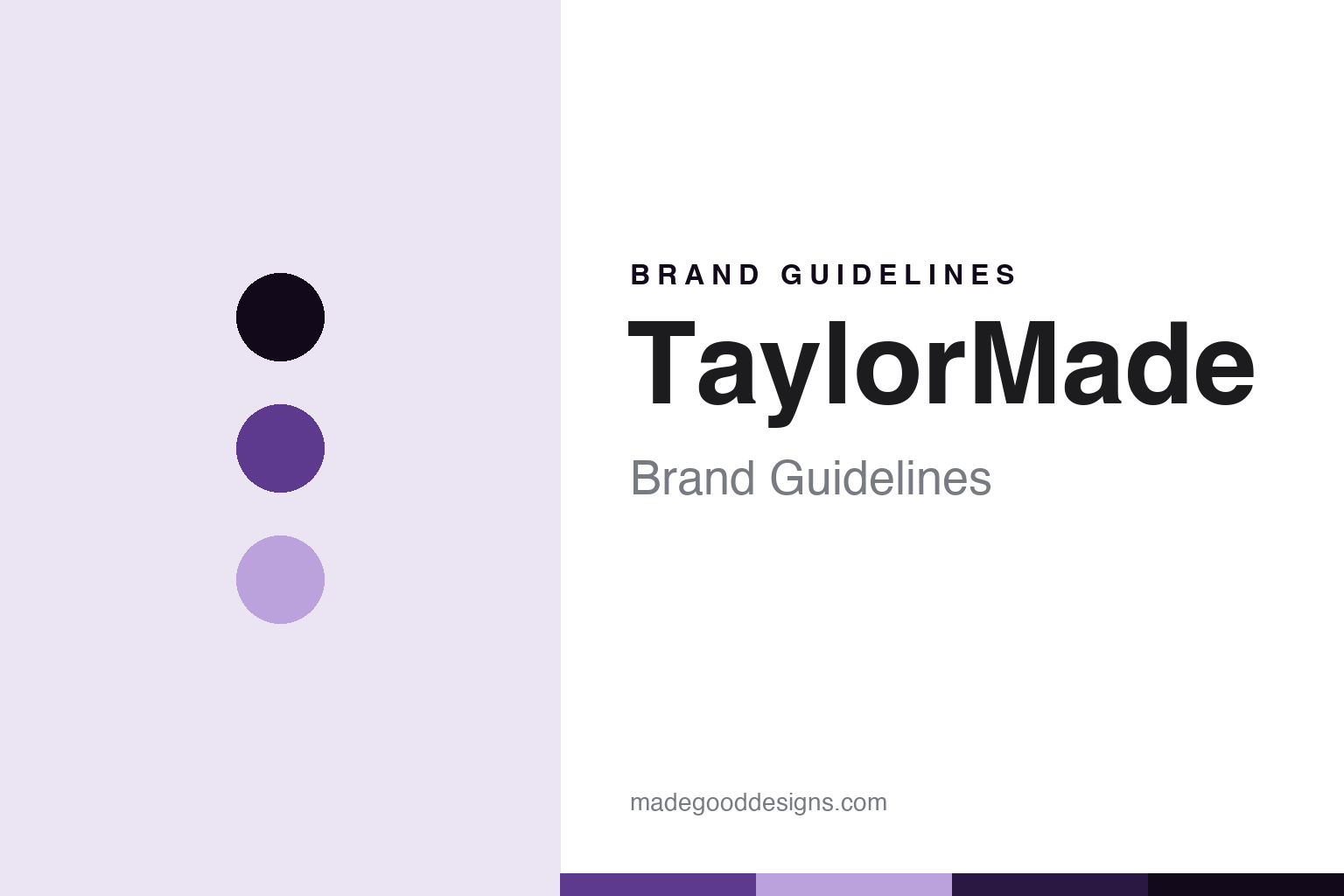
TaylorMade Brand Guidelines
The metalwood, Korean-owned.
Aa
Two constants: a tech-violet palette and a metalwood-sans register. Abstract homage — not a TaylorMade product or mark.
The metalwood, Korean-owned
TaylorMade is the metalwood pioneer of 1979 — drivers designed in California, now owned by a South Korean firm.
TaylorMade brings the round its metalwood pioneer — the company that replaced the persimmon wood with a metal head and now sits, after a long ownership journey, with a South Korean private-equity firm. TaylorMade makes drivers and clubs, and its answer to a round about club makers is a technology brand that has changed hands repeatedly: an American pioneer, now Korean-owned. A driver, invented in Illinois.
Its identity is the metalwood, Korean-owned. TaylorMade’s metalwood heritage, its Carlsbad design and its Centroid ownership are the story here. A driver, designed in California. The metalwood, Korean-owned.
(Honest notes, so the story stays precise. TaylorMade — at taylormadegolf.com — makes drivers and metalwoods as its icon, with lines such as the carbon-faced Stealth and the Qi10, alongside irons, Spider putters and TP5 balls. It was founded in 1979 in McHenry, Illinois by Gary Adams, who pioneered the metalwood, a steel-headed driver that replaced the persimmon wood; it is headquartered in Carlsbad, California. On where it is made — a theme of this round — its clubs are designed in Carlsbad but its club heads are largely made overseas, in Asia, so it is designed in California, not US-made. On ownership — the heart of this entry — TaylorMade has changed hands repeatedly: independent, then owned by Salomon from 1984, then by adidas from 1997, then sold to the US private-equity firm KPS Capital Partners in 2017, and sold again in 2021 to Centroid Investment Partners, a South Korean private-equity firm; it is now Korean-owned. Its marks — TaylorMade, Stealth, Qi10, Spider — are IP we describe but do not reproduce, and there is no official brand hex; these tones are an unofficial interpretation. This is design commentary and does not promote any product.)
Colour
TaylorMade lives in a tech violet. Click a swatch to copy the hex.
TaylorMade’s identity is technical, offshore and re-owned — a tech violet, an ink, a lilac, a deep violet, and a paper. The palette leans tech violet and lilac: a modern, engineered register that nods to carbon-faced drivers and performance technology rather than a classic golf palette. It signals a technology pioneer passed between owners. The honest caveat: with no published brand hex, these values are an original, unofficial interpretation, not first-party colours.
The lesson is a tech violet signals a technical, re-owned identity. TaylorMade’s world is a technical object with a changing owner. For designers, it is a reminder that a modern tech violet and a soft lilac can carry a club maker — the tone of a carbon face. Because these tones can fail as small text, keep type dark and let the colour live in the accents, palette and band. The takeaways: pioneer a technology; expect ownership to change; name each owner; and treat any single hex as unofficial.
Typography
The register is a metalwood sans — modern, technical, made.
TaylorMade’s identity carries a modern, technical, made spirit — a metalwood pioneer, not a fashion. A metalwood sans captures the mood: engineered, contemporary and fast, the register of a carbon-faced driver built for distance. Set in a tech-violet palette, the metalwood sans feels modern and technical — exactly the personality TaylorMade carries. It is technology rather than a logo, mirroring a carbon face and cast titanium. (TaylorMade’s real wordmark, and Stealth, are things we describe but do not reproduce, and the exact typeface is not ours to use.) Because it is not ours to use, the honest description is “a metalwood-sans spirit,” shown here in a stand-in. The type behaves like the driver: modern, technical and made.
Aa
A metalwood-sans spirit — modern and technical. (Specimen set in Manrope, a metalwood-sans STAND-IN; NOT the TaylorMade logo.)
The club makers
TaylorMade stands for the metalwood, Korean-owned.
TaylorMade brings the round its metalwood pioneer. A tech-violet palette, a metalwood sans and a driver make one thing — the metalwood, Korean-owned — the whole identity: technical, offshore and re-owned. The metalwood invention is the differentiator, and the Centroid ownership is the meaning. The point is an American pioneer that invented the metal driver and has since passed through Salomon, adidas, a US private-equity firm and now a South Korean one.
Put to work, the identity is an ownership journey told straight, as design. A maker in this spirit would honour a real invention while being honest that it is offshore-made and has changed owners repeatedly. A reader in this spirit would keep the facts right: it was founded in 1979 by Gary Adams; it pioneered the metalwood; it is designed in Carlsbad and made offshore; and its ownership ran independent, Salomon, adidas, KPS Capital, and now Centroid Investment Partners of South Korea. TaylorMade sits in the round’s where-made thread at the offshore end with Callaway, and in the owner thread among the Korean-owned brands with Titleist — though a private-equity firm rather than a consumer consortium. A cross-tie worth noting: TaylorMade was owned by Salomon, which appears in the ski round, tying golf to the wider sporting-goods world. The honest editorial moves are to credit Gary Adams, to frame the making as offshore, and to name each owner in the chain. The lesson TaylorMade teaches is that a technology pioneer can be bought and sold many times and keep its identity — provided the whole chain is named.
For designers and brand-builders, TaylorMade continues the club makers: pioneer a technology — and expect to be bought and sold. The lessons: build a real innovation; accept that ownership changes; name the whole chain; keep the founder to public facts; and never reproduce a logo. It is also a reminder to stay precise: TaylorMade is the metalwood pioneer of 1979, drivers designed in California, now owned by a South Korean firm — with the palette here an unofficial interpretation. Read that way, TaylorMade is less a driver than a passage: an American invention, passed through owners on three continents. The lesson for a brand is that a genuine technology can outlast every owner, and honesty about the ownership journey keeps the pioneer credible. TaylorMade made the-metalwood-Korean-owned the identity — proof that an invention can survive any number of owners.
Explore & save
Keep TaylorMade’s identity on hand — save it to a board in the Made Good inspiration library.
TaylorMade identity set
Pin the tech-violet palette and the metalwood-sans register to your own board.