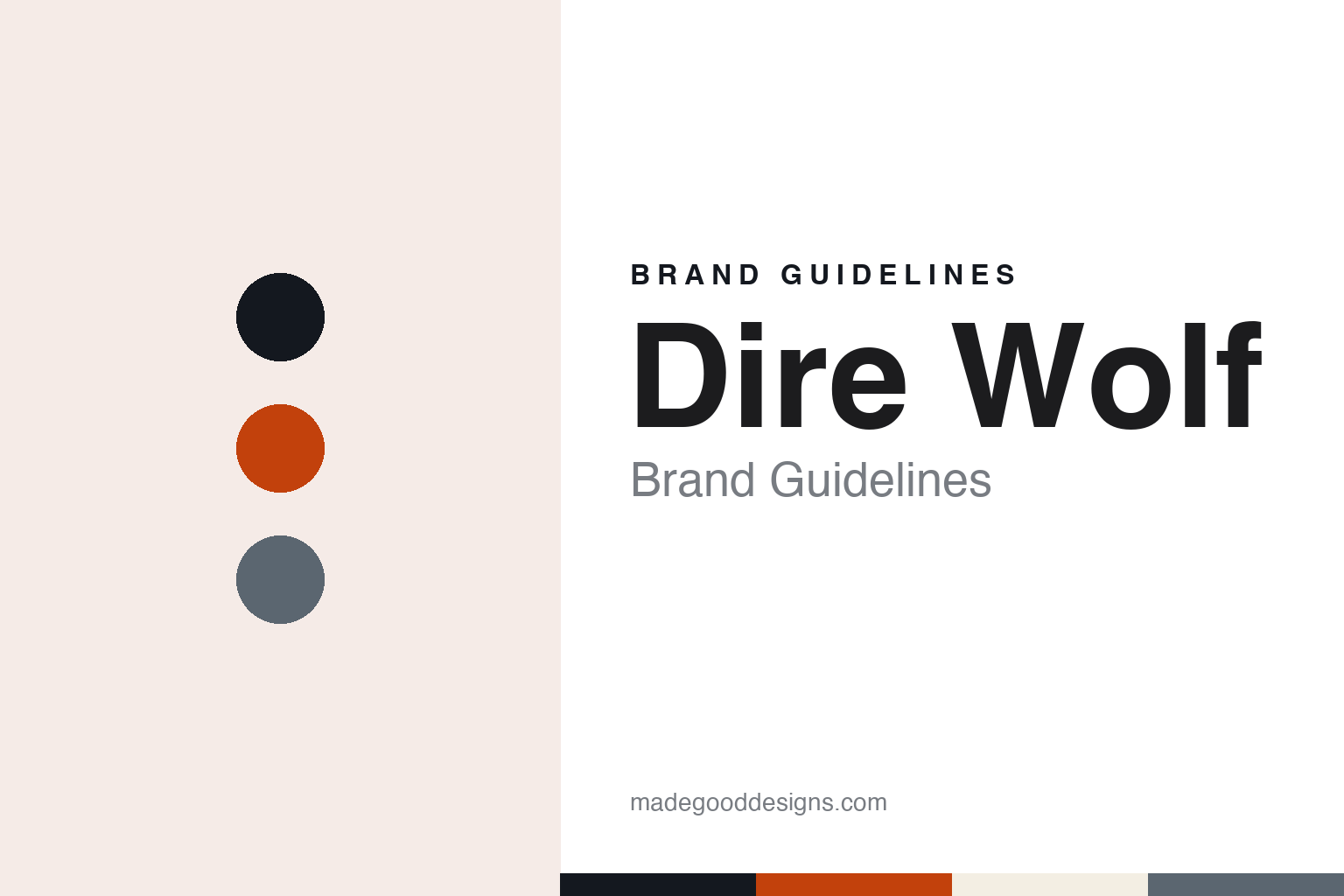
Dire Wolf Brand Guidelines
The Denver studio that moves between card tables and screens.
Aa
Two constants: a midnight, ember and wolf grey palette and a carved display serif register. Abstract homage — not a Dire Wolf product or mark; no box, logo or card art is reproduced.
From card servers to card tables
A Denver team that started with trading card games on screens.
Dire Wolf began as a digital company. In July 2010 the trade publication ICv2 reported the formation of Dire Wolf Digital, a new company formed by former principals of Worlds Apart Productions and Sony Online Entertainment Denver. It was led by Scott Martins, who had founded Worlds Apart and then headed Sony Online Entertainment’s Denver studio after Sony acquired his company. ICv2 listed the trading card games those teams had made before, including the Lord of the Rings Online, Stargate and Star Wars Galaxies card games and Legends of Norrath.
The new company’s first announced project was a licence: the rights to produce a trading card game and digital games based on Lego Universe, the online game then due in October 2010. ICv2 said Dire Wolf planned games built around “Anytime, Anyplace” play, in which players on web, mobile and console clients would connect to a single back end.
The studio’s best-known early work was for other companies’ card games. English Wikipedia says Pokémon TCG Online, the digital version of the Pokémon Trading Card Game, was developed by Dire Wolf Digital, “a studio based in Denver, Colorado”; it launched in March 2011 as a browser game called Pokémon Trainer Challenge and shut down on 5 June 2023, after being replaced by Pokémon Trading Card Game Live. Dire Wolf also initially developed The Elder Scrolls: Legends, the digital card game published by Bethesda Softworks in 2017; in May 2018, English Wikipedia says, Bethesda announced that development had passed to Sparkypants Studios.
Its own card game, Eternal, followed: a free-to-play digital collectible card game that Dire Wolf both developed and published. English Wikipedia dates its Steam early access to November 2016, its wide release to November 2018 and its Nintendo Switch release to October 2019.
Colour
Clank!, then Dune.
The move onto the table came through a partner. In July 2016 ICv2 reported that Renegade Game Studios would co-publish Clank! A Deck-Building Adventure, a card game designed by Paul Dennen, Dire Wolf’s creative director. ICv2 called it a reversal of the two companies’ earlier relationship, in which Dire Wolf had made a digital app for Renegade’s dice game FUSE and then a digital version of Lanterns: The Harvest Festival. Clank!, in which players sneak into a dragon’s lair and try not to make too much noise, was due to debut at Gen Con in August 2016.
Clank! became a family of games. In November 2019 Dire Wolf announced Clank! Legacy: Acquisitions Incorporated, made with Penny Arcade, around its comedy franchise of that name, and again co-published with Renegade, according to the press release. The company’s website now lists Clank! In! Space!, Clank! Catacombs and a second Acquisitions Incorporated legacy game among its tabletop titles.
The larger licence arrived in 2020. In August that year ICv2 reported that Gale Force Nine, which holds the tabletop gaming rights to the Dune franchise, had chosen Dire Wolf to make a board game inspired by Legendary Entertainment’s coming Dune film, designed by Paul Dennen and the Clank! team. Dune: Imperium was published in 2020; English Wikipedia lists the expansions Rise of Ix in late 2021 and Immortality in late 2022, the standalone Dune: Imperium – Uprising in 2023 and Bloodlines in January 2025.
The Spiel des Jahres association’s own page for the game marks Dune: Imperium as nominated for the Kennerspiel des Jahres in 2022, the German jury’s prize for more demanding games, and names its publisher simply as “Dire Wolf.”
In August 2022, Mobidictum reported, the fan platform Fandom sold the Cortex roleplaying-game system and its related assets to Dire Wolf Digital, including Tales of Xadia, the roleplaying game set in the world of the animated series The Dragon Prince; Cortex designer Cam Banks joined Dire Wolf as a creative director.
Typography
Design and documentation.
The seven brands in this group are all board-game publishers: Fowers Games, Alley Cat Games, Dire Wolf, Rebel, Ludonaute, Catch Up Games and Next Move Games. Board-game publishers in general sit at many different points in the trade, from small studios still run by the people who started them to labels that now belong to much larger games groups, and a single name can appear everywhere from a hobby-shop shelf to a department-store toy aisle.
A publisher’s identity is usually carried less by a single box than by a logo on many boxes, a house style of art and graphic design, and the games it becomes known for, because the company behind the name may have changed hands, merged its studios or moved its production far from where it started. That makes the questions behind each name worth asking plainly: who started it, who owns it now, and where its games are designed and made.
Each guide separates what independent sources record from what the company says about itself — its founding story, its owners over time, where its games are made and how its look has changed — and marks plainly what rests only on the company’s own word.
Aa
A carved display serif for a fantasy-adventure catalogue. (Specimen set in Cinzel, a serif STAND-IN; NOT the Dire Wolf logo.)
Dire Wolf
One name on boxes and on app stores.
Dire Wolf still works in both directions. Its website divides the catalogue into tabletop games, digital originals and digital adaptations. The tabletop list includes the Dune: Imperium games, the Clank! line, Lightning Train, Invincible, War of the Dragon and Wild Tiled West; the digital originals include Eternal and a Tales of Xadia card battler. The adaptations bring other publishers’ board games to phones and computers — among them Root, Everdell, Sagrada and Ark Nova, and Munchkin, made, the site says, in partnership with Steve Jackson Games. English Wikipedia dates Root: Digital Edition, developed by Dire Wolf, to September 2020.
In 2019 the company described itself as an independent Denver studio making strategy card and board games, both digital and physical, in the “About Dire Wolf” text of its press releases. The footer of its website today reads “Dire Wolf Digital, Inc.” and states that Dire Wolf and Eternal are registered trademarks of the company, with Clank! and Clank! In! Space! as its trademarks.
The two names do different jobs. The full corporate name, Dire Wolf Digital, carries the studio’s origins in online card games, while the shorter Dire Wolf is the name the Spiel des Jahres jury’s page gives as the publisher of Dune: Imperium, and the one the company uses in its own trademark notice alongside Eternal. Clank! and Dune: Imperium each appear on its website both as tabletop games and as digital editions.
The studio’s licensing record shows the same approach. Its games sit inside worlds owned by others — Pokémon, The Elder Scrolls, Dune, Penny Arcade’s Acquisitions Incorporated, The Dragon Prince — and its adaptations carry other publishers’ designs.
For a design guide, Dire Wolf shows how a publisher can build one name across physical and digital editions of the same games. Compare Asmodee, which the Spiel des Jahres page lists as the distributor of Dune: Imperium, and Kolossal Games, another American publisher. For this guide we use midnight, ember and wolf grey with a serif, an unofficial interpretation; no product or logo is reproduced.
Explore & save
Keep Dire Wolf’s identity on hand — save it to a board in the Made Good inspiration library.
Dire Wolf identity set
Pin the Dire Wolf midnight, ember and wolf grey palette and the carved display serif register to your own board.