Rebel Brand Guidelines
From a Gdańsk basement shop to a publisher with a colour for every game.
Aa
Two constants: a red and black core with five supporting colours, and a geometric sans register. Abstract homage — not a Rebel product or mark; no box, logo or letter is reproduced.
A shop in a basement
Two Tricity board-game fans and a cellar in Gdańsk.
Rebel started as a shop. Polish Wikipedia says the company was founded in 2003 by Piotr Kątnik and Paweł Piechota, with its headquarters in Gdańsk, and that it began as a bricks-and-mortar and online shop for board games before it started publishing titles of its own. The company tells the same story in its own words: the idea came from two board-game fans from the Tricity — Gdańsk, Gdynia and Sopot — and Rebel says it began as a small shop based in a Gdańsk basement, where a handful of enthusiasts imported, lent and sold the popular games of the day.
The business grew into three things at once. In January 2018 the trade publication ICv2 described Rebel as a Polish distributor and publisher based in Gdańsk, founded in 2003 by Piotr Kątnik, its chief executive, and active in distribution, sales and publishing, including an online tabletop game shop. Its website, rebel.pl, remains a shop as well as the company’s home page, and links out to a separate publishing site and to an international imprint, Rebel Studio.
For years Rebel also had a shop floor. The company says it opened a store in the Galeria Metropolia shopping centre in Wrzeszcz, a district of Gdańsk, and from 2019 ran a games zone there where customers could play classics and new releases and join regular events. Its “About us” page now says the store closed on 27 September 2025.
Rebel built a public around its games as well as a catalogue. From October 2007 to December 2019 it published Rebel Times, a free monthly magazine about board games distributed as a PDF, and later also as an e-book; Polish Wikipedia counts 147 issues, edited by Tomasz Chmielik. Polish Wikipedia also says Rebel created GRAMY, a board-game festival held in the Tricity, alternately in Gdynia and Gdańsk, from 2009 until 2019.
Colour
Polish designers, Polish editions, and Asmodee.
Publishing came out of retail. Among the company’s own games, Polish Wikipedia highlights K2, Adam Kałuża’s 2010 game about leading a pair of climbers up the Himalayan peak, and Drako, his 2011 two-player game of dwarves against a dragon, which was followed by two sequels. It also lists the Polish edition of Nemesis, released in 2019 in cooperation with Awaken Realms, and Zona: Sekret Czarnobyla, a 2019 adventure game set in the Chernobyl exclusion zone.
Rebel Studio carries the company’s own titles abroad. Its English-language website lists Chronicles of Avel, a cooperative family game from 2021, and Meadow, a nature-observation game from the same year, as well as San Francisco, a 2022 city-planning game it credits to Reiner Knizia, and later titles including Pergola and Dungeon Legends, a card game set in the world of Avel. The same site gives contacts for retailers, rules questions and designers’ submissions, all at Rebel in Gdańsk.
Alongside its own games, Rebel publishes and distributes Polish editions of games from abroad. Polish Wikipedia names Ticket to Ride, sold in Poland as Wsiąść do Pociągu, Splendor, Dobble, 7 Wonders, Dixit and Takenoko among the Asmodee titles it publishes or distributes for partner publishers.
That relationship became ownership. In January 2018 ICv2 reported that the Asmodee group had entered exclusive discussions to acquire Rebel, noting that the two companies had worked together for more than ten years. “We are proud to join the Asmodee Group,” Piotr Kątnik said in the announcement. Poland’s National Court Register now lists Asmodee Group SAS as the holder of all of Rebel’s shares.
Typography
Design and documentation.
The seven brands in this group are all board-game publishers: Fowers Games, Alley Cat Games, Dire Wolf, Rebel, Ludonaute, Catch Up Games and Next Move Games. Board-game publishers in general sit at many different points in the trade, from small studios still run by the people who started them to labels that now belong to much larger games groups, and a single name can appear everywhere from a hobby-shop shelf to a department-store toy aisle.
A publisher’s identity is usually carried less by a single box than by a logo on many boxes, a house style of art and graphic design, and the games it becomes known for, because the company behind the name may have changed hands, merged its studios or moved its production far from where it started. That makes the questions behind each name worth asking plainly: who started it, who owns it now, and where its games are designed and made.
Each guide separates what independent sources record from what the company says about itself — its founding story, its owners over time, where its games are made and how its look has changed — and marks plainly what rests only on the company’s own word.
Aa
A geometric sans, after the brand book’s Geomanist. (Specimen set in Outfit, a geometric sans STAND-IN; NOT the Rebel logo, which is custom-drawn.)
Rebel
A custom wordmark, a red and a scatter of letters.
Rebel publishes its brand rules. Its website’s “Visual identity” page offers the logo in several formats and a 2024 presentation of the brand book, the Księga znaku marki Rebel. The book says the logotype was drawn on a geometric, modular grid and is an original form that does not use any existing font. Its distinguishing feature, the book says, is that the two letters “e” have no counters — the enclosed eye of the letter is left out. The clear space around the mark is set as a square measured in modules of the grid, and the book gives minimum sizes for print.
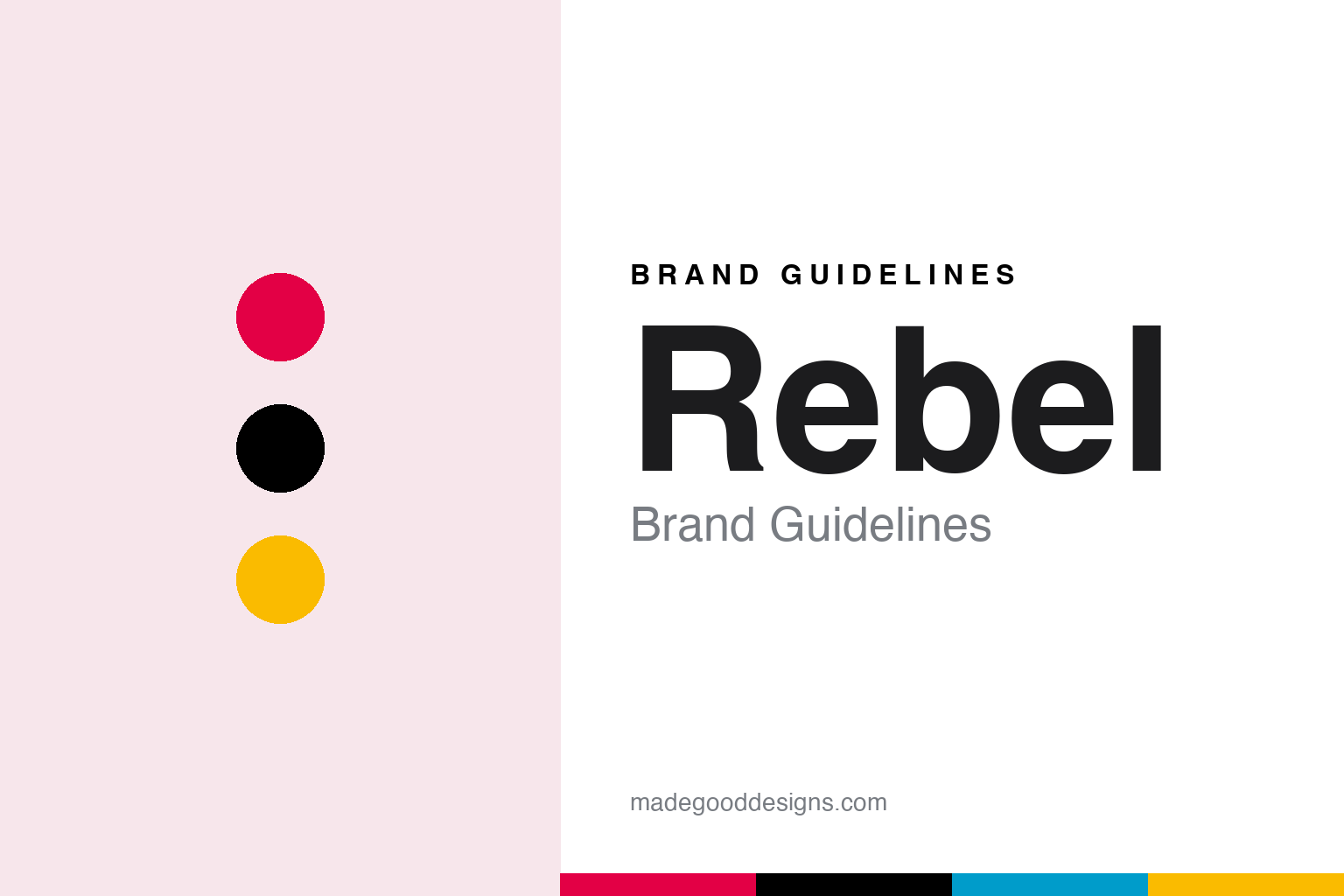
The colours are specified exactly. The two primary colours are a red — CMYK 0/100/60/0, RGB 227/0/69, #e30045 — and black, which the book says should be used where possible when Rebel appears as a business partner or in official presentations. Five supporting colours follow: a blue, #009cca; a yellow, #fabb00; a green, #a4c537; a purple, #9d3488; and a grey, #9faeb5. The book explains why: Rebel “should be perceived as a company shimmering with many colours,” matching a wide audience and a broad range of products, so the supporting colours and their tints are meant especially for promoting games and for dealing with retail customers.
The main graphic motif is built from the logotype itself. The book calls it a rozsypanka — a scattering — made of different arrangements of the logo’s letters, which can be scaled from a dense pattern of small shapes to single letters that work almost as abstract forms, and laid over backgrounds in any of the brand colours. For type, the book specifies Geomanist: large titles at about four times the body size in the ExtraLight weight, and smaller titles at about twice the body size in Bold. For the many games Rebel distributes, the book shows where its logo goes on a box, recommending a centred position at the bottom.
For a design guide, Rebel shows how a retailer-publisher can keep one strict mark while leaving room for many colours and many games. Compare Asmodee, the group that owns it, and Portal Games, another Polish publisher. For this guide we use Rebel’s published red, black, blue, yellow and purple with a geometric sans, an unofficial interpretation; no product or logo is reproduced.
Explore & save
Keep Rebel’s identity on hand — save it to a board in the Made Good inspiration library.
Rebel identity set
Pin the Rebel red, black and supporting-colour palette and the geometric sans register to your own board.