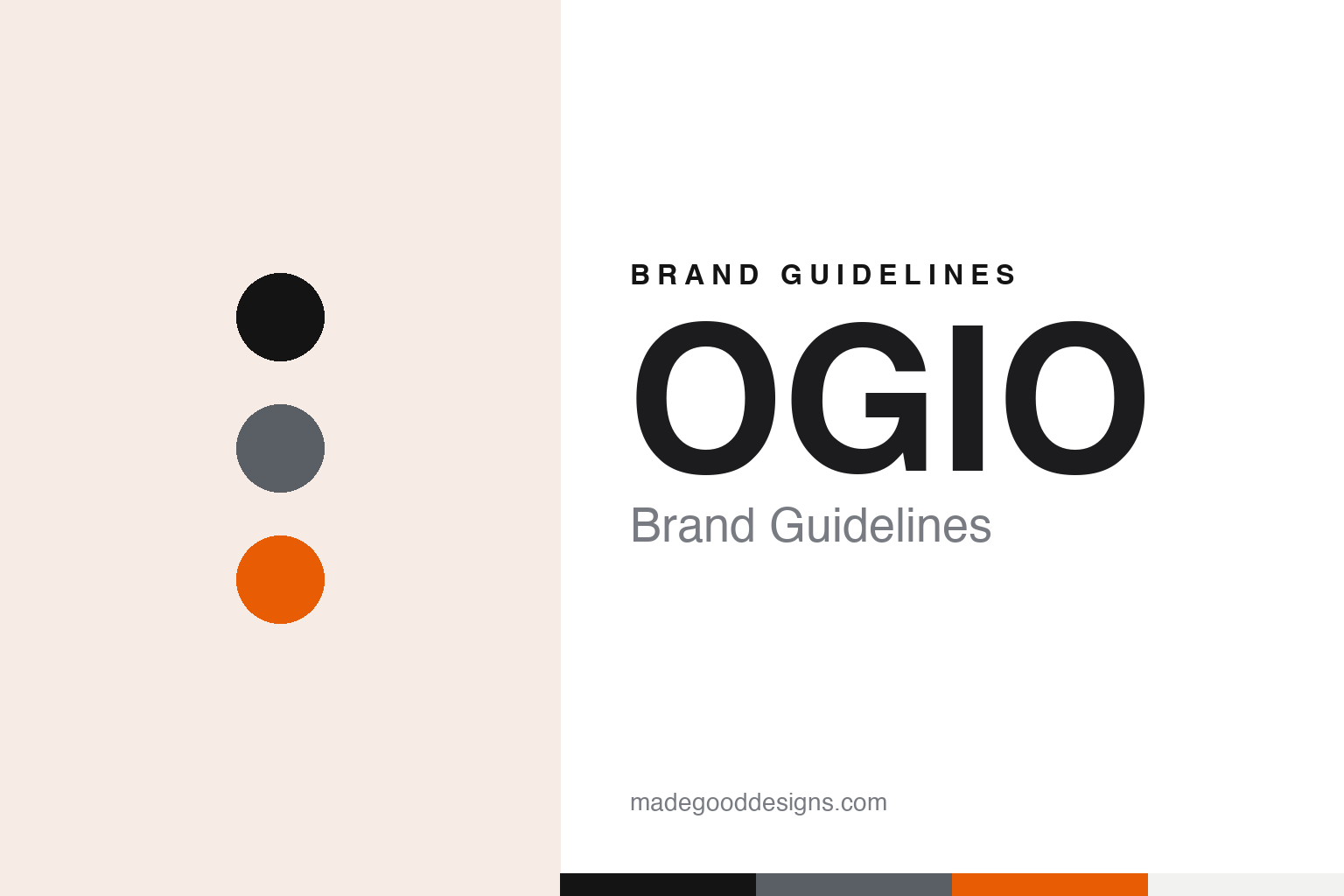
OGIO Brand Guidelines
Mike Pratt’s 1987 Utah bag maker, owned by Callaway since 2017.
Aa
Two constants: an OGIO black, graphite and orange palette and a Condensed sans register. Abstract homage — not an OGIO product or mark; no bag, logo or label is reproduced.
The Travel Cube
A toiletry kit, a phrase from a phone company and a name.
OGIO began with a single bag. In February 1991 the Deseret News of Salt Lake City profiled OGIO International Inc. and its president, Michael J. Pratt, describing it as a company three and a half years old. The paper reported that the first bags had been shipped to Pratt in May 1987, and that the first product was the Travel Cube, a toiletry kit. OGIO’s Australian website today gives 1987 as the year the brand was founded.
The name came before its meaning. According to the Deseret News, Pratt took the letters from “outgoing only”, a phrase his wife used in her job at the telephone company US West Communications; about three years later he settled on what the letters should stand for: “Our Gear Is Organized.” The paper quoted the company’s ambition plainly: “We believe people who carry an OGIO bag will make a statement to their peers that they are organized.”
The early bags were not made in Utah. The Deseret News reported that a company in Korea made the first bags, and that later production came from another Korean company and from a company in Taiwan. By 1991 the range had grown from the Travel Cube to backpacks for students, locker bags, duffel bags and waist pouches, along with waterproof bags for water sports, and the company was preparing to move into a larger building in the Salt Lake area.
Organisation remains the brand’s stated idea. OGIO’s Australian website sums the range up as “gear-focused bags with durable materials, long shelf lives and a plethora of pockets for storage,” runs the heading “Functional. Durable. Organised,” and lists six pillars: organisation, durability, protection, ergonomics, mobility and sustainability.
Colour
From gym bags to golf bags and motocross.
By the early 2000s OGIO had moved well beyond travel kits. In April 2002 Entrepreneur described the company as based in Bluffdale, Utah, with Pratt as its founder and chief executive. The magazine reported that OGIO made sports and gear bags, including golf bags, and that it also made golf bags for Callaway — the company that would later buy it.
The same article described OGIO designing gear bags for professional riders in snowboarding, skateboarding and motocross, and an arrangement under which OGIO golf bags carried hangtags for the Italian motorcycle maker Ducati. Pratt told the magazine: “We’ve always been known for quality and fresh designs,” while explaining that the company had worked to build a stronger brand by partnering with well-known names from outside golf.
Motorsport is still part of the business. Its owner’s annual report for 2025 describes OGIO as “a soft goods brand that offers a variety of equipment and active travel gear for sport and personal use,” and records that the line of OGIO motorsport products is licensed to a third party in exchange for a royalty fee.
Corporate customers are another channel. Callaway’s annual report for 2017 said it licensed the OGIO trademarks for bags to SanMar Corporation, covering both OGIO products and SanMar-designed, OGIO-branded products; the report for 2025 says other OGIO products are licensed for distribution through the corporate channel in the United States, Canada and Mexico, without naming the licensee.
The same reports describe how the bags are made. In 2017 Callaway said its soft goods under the Callaway, OGIO and TravisMathew brands were designed and developed internally, with the specifications sent to third-party contract manufacturers that source the materials and build the products. Its 2025 report lists manufacturing partners for its soft goods in countries including Vietnam, China, Indonesia and Thailand; it gives that list for the soft-goods business as a whole rather than for OGIO alone.
Typography
Bags, carts and the golfers who push them.
The seven brands in this group are all names from the golf course’s carrying and clothing trade: OGIO, Sun Day Red, PowaKaddy, Motocaddy, Stewart Golf, BIG MAX and Clicgear. They cover golf bags, push carts, electric trolleys and a new apparel label.
A bag or trolley brand’s identity is usually carried by a name, a mark and a recognisable product shape rather than by any one model, because the company behind the name may have changed hands, moved its manufacturing or changed the way it sells. That makes the questions behind each name worth asking plainly: who started it, who owns it now, and where its products are actually designed and made.
Each guide separates what independent sources record from what the company says about itself — its founding story, its owners over time, where its products are made and how its range has changed — and marks plainly what rests only on the company’s own word.
Aa
A condensed, utilitarian sans for a brand built on compartments. (Specimen set in Barlow Condensed, a sans STAND-IN; NOT the OGIO logo.)
OGIO
Part of Callaway since January 2017.
OGIO’s independence ended in January 2017. Callaway Golf Company’s annual report for that year states that “in January 2017, the Company acquired OGIO International, Inc.,” describing it as a maker of high-quality bags and accessories and saying the deal would provide “a platform for future growth in the lifestyle category.” Inside Golf reported the purchase on 13 January 2017 and quoted Callaway’s chief executive, Chip Brewer: “We are excited about OGIO becoming part of Callaway.” Later that year Callaway also bought the apparel brand TravisMathew.
The parent company has since changed shape around OGIO. According to its annual report for 2025, it sold its Jack Wolfskin business on 31 May 2025 and, with effect from 1 January 2026, sold a 60 per cent interest in its Topgolf and Toptracer businesses; on 15 January 2026 it changed its corporate name from Topgolf Callaway Brands Corp. back to Callaway Golf Company. The report lists the ongoing brand portfolio as Callaway Golf, Odyssey, TravisMathew and OGIO, so Callaway has owned OGIO since 2017. OGIO sits in the segment the company renamed “Apparel, Gear and Other” in the fourth quarter of 2025.
For a design guide, OGIO shows how a brand can be built on a single organising idea: a name that was turned into a promise, “Our Gear Is Organized,” and a range that has stretched from a toiletry kit to golf bags and motocross gear without losing it. Compare Callaway, its owner, and Sun Mountain, another American golf bag maker. For this guide we use black, graphite and a signal orange with a condensed sans, an unofficial interpretation; no product or logo is reproduced.
Explore & save
Keep OGIO’s identity on hand — save it to a board in the Made Good inspiration library.
OGIO identity set
Pin the OGIO black, graphite and orange palette and the Condensed sans register to your own board.