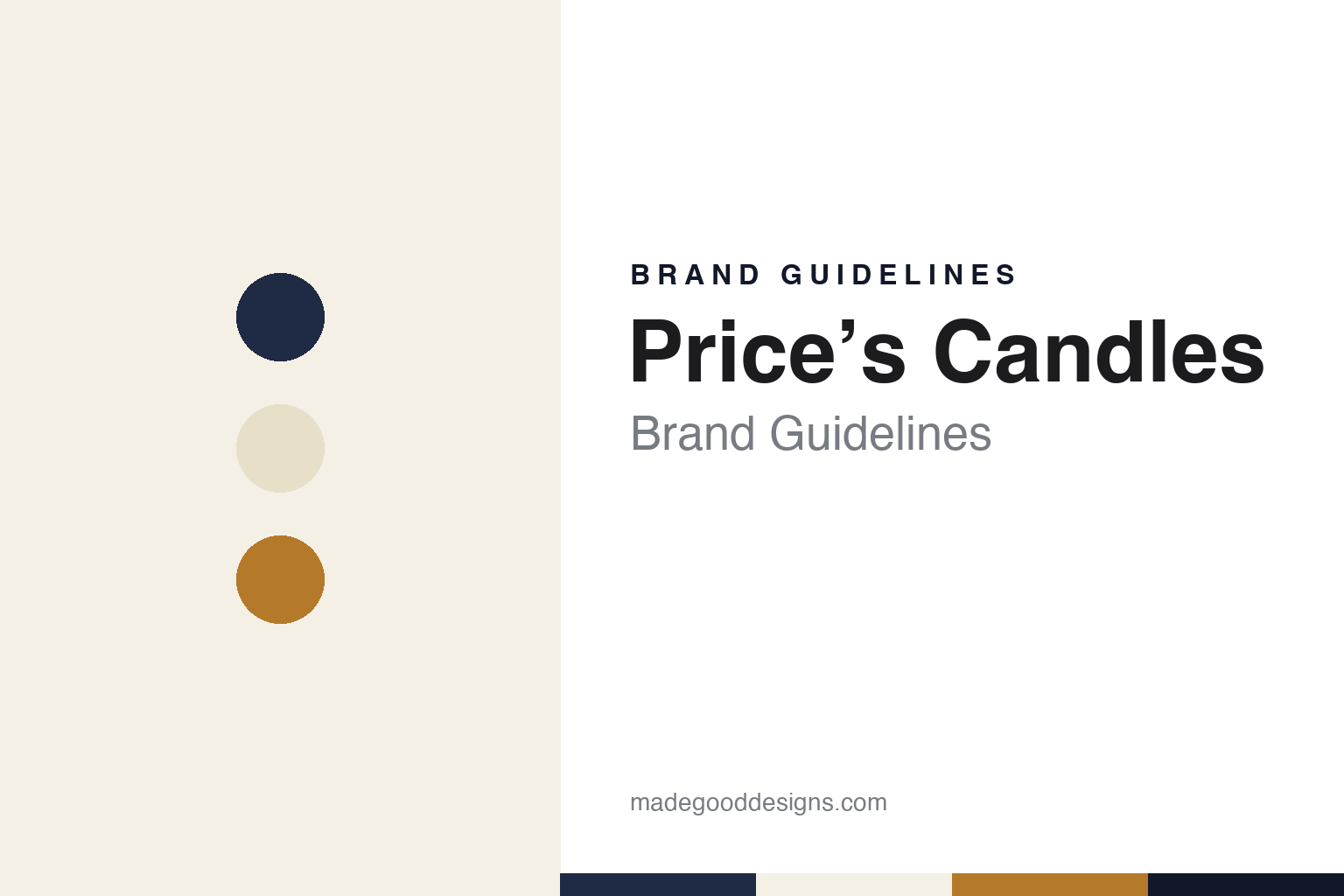
Price’s Candles Brand Guidelines
A Vauxhall candle maker of 1830, now made near Turin.
Aa
Two constants: a navy, ivory and amber palette and a Victorian serif register. Abstract homage — not a Price’s Candles product or mark; no candle, label, seal or logo is reproduced.
Edward Price & Co.
A borrowed name, a Thames-side factory and a patent.
Price’s Candles traces itself to London in 1830. English Wikipedia says that William Wilson had licensed a patent in 1829 for the hydraulic separation of coconut fats, and that with his partner Benjamin Lancaster he launched a business called Edward Price and Co. The company’s own heritage page describes that name as fictitious: there was no Edward Price behind it. Wilson’s son George Wilson later extended the process with further distillation and went on to use palm oil, Wikipedia says.
The first factory stood at Vauxhall, on the Thames in south-west London, with a crushing mill a little upriver at Battersea, and the partners also invested in coconut plantations in what is now Sri Lanka, according to both Wikipedia and the company. Wikipedia explains that research on fatty acids by the French chemist Michel Eugène Chevreul in the 1820s led candle makers to stearin, a harder and whiter fat, and that “composite” candles made from refined tallow and coconut oil came to prominence around 1840.
The company says its stearine composite candles were used at Queen Victoria’s wedding on 20 February 1840, and that it did not patent them, so rivals copied them. In 1847 the business took the name Price’s Patent Candle Company, Wikipedia and the company both say. Its seal of that period, Wikipedia records, showed Africans bringing calabashes of palm oil to a seated Britannia beneath a palm tree, an image the article links to how the company presented its palm-oil sourcing.
Colour
Nightlights, a model village and a clipper ship.
In 1849, it says, it bought Samuel Childs’s nightlight business; its current website sells tealights and nightlights alongside dinner candles. In 1853, the company says, it chose Bromborough Pool on the Wirral, near Liverpool, as a second major site. By 1855 it had two London factories and the Bromborough works, according to Wikipedia, which adds that the company built a village there with houses, a church, an institute, a shop and a library for its workers.
The heritage page lists other episodes the company is proud of: candle stoves and lanterns sent to British troops in the Crimean War in 1855, a profit-sharing scheme for staff introduced in 1869, and Belmont stearine candles supplied to Captain Scott’s South Pole expedition of 1910–11. Wikipedia says Price’s also supplied lubricants in the early twentieth century, and that from 1906 into the 1930s new Rolls-Royce cars were supplied with its Motorine oil.
For the visual story, the most concrete detail comes from the company itself: it says its clipper ship trademark was introduced in the 1870s. The company says it supplied candles for Winston Churchill’s state funeral in 1965.
Typography
Candles and home fragrance.
The seven brands in this group are all candle and home-fragrance names: Glade, Bath & Body Works, Chesapeake Bay Candle, Bolsius, ILLUME, Mrs. Meyer’s Clean Day and Price’s Candles. Candle and home-fragrance brands in general sit at many different points in the trade, from small studios that still pour by hand to names that now belong to much larger household-goods groups, and a single brand can be sold everywhere from a supermarket aisle to a boutique shelf.
A candle brand’s identity is usually carried less by a single candle than by a jar, a label, a scent name and the story printed on the box, because the company behind the name may have changed hands, moved its production or grown far beyond the place where it started. That makes the questions behind each name worth asking plainly: who started it, who owns it now, and where its candles are actually made.
Each guide separates what independent sources record from what the company says about itself — its founding story, its owners over time, where its candles are made and how its packaging has changed — and marks plainly what rests only on the company’s own word.
Aa
A Victorian serif — the register of a company that took its name in 1847. (Specimen set in Cormorant Garamond, a serif STAND-IN; NOT the Price’s Candles logo.)
Price’s Candles
From Lever Brothers to an Italian wax group.
Price’s did not stay independent. According to the company’s heritage page, Lever Brothers took over Price’s in 1919. In 1936, the company says, the candle business became part of Candles Ltd, with Lever keeping the Bromborough works, and in 1954 BP moved the lubricating-oil business to Grangemouth in Scotland. After BP and Burmah sold their stakes in 1982, the company says, Shell was left as owner of Candles Ltd, and when Shell sold it in 1991 Price’s became privately owned again.
The modern company took shape around the turn of the century. Price’s says it moved its British candle manufacture to Bicester in 1998. In 2001 it moved its head office to Bedford, Wikipedia and the company agree, and the company says it went into administration the same year. In 2003, the company says, it was bought by Cereria Sgarbi and then, that summer, by SER Wax Industry, with production consolidated near Turin. Wikipedia likewise says Price’s has been owned by the Italian company SER since 2003, and that most of its manufacturing is done by SER in Turin; Wikipedia describes the British business as an importer and retailer of candles based in Bedford.
The current website keeps both sides of that history in view. It says the company has been “crafting beautiful candles since 1830,” calls itself the trusted candle supplier to the British Royal Family, and carries the words “made in Italy” in its footer. Its range runs from dinner candles and altar and pillar candles to reed diffusers and a fragrance collection, with a citronella line for gardens.
For a design guide, Price’s Candles shows how a nineteenth-century name and a trademark can carry a brand through changes of owner, factory and country. Compare Cire Trudon, another candle maker that leans on a long history, and Yankee Candle. For this guide we use clipper navy, wax ivory and flame amber with a serif, an unofficial interpretation; no product or logo is reproduced.
Explore & save
Keep Price’s Candles’s identity on hand — save it to a board in the Made Good inspiration library.
Price’s Candles identity set
Pin the Price’s Candles navy, ivory and amber palette and the Victorian serif register to your own board.