Harringtons Brand Guidelines
The Yorkshire pet food brand of “Natural for All.”
Aa
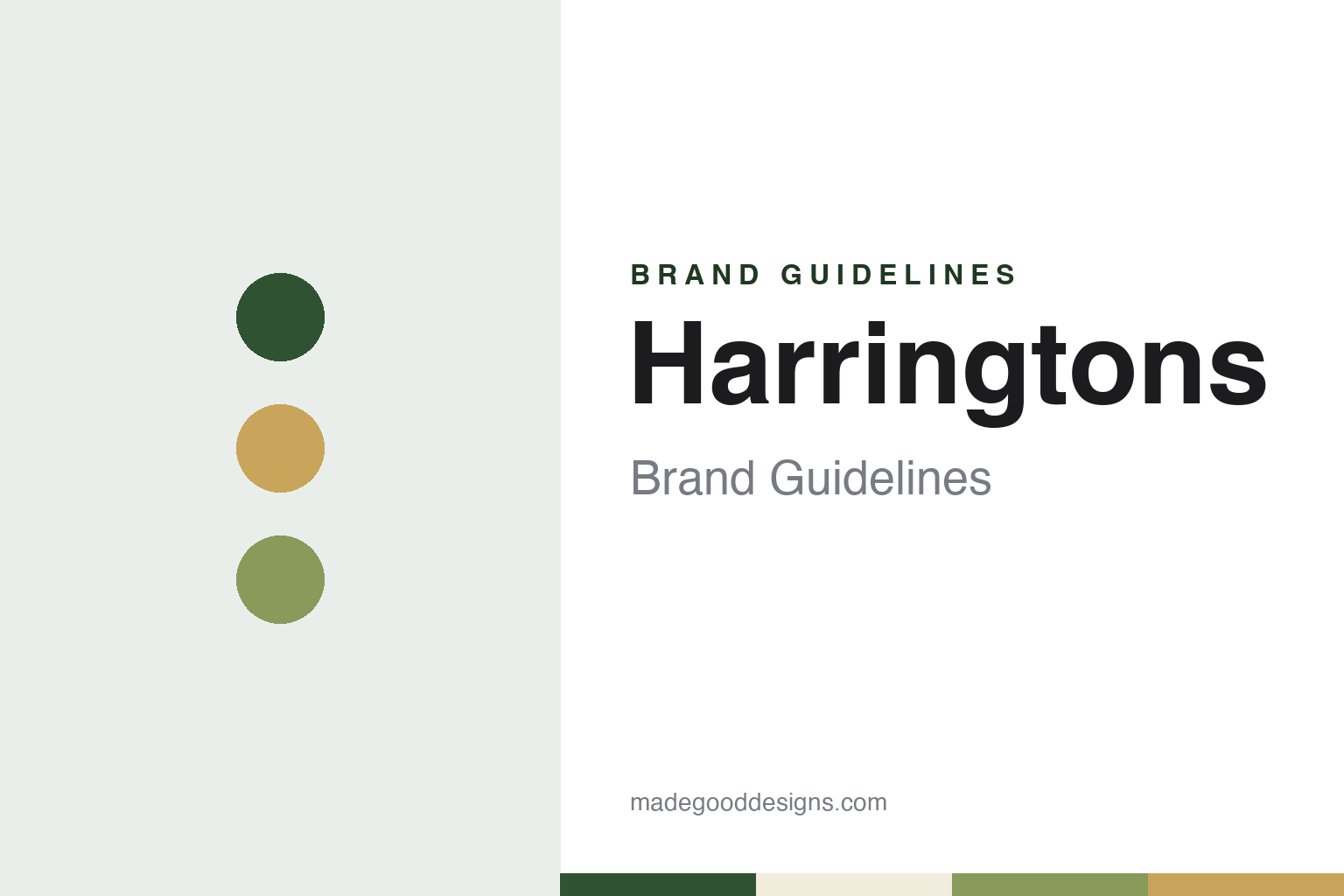
Two constants: a Dales green, meadow sage and oat gold palette and a sturdy slab serif register. Abstract homage — not a Harringtons product or mark; no bag, tray, label or logo is reproduced.
A Yorkshire mill, a feed business and a dog food maker
From a 1923 family business to Wagg at Topcliffe.
Harringtons is a young brand from an old business. The company behind it, Inspired Pet Nutrition, is based near Thirsk in North Yorkshire and grew out of a family business whose history goes back to 1923. Accounts of that start differ in the detail. The Harringtons website says that in 1923 a great-grandfather it calls Harrington started an animal feed mill in Tadcaster, and that the family moved from milling into animal feed before it began making pet food in the mid-1980s. Food Chain Magazine, profiling the company in June 2018, describes the 1923 business instead as a wheat trading concern in North Yorkshire. Trade profiles describe it as the business of the Page family: the magazine PET worldwide wrote in 2013 that the Page family had built up long experience in animal feeds since 1923, and that the move from agricultural feed to pet food came through the vision of Bill Page.
According to Food Chain Magazine, the business moved into animal feed in the 1960s, when it was known as Page Feeds and ran four feed mills serving farmers across the county. It launched its first complete dry dog food range in 1985, and in 1990 it changed its name to Wagg and moved into a purpose-built site at Topcliffe, near Thirsk. A dog food extrusion factory followed in 2002. Wagg remains one of the group’s brands; L Catterton’s December 2020 announcement described the company as best known for dry dog food and treats under the Harringtons and Wagg names.
The family’s next generation shaped the newer brand. A profile published by Connect Yorkshire says Richard Page returned to Yorkshire in 2006 after a career in the City of London to join the family firm, then called WaggFoods, as managing director, and helped steer it towards a more premium position, including a move into pet treats and the creation of a new natural brand in 2008. That brand was Harringtons. Richard Page was later chairman of the company, L Catterton’s 2020 announcement says, and it calls the business a third-generation family enterprise.
Colour
Two flavours in 2008, then cats, small pets, trays and treats.
PET worldwide reported that the company launched Harringtons in 2008 in an attempt to make premium dog food affordable to the general consumer. The brand’s own timeline says it started with just two flavours and went on sale that year in ASDA and then Tesco. The range then spread from dogs to other animals: oven-baked semi-moist treats in 2010, a range for cats, guinea pigs and rabbits in 2012, wet food trays in 2015, a grain-free range in 2018 and a dry cat range in 2020, the company says.
The pack has been reworked more than once. Harringtons lists a full pack redesign in 2017 and a full relaunch with a recipe upgrade in 2022, the same year it launched a range called Advanced Science Diet. The brand’s written voice is plain and regional — it describes itself as “proudly Yorkshire born and bred” — and its slogan, “Natural for All,” sets out the brief the company gives itself: food made from locally sourced ingredients, free from artificial flavours and colours, at a price meant for every pet owner, in its own words. The company says it also tries to cut wastage and unnecessary packaging, and that its large dry-food bags can go into local authority recycling.
Harringtons is made in factories its owner runs. “We own our own factories,” the company says, explaining that this lets it control what goes into its food and how it is made. Its timeline records the purchase of a Welsh manufacturing plant in 2016 and says that in 2017 it began making its wet food itself. Food Manufacture reported in April 2022 that Inspired Pet Nutrition was adding a second, faster processing and filling line at its site at Kinmel in North Wales to produce Harringtons wet trays, with the option of recyclable aluminium tray formats. The company also says it commissioned a combined heat and power plant in 2013 to generate its own electricity.
Typography
Design and documentation.
The seven brands in this group are all British pet food names: Canagan, Lily’s Kitchen, Applaws, Harringtons, Forthglade, Burns and James Wellbeloved. Pet food brands in general sit at many different points in the trade, from family firms that still carry a founder’s name to labels that now belong to much larger food groups, and a single brand can be sold everywhere from a supermarket aisle to a vet’s counter or an online subscription.
A pet food brand’s identity is usually carried less by a single recipe than by a pack, a name and the story it tells about where it comes from, because the company behind the name may have changed hands, moved its production or grown far beyond the kitchen or town where it started. That makes the questions behind each name worth asking plainly: who started it, who owns it now, and where its food is actually made.
Each guide separates what independent sources record from what the company says about itself — its founding story, its owners over time, where its food is made and how its packs have changed — and marks plainly what rests only on the company’s own word.
Aa
A sturdy slab serif for a Yorkshire brand with a mill in its past. (Specimen set in Zilla Slab, a serif STAND-IN; NOT the Harringtons logo.)
Harringtons
From a family company to L Catterton and CapVest.
Outside investors arrived in 2015. L Catterton, the consumer-focused private equity firm, invested in the company in March 2015, its announcement says, and the business took its present name, Inspired Pet Nutrition, in 2016, according to Food Chain Magazine. L Catterton says that during its ownership the company built a new wet dog food facility, a baked dog food facility and a distribution centre, while adding to its dry dog food capacity. L Catterton’s list of pet food investments in the same announcement includes Lily’s Kitchen.
On 21 December 2020, L Catterton announced a definitive agreement to sell Inspired Pet Nutrition to funds managed by CapVest Partners; the terms were not disclosed. Kate Briant, a partner at CapVest, described the firm as experienced consumer investors with “deep buy-and-build capabilities.” The group has since grown by acquisition: GlobalPETS reported in October 2024 that Inspired Pet Nutrition had completed its purchase of Butcher’s Pet Care, the wet pet food maker based in Northampton, first announced that August.
One practical note: “Harrington” is also the name of a classic British zip-up jacket and of many unrelated businesses, so searches for the pet food work best with the full name and the Yorkshire link; the brand’s own site is harringtonspetfood.com.
For a design guide, Harringtons shows how a new brand can borrow its story from an old family business — a 1923 mill, a Yorkshire address and a promise of “Natural for All” — and carry it across bags, trays and treats for several kinds of pet. Compare Lily’s Kitchen, another British natural pet food brand once backed by L Catterton, and Pedigree, Mars’s dog food brand. For this guide we use Dales green, meadow sage and oat gold with a slab serif, an unofficial interpretation; no product or logo is reproduced.
Explore & save
Keep Harringtons’s identity on hand — save it to a board in the Made Good inspiration library.
Harringtons identity set
Pin the Harringtons Dales green, meadow sage and oat gold palette and the sturdy slab serif register to your own board.