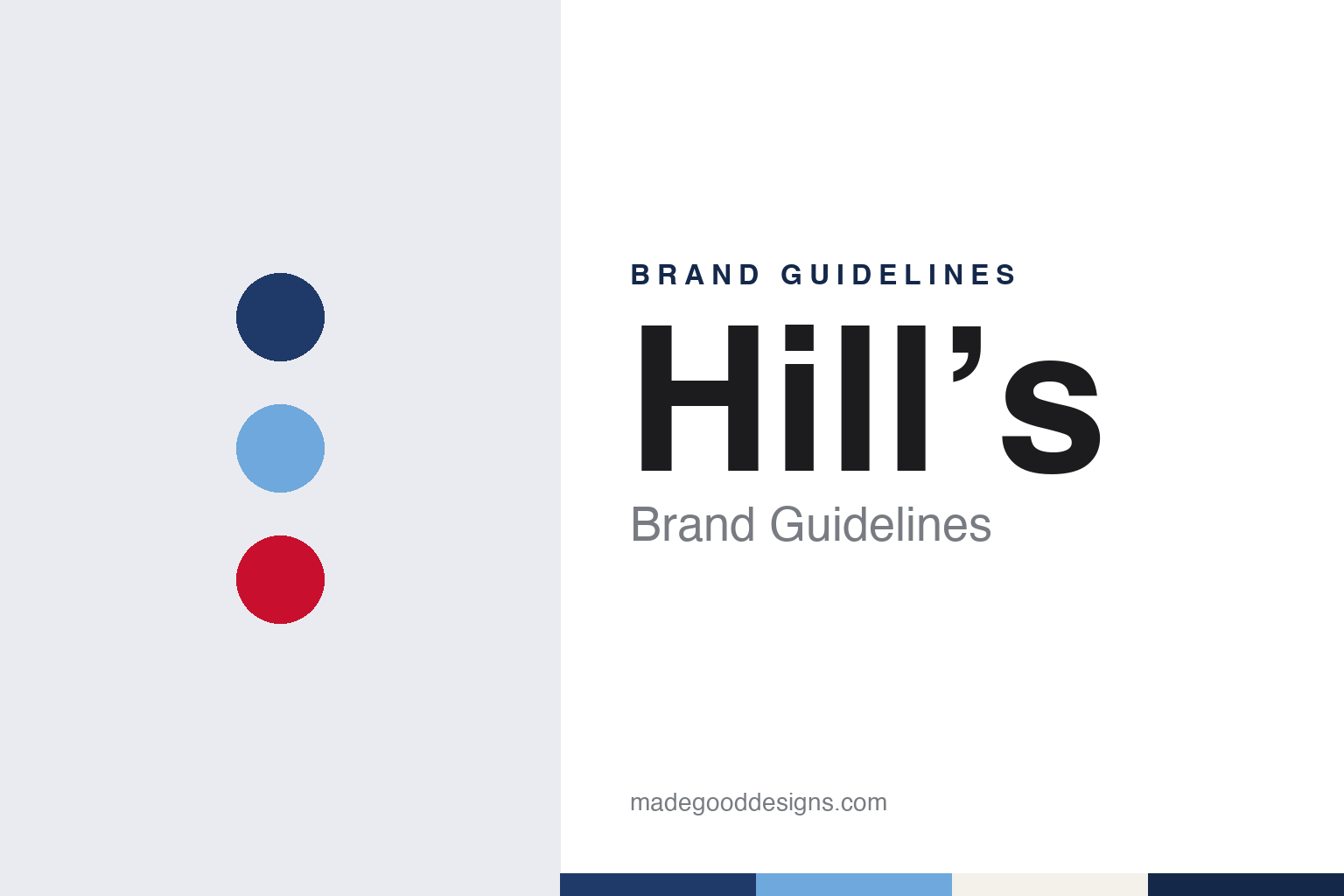
Hill’s Brand Guidelines
The Topeka pet food maker owned by Colgate-Palmolive since 1976.
Aa
Two constants: a Topeka navy, prairie sky and signal red palette and a Clean clinical sans register. Abstract homage — not a Hill’s product or mark; no pack, logo or label is reproduced.
Hill Rendering Works
A Kansas meat business and a veterinarian’s formula.
Hill’s Pet Nutrition takes its name from a Kansas meat business, not from the man whose formula made it known. English Wikipedia, citing the Estherville Daily News of 1962, says Burton Hill founded Hill Rendering Works in Topeka in the spring of 1907, providing rendering services for Shawnee County and holding a Topeka city contract to dispose of dead and lame animals. By the 1930s, according to newspapers of the period cited by Wikipedia, the business was called the Hill Packing Company, with a milling arm, the Hill Milling Company.
The food that made the name famous came from a veterinarian. Hill’s tells the story this way: “in the late 1930s,” Morris Frank, a young blind man, was touring the United States with his guide dog, Buddy, a German Shepherd with kidney failure, and asked Dr. Mark Morris Sr. for help; Morris, the company says, developed a new food with his wife, Louise, in their kitchen. Colgate-Palmolive’s own history dates that work to 1939 and calls it the origin of the first Prescription Diet product. Frank himself is independently documented: English Wikipedia records him as a co-founder of The Seeing Eye, the guide-dog school incorporated in Nashville in 1929, and notes that each of his guide dogs was named Buddy. Frank brought the first Buddy back from training in Switzerland in 1928; that dog died in May 1938, and the dogs that followed took the same name. The school itself moved from Nashville to Whippany, New Jersey, two years after its founding, and to Morristown in 1965.
The two strands met after the war. In 1948, according to Hill’s, Morris approached Hill Packing to produce his Canine k/d, and the Topeka company became its licensed maker. Hill’s counts its age from that point: when it opened a new plant in 2023, its chief executive, John Hazlin, tied the event to “Hill’s 75th anniversary.”
Colour
Prescription Diet, then Science Diet.
Hill’s built two brands on that start. Prescription Diet is the line that grew out of Morris’s formula, and it still uses short letter codes of the k/d kind; the company’s 2023 release names Prescription Diet k/d among the foods made at its newest plant. Science Diet followed: Hill’s says the food was made available through veterinarians as Hill’s Science Diet in 1968, and English Wikipedia credits its development in the 1960s to Morris’s son, Mark L. Morris Jr.
Ownership changed twice in eight years. In 1968 the Hill Packing Company was sold to Riviana Foods, The Salina Journal reported that April, as cited by English Wikipedia. In 1976 Riviana merged with Colgate-Palmolive, a deal covered by the Des Moines Register in February that year; Colgate records it in its own history as “1976: Colgate-Palmolive acquires Hill’s Pet Nutrition.” Colgate-Palmolive has owned Hill’s since 1976, and the Hill’s website still signs itself “a Colgate-Palmolive Company.”
Under Colgate the range widened. Colgate’s history records the launch of Hill’s Ideal Balance in 2013, a brand outside the two founding lines, as Hill’s entry into natural pet food, and a relaunch of Hill’s Science Diet in 2019. Through all of these changes the company has kept the surname of the Topeka renderer rather than that of the veterinarian.
Typography
Design and documentation.
The seven brands in this group are all pet food names: Royal Canin, Purina Pro Plan, Hill’s, Pedigree, Whiskas, Felix and ACANA. Pet food brands in general sit at many different points in the trade, from names that began with a single founder or a small regional company to labels that now belong to much larger food and consumer-goods groups, and a single brand can be sold everywhere from a supermarket shelf to a specialist pet shop or a veterinary practice.
A pet food brand’s identity is usually carried less by the food itself than by a name, a bag or a can, an animal on the label and the promise the company makes about where its food comes from, because the company behind the name may have changed hands, moved its production or grown far beyond the place where it started. That makes the questions behind each name worth asking plainly: who started it, who owns it now, and where its food is actually made.
Each guide separates what independent sources record from what the company says about itself — its founding story, its owners over time, where its food is made and how its packaging and advertising have changed — and marks plainly what rests only on the company’s own word. None of the guides assesses the food, and none repeats a company’s claims about health or nutrition.
Aa
A clean clinical sans — Hill’s, Science Diet, Prescription Diet. (Specimen set in Inter Tight, a sans STAND-IN; NOT the Hill’s logo.)
Hill’s
A Topeka name inside Colgate-Palmolive.
The manufacturing record sits in Kansas and in Colgate’s filings. On 16 October 2023, in a release datelined Topeka, Hill’s announced the opening of a plant at Tonganoxie, Kansas, built to make canned Science Diet and Prescription Diet foods; the company says it was the first site within Colgate-Palmolive to earn LEED Gold certification. A year earlier, according to Colgate’s quarterly filing with the US Securities and Exchange Commission, on 30 September 2022 Colgate acquired a business operating three dry pet food plants in the United States “to further support the global growth of its Hill’s Pet Nutrition business.” ESM Magazine reported in August 2022 that the plants, bought from Red Collar Pet Foods, an Arbor Investments portfolio company, were in South Carolina, Oklahoma and Ohio.
Hill’s naming is consistent across the business. The company name, Hill’s Pet Nutrition, keeps the possessive of the founding family; the two main lines pair that name with a plain descriptive phrase, Science Diet and Prescription Diet; and individual Prescription Diet foods use short lower-case letter codes, of which k/d, from 1948, is the earliest named by the company.
The brand’s story turns on two names. Hill is the Topeka family business that gave the company its name; Morris is the veterinarian whose formulas gave it a product. Hill’s own About page leads with the Morris kitchen and the guide dog, while the name on every pack keeps the meat-packer’s.
For a design guide, Hill’s shows how a company can carry a founder’s surname long after its product story moved to someone else. Compare Royal Canin, the French pet food brand, and Blue Buffalo, another American pet food brand. For this guide we use a navy, a sky blue and a red with a sans, an unofficial interpretation; no product or logo is reproduced.
Explore & save
Keep Hill’s’s identity on hand — save it to a board in the Made Good inspiration library.
Hill’s identity set
Pin the Hill’s navy, prairie sky and signal red palette and the Clean clinical sans register to your own board.


