Klorane Brand Guidelines
Pierre Fabre’s botanical hair-care brand, from the 1966 chamomile shampoo.
Aa
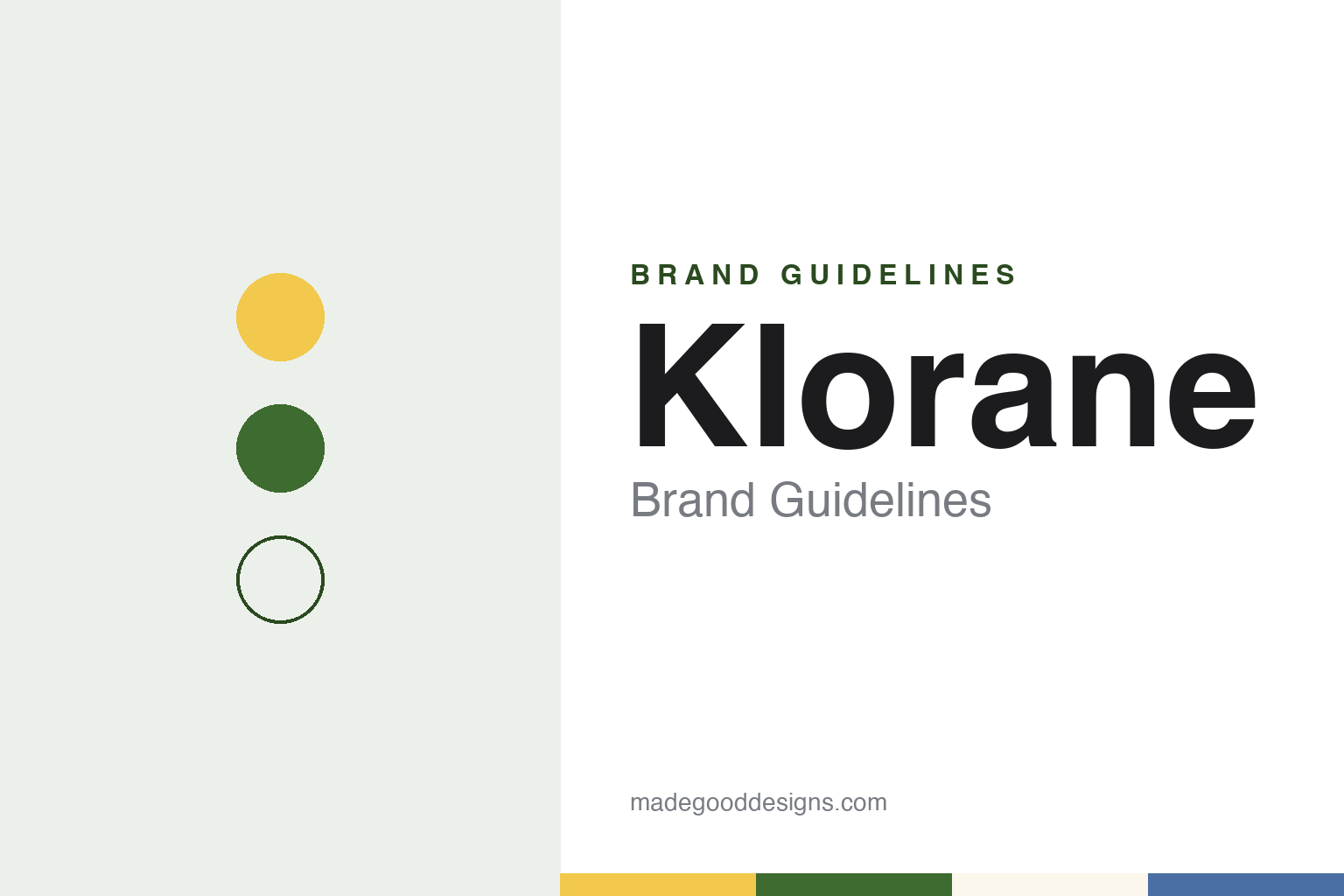
Two constants: a chamomile yellow, leaf green and cornflower palette and a friendly geometric sans register. Abstract homage — not a Klorane product or mark; no pack, logo or label is reproduced.
A Paris laboratory
Bought by a pharmacist in 1965.
Klorane is a botanical hair- and skin-care brand that has belonged to the French group Pierre Fabre since 1965. The brand’s own history says that in 1965 the young pharmacist Pierre Fabre bought the Parisian laboratory Klorane and, with its range of soaps, opened what Klorane calls the era of dermo-cosmetics. French Wikipedia, citing the trade magazine LSA, describes the purchase of the Laboratoires Klorane as the starting point of the group’s dermo-cosmetics business, and a 2013 portrait of the group in the German pharmacy trade title apotheke adhoc also dates the takeover to 1965. Pierre Fabre’s own corporate timeline words the same year as the launch of the Klorane brand.
The purchase came three years after Fabre had founded the Laboratoires Pierre Fabre, in 1962, according to the group, which is based in Castres, in the Tarn. Other dermo-cosmetics names followed: the group’s timeline records the purchase of Ducray in 1969 and of the Avène spring and spa in 1975, and French Wikipedia dates the purchase of René Furterer to 1978.
Ownership sits largely with a foundation. Pierre Fabre says the Fondation Pierre Fabre, created in 1999 and recognised as a public-utility foundation, became the company’s principal shareholder from 2005. The group lists Klorane among its brands alongside A-Derma, Ducray, Eau Thermale Avène, Elgydium and René Furterer, each with its own website.
Colour
Chamomile, cornflower and a dry shampoo.
The product that made the name came in 1966. Klorane says that was the year it truly entered French bathrooms, with its first chamomile shampoo, designed to bring out blonde hair. In 2016 Le Quotidien du pharmacien called the chamomile shampoo the first “baby” of Klorane, and reported that a quinine shampoo followed in 1968.
The company says that in 1967 it added a baby range made with calendula and a make-up-removing water made with cornflower, two products it credits with fixing the brand’s position as plant-inspired cosmetics. Pierre Fabre’s group history, for its part, dates a Klorane dry shampoo made with white nettle to 1970, describing the idea of washing hair without water as practical and ecological ahead of its time.
The brand’s organising rule is a formula of its own. Klorane says that in 1969 Pierre Fabre set down the principle of “one plant, one indication”, which it says still guides it, and that from the 1970s he filed patents on plant-based ingredients. The company also publishes where some of its plants come from: it says it grows plants for its ingredients with farmers in the Tarn, and grows citron, or cédrat, in Corsica for a range aimed at hair that gets oily quickly. It says it keeps traceability of its plant ingredients from harvest to finished product; that is the company’s claim.
Typography
French hair care and its owners.
The seven brands in this group are all haircare names: Shu Uemura, Leonor Greyl, René Furterer, Klorane, HASK, R+Co and John Masters Organics. Haircare brands in general sit at many different points in the trade, from names that still carry a founder’s signature to labels that now belong to much larger beauty groups, and a single brand can be sold everywhere from a pharmacy shelf to a salon backbar.
A haircare brand’s identity is usually carried less by a single product than by a bottle, a name and the story it tells about where it came from, because the company behind the name may have changed hands, moved its production or grown far beyond the place where it started. That makes the questions behind each name worth asking plainly: who started it, who owns it now, and where its products are actually made.
Each guide separates what independent sources record from what the company says about itself — its founding story, its owners over time, where its products are made and how its packaging has changed — and marks plainly what rests only on the company’s own word.
Aa
A friendly geometric sans for a botanical brand. (Specimen set in DM Sans, a sans STAND-IN; NOT the Klorane logo.)
Klorane
A foundation, a new identity and a colourful pack family.
The botanical framing reaches beyond the products. Klorane says that after the 1992 Earth Summit in Rio, Pierre Fabre and Klorane created the Institut Klorane, a corporate foundation it dates to 1994 and now calls the Klorane Botanical Foundation, with three stated aims: protect, explore and transmit. The company says the foundation plants desert date trees in Senegal for the Great Green Wall, supports agroforestry in the Ecuadorian Amazon, funds university theses and takes part in creating seed banks for threatened species. Since 2018, the company says, the brand has expressed its environmental and social commitments in a new identity it calls “l’Âme botanique”, the botanical soul, which it presents as the fruit of fifty years of love and care for nature and for people.
On the shelf, that identity is carried by the packaging. The design agency Dragon Rouge says Klorane asked it to update the hair-care range, and that it created a “colourful design” in which plants and their benefits are shown off across the packs to form, in the agency’s French text, a colourful and diverse family. Klorane says it has removed paper leaflets from its products, that its cartons come from sustainably managed forests, and that since 2021 its shampoo bottles have been made of recyclable and recycled plastic. It says it relaunched its baby range, Klorane bébé, in September 2018 with cartons removed, and that since 2012 it has developed its rinse-off formulas to be biodegradable under the OECD 301B test. Since 2019, the company says, the brand has worked within Green Mission Pierre Fabre, the group’s programme for all its brands.
On manufacturing, Klorane says its products are made at an ISO 14001-certified extraction site and in a factory built under an experimental High Environmental Quality approach, with a biomass boiler fed by plant waste. In October 2010 FashionNetwork reported that the Pierre Fabre plant at Soual, in the Tarn, made products for Klorane among other group brands.
For a design guide, Klorane shows how a single rule — one plant per range — can become a packaging system. Compare René Furterer, its stablemate at Pierre Fabre, and Leonor Greyl, another French hair-care house. For this guide we use chamomile yellow, leaf green and cornflower blue with a sans, an unofficial interpretation; no product or logo is reproduced.
Explore & save
Keep Klorane’s identity on hand — save it to a board in the Made Good inspiration library.
Klorane identity set
Pin the Klorane chamomile yellow, leaf green and cornflower palette and the friendly geometric sans register to your own board.