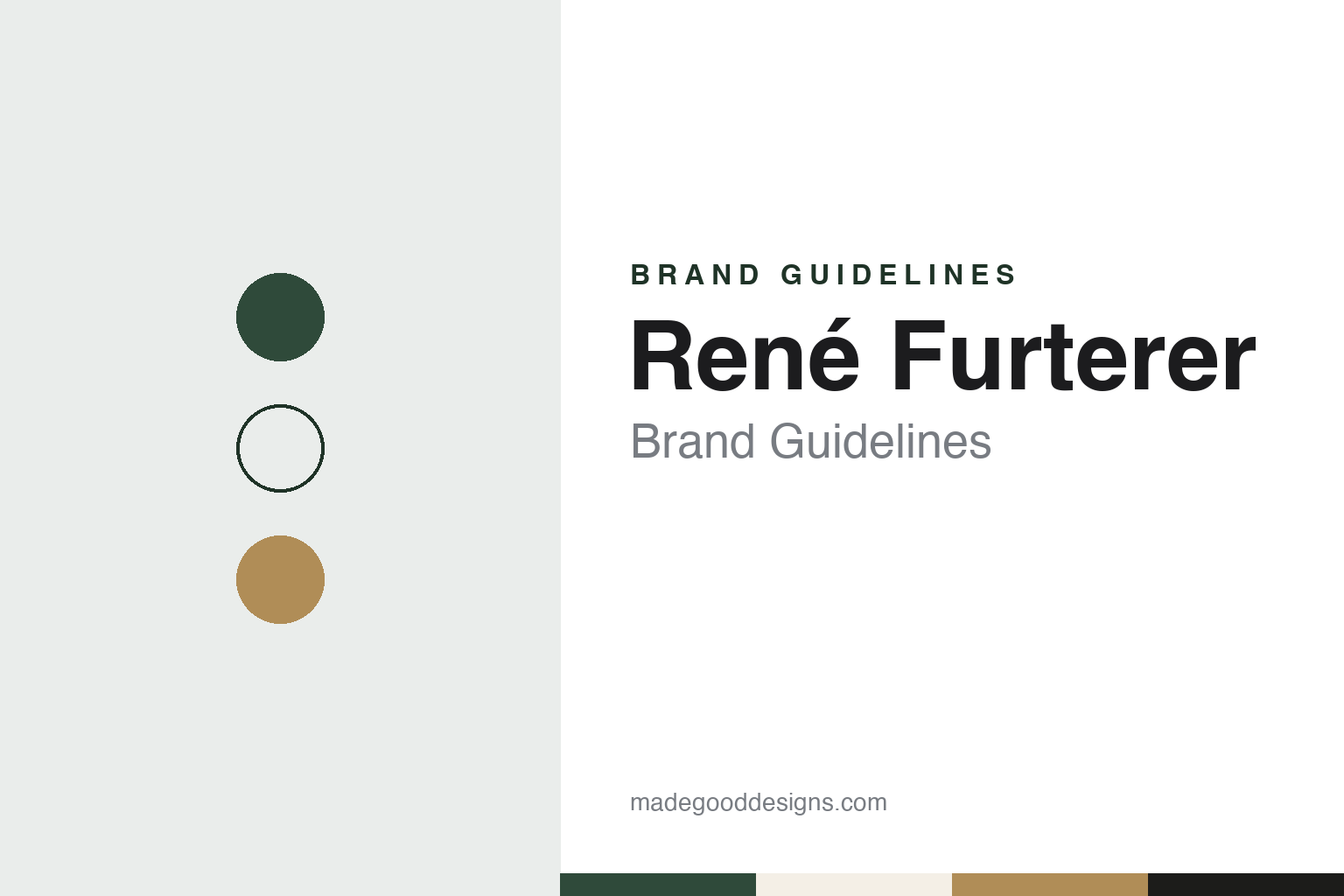
René Furterer Brand Guidelines
The Paris hair-spa brand owned by Pierre Fabre since 1978.
Aa
Two constants: a botanical green, ivory and gold palette and a classical serif register. Abstract homage — not a René Furterer product or mark; no pack, logo or label is reproduced.
A hairdresser from Provence
A salon, a cream and an essential-oil blend.
René Furterer is a French hair-care brand that has belonged to the Castres-based group Pierre Fabre since 1978, the year French Wikipedia, citing the trade magazine LSA, gives for the purchase. A 2013 portrait of the group in the German pharmacy trade title apotheke adhoc likewise places the arrival of the René Furterer hair and scalp products at the end of the 1970s. The brand carries the name of its founder, the hairdresser René Furterer.
The brand’s own account of him begins in the countryside. The company says Furterer grew up in a village in Provence, where the scents and colours of plants shaped the formulas he would later write, and that he went on to work as a hairdresser in his wife’s salon in the Paris region. At the time, it says, women wanted the blonde curls of Marilyn Monroe, and the treatments of the day left hair damaged by bleaching and curling.
His answer, according to the company, was a Crème revitalisante, a conditioning cream the brand still describes as part of its range. It was followed by Complexe 5, a blend of essential oils that the company presents as a signature step of its routine. The idea the brand returns to is a gardener’s one. René Furterer quotes its founder as saying that beautiful hair grows on a healthy scalp, “just as a plant grows in fertile soil” — our translation of the French.
Colour
Étheirologie and a three-step ritual.
The founding date the brand uses is 1957. That year, the company says, Furterer coined the word “étheirologie”, built from Greek words for hair and for caring, to name his approach to the scalp and hair, and put it into practice in his first hair spa in Paris. The method he set out had three steps — “Préparer, Laver, Traiter”, or prepare, wash and treat — preceded by a diagnosis. The company still describes its rituals in those terms: a scalp preparation with Complexe 5 or Astera Fresh, a shampoo chosen for the scalp, and then a treatment for the scalp and lengths.
The salon thread has not been cut. The brand’s French website takes bookings for a René Furterer Salon & HairSpa in Paris’s 9th arrondissement, and the company says it gives haute coiffure a privileged place, presenting cuts at hair shows in France and abroad.
The range itself is organised around named lines rather than single products. The current French site groups its products under Triphasic, Sublime Karité, Forticea and Absolue Kératine, alongside lines called Astera, Curbicia, Tonucia, Okara, Naturia and Volumea, plus Complexe 5 and a Head Spa line. The company says the brand rests on a conviction that botany holds the qualities to restore hair’s strength and beauty, and it describes its founder as selecting rare essential oils for each formula; those are the brand’s own words.
The coined word is the most distinctive piece of that vocabulary. The company explains “étheirologie” as joining etheira, hair, and etheiro, to care for, and it uses the term to describe a whole philosophy of scalp health and hair beauty rather than a single product. It also says its hair spa offered natural, tailor-made treatments that it calls “délices capillaires”, or hair delights; that is the company’s own framing of its history.
Typography
French hair care and its owners.
The seven brands in this group are all haircare names: Shu Uemura, Leonor Greyl, René Furterer, Klorane, HASK, R+Co and John Masters Organics. Haircare brands in general sit at many different points in the trade, from names that still carry a founder’s signature to labels that now belong to much larger beauty groups, and a single brand can be sold everywhere from a pharmacy shelf to a salon backbar.
A haircare brand’s identity is usually carried less by a single product than by a bottle, a name and the story it tells about where it came from, because the company behind the name may have changed hands, moved its production or grown far beyond the place where it started. That makes the questions behind each name worth asking plainly: who started it, who owns it now, and where its products are actually made.
Each guide separates what independent sources record from what the company says about itself — its founding story, its owners over time, where its products are made and how its packaging has changed — and marks plainly what rests only on the company’s own word.
Aa
A classical serif for a Paris salon brand. (Specimen set in Cormorant Garamond, a serif STAND-IN; NOT the René Furterer logo.)
René Furterer
Made in the Tarn, owned by a foundation-backed group.
Where the products are made is stated by the company. René Furterer says its plant ingredients are turned into formulas at the Pierre Fabre site at Gaillac, in the Tarn, which it says holds ISO 14001 environmental certification. In October 2010 FashionNetwork reported that the group’s plant at Soual, also in the Tarn and dedicated to cosmetics since 1995, made products for brands including René Furterer and Klorane. The brand frames its environmental work within Green Mission Pierre Fabre, the group’s programme, and says its research is carried out mainly in Occitanie, the south-western region the group calls home, and it quotes Pierre Fabre’s line about being “everywhere in the world while being here” — our translation. The group lists French sites in the Tarn at Castres, Soual, Mazamet, Gaillac, Sorèze and Lavaur, among others.
The brand is also run as an international one. Its website links to local editions for markets including Spain, Italy, Greece, Poland, Japan, Korea, Hong Kong, Taiwan and Singapore, with separate sites for the United States and China.
The owner is largely held by a foundation. The pharmacist Pierre Fabre founded the Laboratoires Pierre Fabre in 1962, and the group, based in Castres, says the Fondation Pierre Fabre, created in 1999 and recognised as a public-utility foundation, became its principal shareholder from 2005. René Furterer sits in the group’s portfolio beside Klorane, Eau Thermale Avène and Ducray.
For a design guide, René Furterer shows how a salon vocabulary — a coined word, a three-step ritual, a botanical metaphor — can carry a brand through a change of ownership. Compare Klorane, its stablemate at Pierre Fabre, and Leonor Greyl, another Paris hair-care house. For this guide we use a botanical green, ivory and a muted gold with a serif, an unofficial interpretation; no product or logo is reproduced.
Explore & save
Keep René Furterer’s identity on hand — save it to a board in the Made Good inspiration library.
René Furterer identity set
Pin the René Furterer botanical green, ivory and gold palette and the classical serif register to your own board.