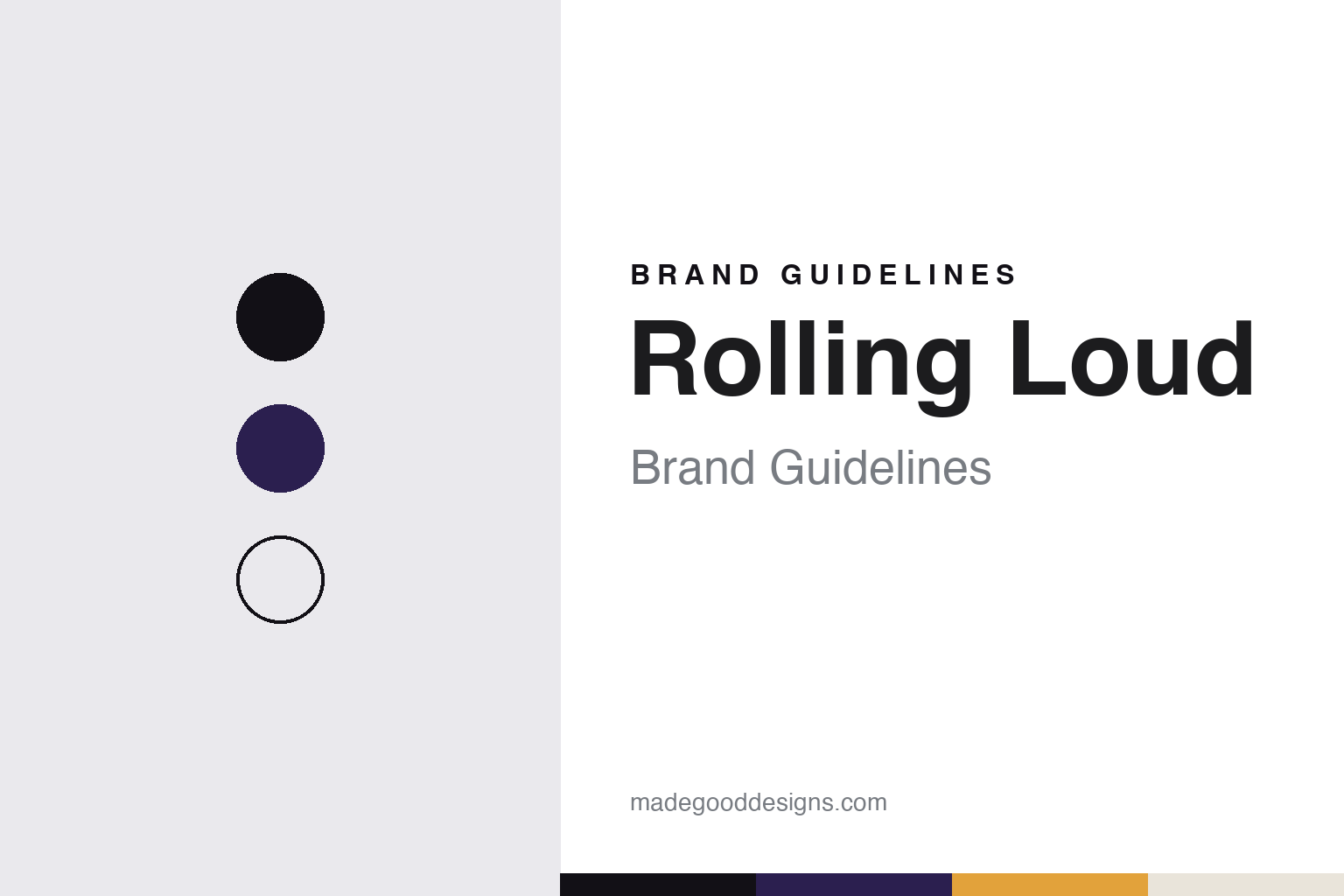
Rolling Loud Brand Guidelines
The hip-hop festival that began in a Wynwood warehouse in 2015.
Aa
Two constants: a night ink, violet and amber palette and a condensed poster sans register. Abstract homage — not a Rolling Loud asset; no poster, logo or wristband is reproduced.
Wynwood, 2015
Two Florida promoters and one warehouse.
Rolling Loud is a hip-hop festival founded in Miami by Matt Zingler and Tariq Cherif. English Wikipedia says the two met at elementary school in Hollywood, Florida, began promoting parties in high school and moved into professional concerts in 2010; Miami New Times described them in January 2026 as childhood Florida friends. In a December 2024 interview with GRAMMY.com, Cherif said that by the time the festival began they had spent about five years promoting hip-hop shows with one headliner and a few support acts across the state of Florida.
The idea for a festival came from those shows, Cherif told GRAMMY.com: artists in the same corner of hip-hop tended to share the same fans, so a single bill that brought several of those corners together could become a larger event. The next step, he said, was finding a warehouse in Miami.
The first Rolling Loud took place in February 2015 in the Wynwood district of Miami. English Wikipedia names the venue as Soho Studios and describes a one-day event; Miami New Times, looking back in May 2019, called it “a humble one-day event held in Wynwood” and named Schoolboy Q as its headliner. Zingler told GRAMMY.com that the first capacity was somewhere around 5,000 to 7,500 people, in an indoor room with a smaller main stage and a very small outdoor second stage.
The festival grew quickly from there. English Wikipedia says the 2016 edition moved to the larger Mana Wynwood convention centre, and that in 2017 Rolling Loud moved to Bayfront Park in downtown Miami. Miami New Times wrote in 2019 that by its third year the festival had moved to a larger venue and expanded to three days. From 2018 the Miami edition was held at Hard Rock Stadium in Miami Gardens, English Wikipedia says; the 2019 Miami festival ran from May 10 to 12 at that stadium, according to Miami New Times.
Colour
From one city to many.
Rolling Loud became a name that travels. English Wikipedia dates the first editions outside Miami to 2017, with Rolling Loud Bay Area and Rolling Loud Southern California; Miami New Times wrote in May 2019 that the festival had established sister festivals in Northern and Southern California and had sold out its first Australian event earlier that year. English Wikipedia adds a New York edition from 2019.
The 2020 Miami edition did not take place; English Wikipedia says the festival moved it to July 2021. Editions abroad followed: Rolling Loud Portugal in July 2022 and Rolling Loud Toronto in September 2022, according to English Wikipedia, which also lists a Thailand edition in April 2023 and, in the same summer, editions in Rotterdam and in Munich. The California festival moved to SoFi Stadium in Inglewood in March 2023, English Wikipedia says. In its December 2024 interview, GRAMMY.com summed up the spread: alongside the annual Miami festival, Rolling Loud had expanded to California and Thailand, with other editions held over the years in New York, Australia, Portugal, Canada, the Netherlands, Germany and Austria.
The Miami festival marked its tenth anniversary from December 13 to 15, 2024, GRAMMY.com reported. The founders described Rolling Loud in that interview as a “lifestyle brand,” and the article listed extensions beyond the stage: merchandise, a partnership with the wrestling company WWE, and a record label launched with a single in 2022.
In January 2026 the festival changed its home base. Pollstar reported on January 14, 2026 that the 2026 edition would take place at Camping World Stadium in Orlando from May 8 to 10, the first time the festival had been held there and its only stop in the United States that year, with more than 75 artists on the bill. Stereogum wrote the same day that the festival had hosted its flagship event in Miami since 2015 and would hold no New York or California editions in 2026; Miami New Times reported that it was the first year since the festival began without a Miami edition. Pollstar also reported a return to Australia in March 2026, with festivals in Sydney and Melbourne, the first there since 2019.
Typography
Festivals in the United States.
Music festivals in the United States usually take their names from somewhere or something particular: a city, a park, an island, a television programme, an idea or a short coined word. Austin City Limits Music Festival borrowed the name of a public-television concert series; Governors Ball kept the name of the island where it began even after it moved. Long names are soon cut down to initials or nicknames — ACL Fest, Gov Ball — and posters, wristbands and websites often pair that short form with a year.
Behind the names stand different kinds of organiser. Some festivals are run by promoters and festival companies, a number of which sit inside larger live-entertainment groups; others are run by non-profit foundations or produced in partnership with park foundations and city departments, which grant the use of public land each year. The organiser is rarely the face of the festival, but its name appears in the small print and in the trade press.
The setting is part of the identity. A festival may fill a city park, a polo ground, a motor speedway, a waterfront or a fairground for one weekend or several, laid out with a number of stages, food areas drawn from local restaurants, art installations and markets, and often a children’s area. When a festival changes venue, the new place name usually joins the dates in the line that sits beside the festival name.
Each year brings a new lineup poster, with headliners set in large type above rows of smaller names, and an edition key visual that changes from year to year. Around these, a steady wordmark, the place and the dates hold the identity together. This guide looks at how each festival handles that balance, using only what dated sources and the festivals’ own pages show.
Aa
A tall, condensed poster sans — the register of a crowded line-up bill. (Specimen set in Anton, a condensed sans STAND-IN; NOT the Rolling Loud logo.)
Rolling Loud
A bill read from the top line down to the smallest names.
The visual record of Rolling Loud is mostly its line-up. Each edition is announced with a bill that puts the headliners at the top and dozens of names beneath; Zingler told GRAMMY.com in 2024 that the festival books an average of 30 to 36 artists a day and that “if you look down at the bottom, you’re always going to see the new hot buzzing guys.” Miami New Times made the same point about the 2019 Miami bill, writing that it was “peppered with gems all the way down into the smallest fonts.”
The physical scale has changed with the venues. Zingler told GRAMMY.com that the first festival’s main stage was roughly 20 feet deep by 40 feet wide, while the stages built for the festival by 2024 were about 80 feet deep and between 280 and 320 feet wide. The founders also said both of them attend every multi-stage, multi-day edition, with a single exception: the one-day Australian show of 2019.
The festival’s structure is simple to describe. It is a single named brand, run by its two co-founders, attached to whichever city or country hosts an edition: Rolling Loud Miami, Rolling Loud California, Rolling Loud Portugal and so on, as English Wikipedia lists them. Across those editions the name stays the same, while the Miami venue has changed from a Wynwood warehouse to a downtown park, a stadium in Miami Gardens and, in 2026, a stadium in Orlando.
For a design guide, Rolling Loud shows how a festival name can be carried from city to city while the line-up bill does most of the visual work. Compare Ultra Music Festival, another Miami festival held at Bayfront Park, and Coachella, the desert festival Miami New Times used as a point of comparison in 2019. For this guide we use night ink, a deep violet and an amber with a condensed sans, an unofficial interpretation; no product or logo is reproduced.
Explore & save
Keep Rolling Loud’s identity on hand — save it to a board in the Made Good inspiration library.
Rolling Loud identity set
Pin the Rolling Loud night ink, violet and amber palette and the condensed poster sans register to your own board.
Source & notes
Frequently Asked Questions
What font can I use to match the Rolling Loud look?
This guide describes Rolling Loud’s type as “A tall, condensed poster sans — the register of a crowded line-up bill”. Its type specimen is set in Anton from Google Fonts as a stand-in; Anton is not Rolling Loud’s own lettering.
What colours are in the Rolling Loud palette?
This guide’s Rolling Loud palette is Night ink #121016, Stage violet #2B1F4F, Wristband amber #E2A23B, Warehouse grey #8C8790 and Poster paper #E9E4DA. The tones are the guide’s own unofficial interpretation, not official Rolling Loud hex codes.
When was Rolling Loud founded?
Rolling Loud was founded in 2015 (Wynwood), in Miami, Florida.
Who founded Rolling Loud?
Rolling Loud was founded by Matt Zingler and Tariq Cherif in 2015 (Wynwood).