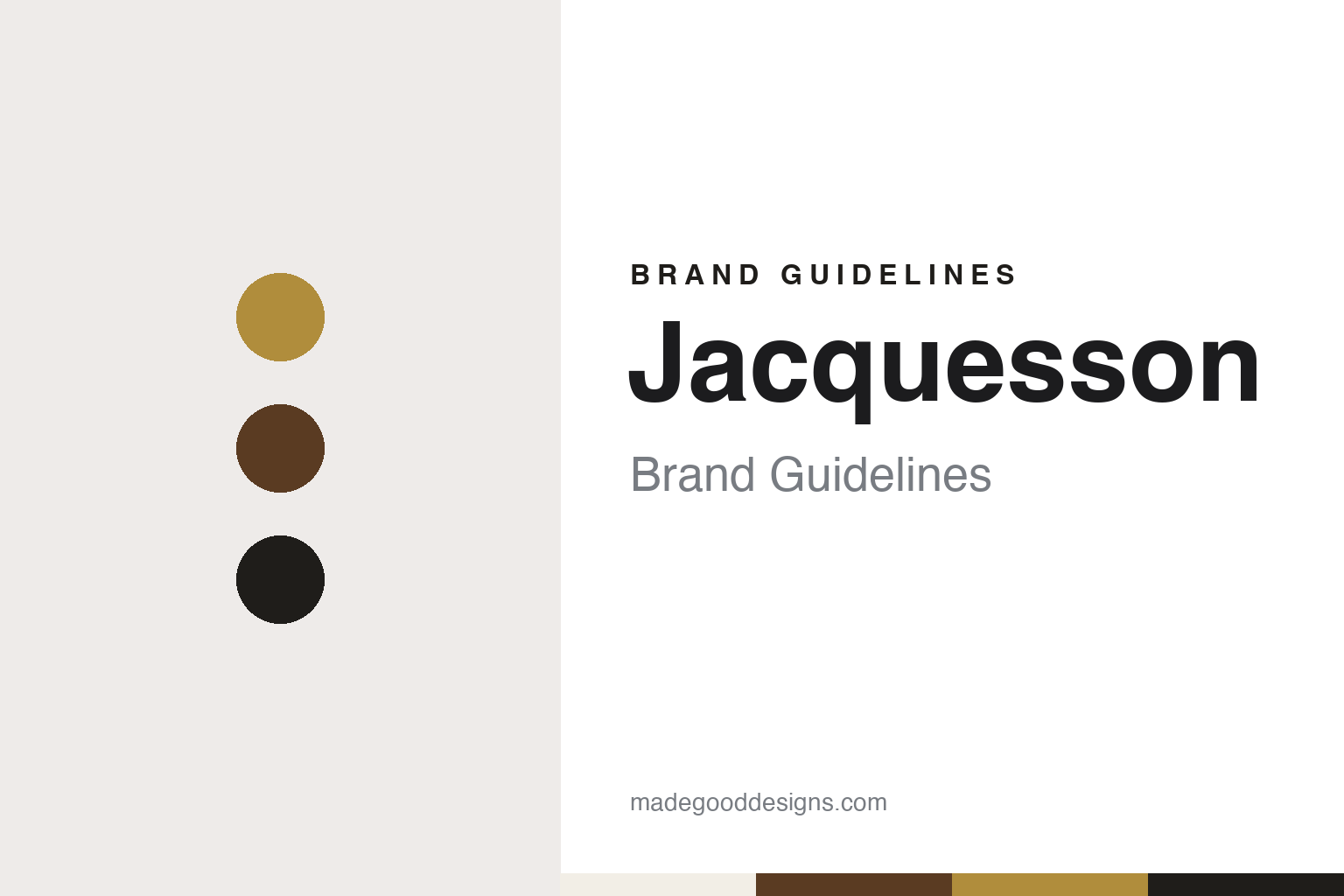
Jacquesson Brand Guidelines
A 1798 house that numbers its cuvées, owned by Artémis Domaines since 2022.
Aa
Two constants: a chalk, foudre oak and wire gold palette and a classical book serif register. Abstract homage — not a Jacquesson product or mark; no label, logo or bottle is reproduced.
A Châlons house with a long memory
Two centuries, a wire cage and a famous cellar master.
Jacquesson — formally Champagne Jacquesson & Fils — is one of the older names in Champagne. The company says the house was founded in 1798 in Châlons-sur-Marne by Claude and Memmie Jacquesson; French Wikipedia gives the same two founders, while English Wikipedia names Memmie alone. French Wikipedia says the partners bought a plot from the hospitals of Châlons and had cellars dug into the hill of Mont Saint-Michel.
The early reputation leaned on a story the house still tells with care: the company itself calls it a persistent rumour that Jacquesson was Napoleon’s favourite Champagne, and English Wikipedia repeats the account that he gave the house a gold medal for its cellars. More solid are the business milestones. Both Wikipedias say Jacquesson absorbed the Champagne house Juglar in 1829, and French Wikipedia says the firm took the name Jacquesson & Fils in 1832, when Memmie’s son Adolphe joined.
Adolphe Jacquesson is the figure the house credits most. The company says he patented the muselet — the small wire cage that holds a Champagne cork in place — in 1844, and that he worked on sparkling-wine techniques with the agronomist Jules Guyot. The company and French Wikipedia also say that under Adolphe a certain Johann Joseph Krug served as Jacquesson’s chef de cave before founding his own house, the Reims Champagne known today as Krug. French Wikipedia puts annual sales at a million bottles by 1867.
The decades that followed were harder, and the house changed hands several times. The company says the de Tassigny family acquired Jacquesson in 1924 and set about rebuilding it; French Wikipedia dates the purchase by the Champagne broker Léon de Tassigny to 1925 and says he bought vines in the Grand Cru villages of Avize and Oiry.
Colour
From a Brut sans année to a number on every bottle.
The modern house dates from 1974, when the Chiquet family bought Jacquesson; the company says the family also moved the business to Dizy. Jean Chiquet and then his sons Laurent and Jean-Hervé Chiquet ran it for close to fifty years, the company says.
The brothers’ best-known decision was about a name. The company says that until 1999 Jacquesson made a conventional non-vintage Brut, and that in 2000 the Chiquets replaced it with what they called the Manifeste des 700: a cuvée built each year around a single harvest, with reserve wines added, and identified by a number rather than presented as the same wine every year. Terre de Vins described the idea in February 2022 as distinguishing each new edition by numbering it, so that the reserve wines serve the character of the base year.
The numbering itself has a story the company tells on its site. The first cuvée, built around the 2000 harvest, became No. 728 because the cellar book then in use, which counted the tirages recorded by the customs service since the house’s centenary in 1898, had stopped at the 728th. The series has climbed one number a year since: the company’s 2025 programme presents Cuvée No. 748, built on the 2020 harvest, as marking twenty years of the 700s, and its online archive lists cuvées up to No. 749. Each harvest is also released a second time as a Dégorgement Tardif, which the company says spends five more years on the lees under cork; the 743 DT, from the 2015 harvest, closed ten years of that series.
For a design reader, the number does the work that a vintage year or a house-style name does elsewhere. English Wikipedia notes that the back label gives the number of bottles produced, the month of disgorgement and the dosage. Alongside the 700s the house releases single-vineyard wines named for lieux-dits, among them Champ Caïn in Avize, Vauzelle Terme in Aÿ and Terres Rouges and Corne Bautray in Dizy.
Typography
Design and documentation.
The seven brands in this group are all Champagne names: Louis Roederer, Salon, Jacques Selosse, Deutz, Philipponnat, Drappier and Jacquesson. Champagne houses and growers in general sit at many different points in the trade, from family houses that still carry a founder’s name to grower estates that make wine from their own vines and houses that now belong to much larger wine or drinks groups, and a single name can be sold everywhere from a wine shop to a restaurant list.
A Champagne brand’s identity is usually carried less by a single bottle than by a label, a name and the place it promises, because the company behind the name may have changed hands, changed its vineyards or grown far beyond the cellar where it started. That makes the questions behind each name worth asking plainly: who started it, who owns it now, and where its wine is actually made and bottled.
Each guide separates what independent sources record from what the company says about itself — its founding story, its owners over time, where its wine is made and how its labels have changed — and marks plainly what rests only on the company’s own word.
728
A classical book serif for a house that names its wine with a number. (Specimen set in Cormorant Garamond, a serif STAND-IN; NOT the Jacquesson logo.)
Jacquesson
From the Chiquet family to the Pinault family’s wine group.
The ownership changed in two steps in 2022. Terre de Vins reported on 22 February 2022 that Artémis Domaines, the wine arm of François Pinault’s Artémis group, had taken a minority stake in Jacquesson, with the Chiquet family keeping control; it called the move the Pinault family’s first step into Champagne, a family wine story that began with Château Latour in Pauillac in 1993. On 20 December 2022 BFM Business, reporting with AFP, said Artémis Domaines had become Jacquesson’s sole shareholder, that Jean Garandeau, managing director since September 2022, would keep running the house, and that Jean-Hervé Chiquet would stay on its board. Decanter confirmed in March 2023 that Artémis Domaines had completed the purchase in December 2022. The same BFM report noted that Artémis Domaines had merged with the Champagne house Henriot in October 2022; Jacquesson’s own site now describes Artémis Domaines as owned by the Pinault and Henriot families.
The wine is still made in Champagne, and the house is still in Dizy. The company says it works from 36 hectares of Grand Cru and Premier Cru vines in Avize, Aÿ, Dizy, Oiry, Champillon and Hautvillers (BFM gave 40 hectares in 2022), that its own vineyards have been certified organic since 2010, and that its wines are fermented and aged in large oak foudres without fining or filtration.
The house’s older history occasionally resurfaces. In July 2010 divers off Åland, in the Baltic, recovered Champagne from a wreck of a ship that sank between 1825 and 1830, and Yle reported in January 2011 that experts had identified Juglar — the house Jacquesson absorbed in 1829 — among the brands, alongside Veuve Clicquot. The official site is champagnejacquesson.com; the name is also a French surname, and Château Jacquesson is a separate historic building in Châlons-en-Champagne.
For a design guide, Jacquesson shows how a small house can make a number — 728, 748, 749 — carry its identity, turning the yearly change in a blend into the thing the label celebrates. Compare Krug, the house founded by Jacquesson’s former chef de cave, and Veuve Clicquot, whose bottles shared that Baltic wreck. For this guide we use chalk, foudre oak and wire gold with a classical serif, an unofficial interpretation; no product or logo is reproduced.
Explore & save
Keep Jacquesson’s identity on hand — save it to a board in the Made Good inspiration library.
Jacquesson identity set
Pin the Jacquesson chalk, foudre oak and wire gold palette and the classical book serif register to your own board.