Henschke Brand Guidelines
The Keyneton family winery behind Hill of Grace, since 1868.
Aa
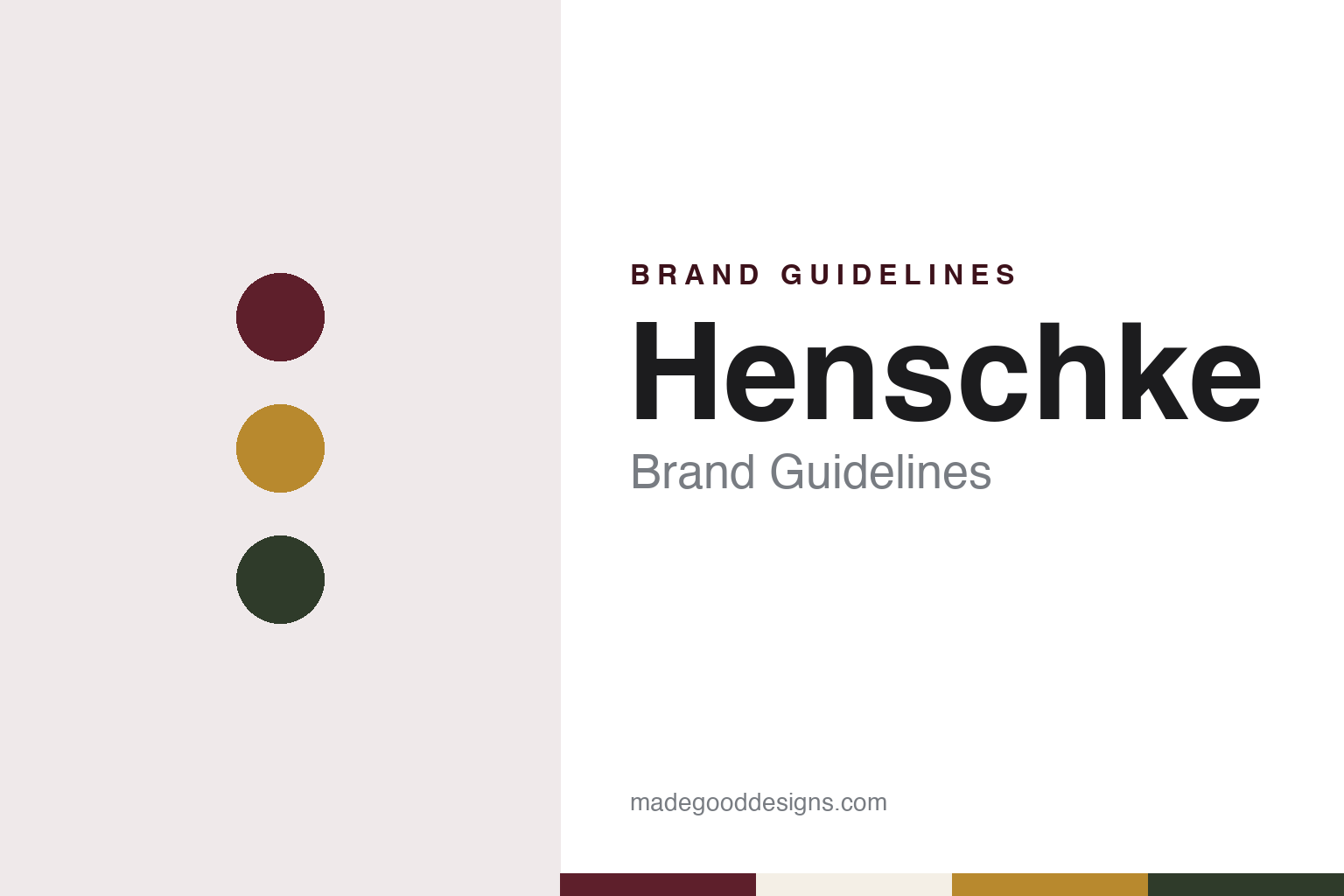
Two constants: a shiraz red, old gold and church-stone cream palette and a classical serif register. Abstract homage — not a Henschke product or mark; no label, logo or bottle is reproduced.
From Silesia to Keyneton
A stonemason’s vineyard on the eastern edge of the Barossa.
Henschke is a family-owned winery at Keyneton, in the Eden Valley wine region on the eastern side of South Australia’s Barossa. Its story begins with Johann Christian Henschke, who emigrated from Silesia to South Australia in 1841. The company says he came from Kutschlau, worked as a stonemason and wheelwright, settled first in the Adelaide Hills and then in the Barossa, and later bought land in the North Rhine district, the area later renamed Keyneton.
The founding year is 1868. The Australian Dictionary of Biography, in an entry by Valmai A. Hankel published in 1996, says Johann Christian and his son Paul Gotthard began selling their wine at Keyneton that year; the company describes 1868 as the first recorded sale of Henschke wine, from a small vineyard planted in the early 1860s that yielded about 300 gallons a year. At first, the company says, the wine was made for family and friends.
The property passed from father to son. The company says Paul Gotthard took over the running of the farm and winery in 1873, and that in 1891 he bought land with a small planting of vines near the Gnadenberg Lutheran church, the vineyard that became Hill of Grace. The third generation, Paul Alfred Henschke, became custodian in 1914. The Australian Dictionary of Biography says that after the turn of the century he produced fortified wines, sold mainly in bulk.
The change to table wine came with the fourth generation. Cyril Henschke took over the family winery in 1950, the company says; the Australian Dictionary of Biography dates his taking charge of winemaking to 1955. He set out to make dry reds and dry whites, and the dictionary says sales improved after his 1952 Mount Edelstone shiraz won the first of several awards at a national wine show in Sydney in 1956. In 1970 he became the first Australian vigneron awarded a Churchill fellowship, which took him to small wineries in Germany, California, South Africa and Britain, and he was a founding member of the Barons of the Barossa, the wine fraternity the company dates to 1975.
Colour
Hill of Grace and the vineyard names.
Henschke’s best-known wine is named after a church. The company says “Hill of Grace” is the English translation of Gnadenberg, a region in Silesia and the name the villagers gave the Lutheran church that overlooks the vineyard. The site lies at Parrot Hill, about four kilometres north-west of the Keyneton winery; the company says its oldest shiraz vines, which it calls the “Grandfathers,” were planted around 1860 by Nicolaus Stanitzki, whose granddaughter married Paul Alfred Henschke in 1907.
Cyril Henschke made the first Hill of Grace from the 1958 vintage, both the company and English Wikipedia say. The Australian Dictionary of Biography notes that the wine, from shiraz planted in the 1860s near the Keyneton cellars, was never entered in wine shows. Halliday Wine Companion reported in April 2024 that the 2019 vintage was the 58th release of Hill of Grace, and that the vineyard holds four hectares of old-vine shiraz; the company says the vines grow on their own roots and that only the six oldest blocks go into the wine.
The same naming habit runs through the rest of the range. Mount Edelstone, from a vineyard the Wine Companion says was planted in 1912, reached its 67th release with the 2019 vintage. The company says later single-vineyard wines from the Hill of Grace site took related names: Hill of Roses from 2001, Hill of Faith from 2008 and Hill of Peace from 2012. The Wine Companion adds two further single-vineyard wines, The Wheelwright and Cyril Henschke, from vineyards planted in the 1960s.
The company describes its aim as the complete integration of vineyard and winery, across six generations of grape growing and winemaking in the Eden Valley, the Barossa Valley and the Adelaide Hills.
Typography
Design and documentation.
The seven brands in this group are all wine names: Henschke, Yalumba, Torbreck, d’Arenberg, Felton Road, Egon Müller and Robert Weil, wine estates from Australia, New Zealand and Germany. Wine brands in general sit at many different points in the trade, from family houses that still carry a founder’s name to labels that now belong to much larger groups, and a single name can be sold everywhere from a corner shop to a restaurant list.
A wine brand’s identity is usually carried less by a single bottle than by a label, a name and the place it promises, because the company behind the name may have changed hands, moved its production or grown far beyond the place where it started. That makes the questions behind each name worth asking plainly: who started it, who owns it now, and where its wine is actually made and bottled.
Each guide separates what independent sources record from what the company says about itself — its founding story, its owners over time, where its wine is made and how its labels have changed — and marks plainly what rests only on the company’s own word.
Aa
A classical serif for a family name and a church-named vineyard. (Specimen set in Cormorant Garamond, a serif STAND-IN; NOT the Henschke logo.)
Henschke
Stephen and Prue Henschke, and the sixth generation.
The fifth generation took over in 1979. English Wikipedia says Stephen and Prue Henschke took over the running of the winery that year, and the Wine Companion describes Stephen as Cyril’s youngest son and his partner in life and wine. The company says the couple met at the University of Adelaide, where Stephen completed a science degree in 1973 and Prue studied botany and zoology, and that they then spent two years studying and working in Geisenheim, Germany. Stephen, the company says, brought back German techniques, barrel fermentation and a preference for French oak; Prue leads the vineyards.
The Wine Companion reported in 2024 that Prue Henschke has farmed the family’s vineyards with organic and biodynamic methods for about four decades, and named her the inaugural inductee of the James Halliday Hall of Fame. In the early 1980s, the company says, the couple bought an apple orchard at Lenswood in the cool-climate Adelaide Hills, now listed among its vineyards alongside sites in the Eden Valley and the Barossa Valley. The winery and cellar door remain at Keyneton.
Ownership has stayed in the family. The company names three members of the sixth generation in the business: Johann Henschke, a winemaker and viticulturist who completed a master’s degree at Geisenheim in 2012; Justine Henschke, who joined in 2015 and runs marketing and public relations; and Andreas Henschke, an engineer working on projects including water management. In 2009 Henschke was invited into Australia’s First Families of Wine, a group of family-owned producers that also includes Yalumba and d’Arenberg, English Wikipedia says, citing Winetitles. The company’s own site is henschke.com.au.
For a design guide, Henschke shows how a family name, a founding date and the names of individual vineyards, above all a church-named hill, can carry a wine house without a loud graphic device. Compare Penfolds, the South Australian winery behind Grange, and Yalumba, its Barossa neighbour at Angaston. For this guide we use shiraz red, old gold and church-stone cream with a classical serif, an unofficial interpretation; no product or logo is reproduced.
Explore & save
Keep Henschke’s identity on hand — save it to a board in the Made Good inspiration library.
Henschke identity set
Pin the Henschke shiraz red, old gold and church-stone cream palette and the classical serif register to your own board.