Tignanello Brand Guidelines
Antinori’s Chianti Classico red, named in 1971.
Aa
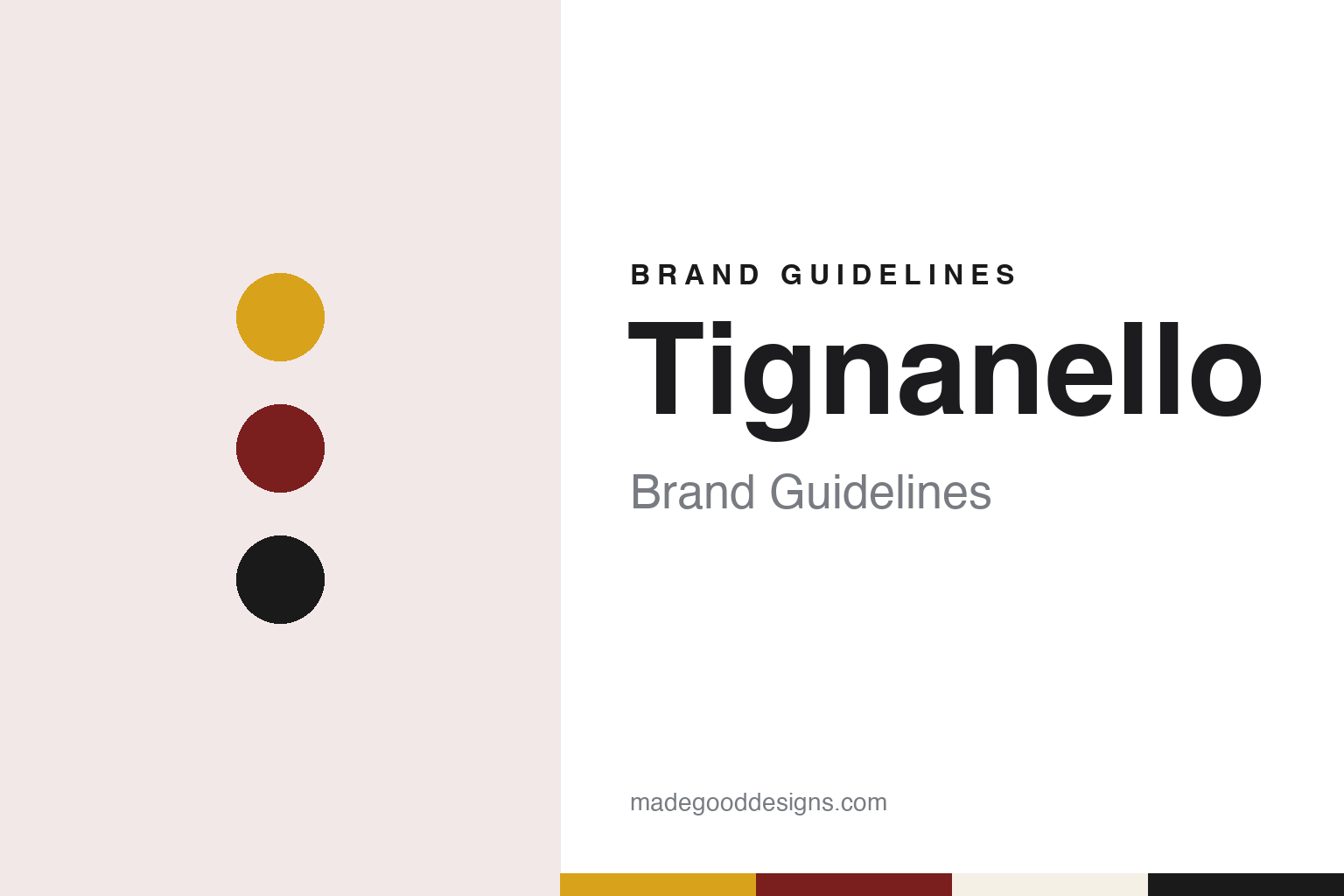
Two constants: a sun gold, Sangiovese red and label black palette and a high-contrast serif register. Abstract homage — not a Tignanello product or mark; no label, logo or bottle is reproduced.
A hillside in Chianti Classico
The Antinori estate that gave the wine its name.
Tignanello is a red wine of Marchesi Antinori, the Florentine wine family firm whose history the company dates to 1385, when Giovanni di Piero Antinori joined the Arte Fiorentina dei Vinattieri, the city’s winemakers’ guild. The family says it has run the business directly for twenty-six generations; the company has its legal seat in Florence and its headquarters at Bargino, in San Casciano in Val di Pesa. The wine takes its name from Tenuta Tignanello, the Antinori estate in San Casciano in Val di Pesa, English Wikipedia says, and the company labels it Toscana IGT.
The estate is in the heart of Chianti Classico, in the hills between the valleys of the Greve and the Pesa. The company gives its size as 319 hectares, of which about 165 are planted with vines and 37 with olive trees. Two of its vineyards, Tignanello and Solaia, share the same hillside, on soils of Pliocene marine marl rich in limestone and schist, at 350 to 400 metres above sea level. Antinori says Tignanello is made only from the vineyard of the same name, a parcel of some 77 hectares facing southwest.
The estate is much older than the wine. Antinori says the present manor house dates from the 16th century and stands on the foundations of a property recorded in 1346, when it belonged to the Buondelmonti family; in the 17th century a cadet branch of the Medici took it over and called it Fonte dei Medici, and the Antinori family acquired it in the mid-1800s. Through the 1970s, the company says, the estate served as a kind of laboratory where it introduced Cabernet Sauvignon and Cabernet Franc and tested new ideas on vine density, pruning and the selection of Sangiovese.
Colour
From Chianti Classico Riserva to Tuscan table wine.
The wine began under another name. Antinori says it was first made in 1970 from a single parcel as “Chianti Classico Riserva Vigneto Tignanello,” with 20 per cent Canaiolo and 5 per cent of the white grapes Trebbiano and Malvasia, aged in small oak barrels. With the 1971 vintage it became a Tuscan red table wine rather than a Chianti Classico, and took the name Tignanello. English Wikipedia credits Piero Antinori, who took over from his father Niccolò when Niccolò retired in 1966, with first producing it, and dates the launch of the 1971 to 1974.
The company says the white grapes were dropped for good with the 1975 vintage and that the blend in use today dates from 1982: mostly Sangiovese, with smaller amounts of Cabernet Sauvignon and Cabernet Franc. Sources give slightly different proportions; English Wikipedia puts the current blend at 80, 15 and 5 per cent, with more Sangiovese from 2001 to 2006. Antinori says the wine is bottled only in favourable years and was not made in 1972, 1973, 1974, 1976, 1984, 1992 or 2002.
Because it no longer followed the Chianti Classico regulations, Wikipedia says, Tignanello lost its denomination and was sold as a plain table wine until 1994, when it received the Indicazione Geografica Tipica designation. Antinori describes it as the first Sangiovese aged in barriques, the first contemporary red blended with untraditional varieties such as Cabernet, and one of the first Chianti Classico reds made without white grapes; Wikipedia counts it among the pioneers of the “Super Tuscans.” Its neighbour on the hillside, Solaia, was first released in 1978, according to Wikipedia.
Typography
Design and documentation.
The seven brands in this group are all Italian wine houses and labels: Gaja, Sassicaia, Ornellaia, Tignanello, Allegrini, Zenato and Pio Cesare. Wine houses and labels in general sit at many different points in the trade, from family houses that still carry a founder’s name to labels that belong to a larger wine group or estate, and a single name can be sold everywhere from a wine shop to a restaurant list.
A wine brand’s identity is usually carried less by a single bottle than by a label, a name and the place it promises, because the company behind the name may have changed hands, bought new vineyards or grown far beyond the place where it started. That makes the questions behind each name worth asking plainly: who started it, who owns it now, and where its wine is actually made and bottled.
Each guide separates what independent sources record from what the company says about itself — its founding story, its owners over time, where its wine is made and how its labels have changed — and marks plainly what rests only on the company’s own word.
Aa
A high-contrast serif for a classic Italian wine label. (Specimen set in Bodoni Moda, a serif STAND-IN; NOT the Tignanello logo.)
Tignanello
A designer’s sun and a father’s signature.
Antinori says the label was designed by Silvio Coppola in 1974 for the release of Tignanello 1971, and that the idea of commissioning him was discussed at an event at Castello della Sala, the family’s Umbrian estate, in 1973. The company describes Coppola as an Italian graphic and interior designer known for minimalist lamps and austere furniture, and for book covers for the publisher Feltrinelli.
The label combines three elements the company names. The first is a stylised sun drawn by Coppola. The second is the historic Antinori family crest, with the motto Te Duce Proficio. The third is a signature: Piero Antinori, the company says, chose to have his father, Niccolò Antinori, sign the label in recognition of his father’s confidence in him. Behind the label, Tignanello and Solaia each have their own vinification and ageing cellars on the estate, and Antinori says the vinification cellar was completely renovated between 2008 and 2009.
For a design guide, Tignanello shows how a single wine can carry its maker’s family history and a modern designer’s mark at once: an old Florentine crest and a signature beside a 1970s sun. Compare Antinori, the family house behind it, and Sassicaia, the Bolgheri red of Tenuta San Guido. For this guide we use sun gold, Sangiovese red and label black with a serif, an unofficial interpretation; no product or logo is reproduced.
Explore & save
Keep Tignanello’s identity on hand — save it to a board in the Made Good inspiration library.
Tignanello identity set
Pin the Tignanello sun gold, Sangiovese red and label black palette and the high-contrast serif register to your own board.